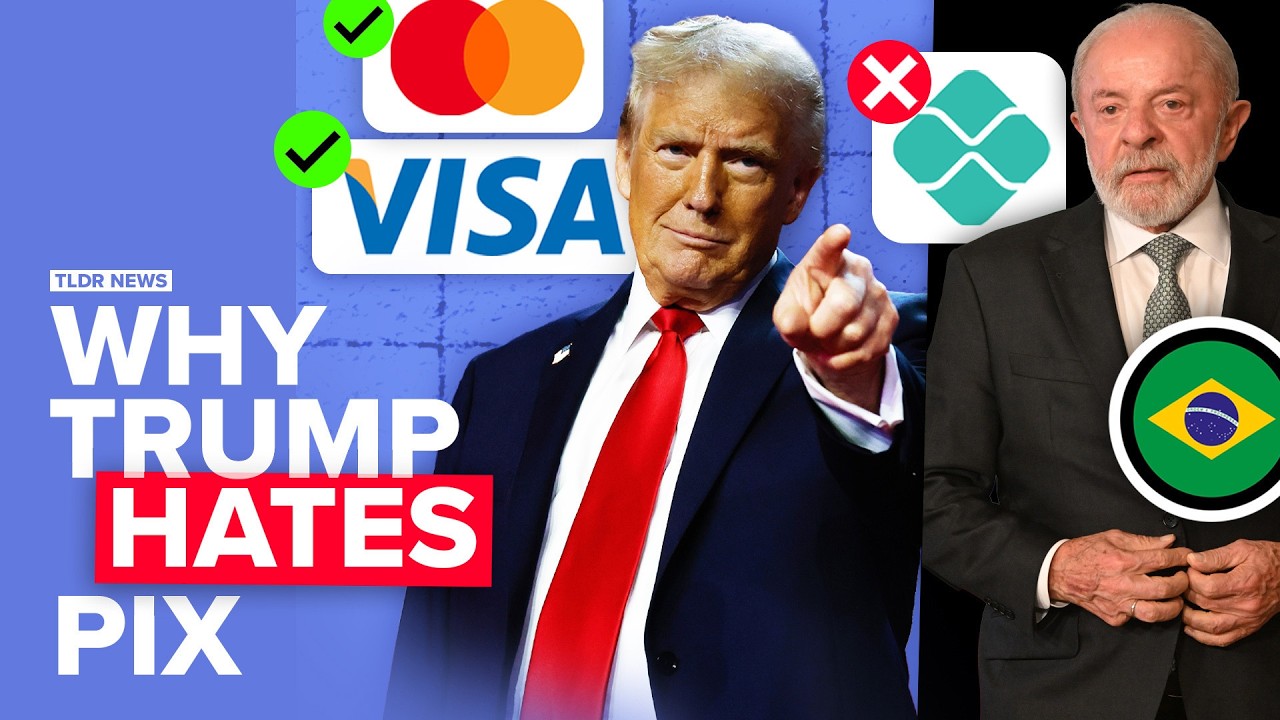
### Trump’s Shadow Over Brazil: Is the U.S. Pushing Mastercard and Visa on a Sovereign Nation?
By [Your Name/Editorial Staff] Date: [Current Date] A quiet but consequential battle is unfolding in Brazil’s financial sector. The question at its center is deceptively simple: Is a former—or future—U.
By [Your Name/Editorial Staff]
Date: [Current Date]
A quiet but consequential battle is unfolding in Brazil’s financial sector. The question at its center is deceptively simple: Is a former—or future—U.S. president forcing American payment giants Mastercard and Visa onto the Brazilian market? The answer, according to recent analyses, is not about direct coercion, but about the leverage of geopolitical and trade policy.
The context is Brazil’s ongoing effort to modernize its instant payment system, Pix. Launched by the Central Bank of Brazil in 2020, Pix has become a staggering success. It allows citizens and businesses to transfer money instantly, 24/7, for free or at negligible cost. Today, over 70% of the Brazilian adult population uses Pix, effectively bypassing traditional credit and debit card networks for the vast majority of transactions. This has directly challenged the oligopoly of Mastercard and Visa, which historically charged high interchange fees in the region.
The alleged “forcing” stems from U.S. trade policy under the Trump administration. According to the transcript’s arguments, the U.S. government—under the banner of “fair trade” and “market access”—has pressured Brazil to open its payment system to American firms. Specifically, the argument posits that the U.S. Trade Representative (USTR) threatened tariffs or other economic penalties unless Brazil allowed Mastercard and Visa to integrate into Pix or, at minimum, ceased policies that favored the local system over foreign competitors.
The key mechanism of this pressure is the World Trade Organization (WTO) dispute framework. The U.S. has previously argued that Brazil’s regulatory environment for credit and debit cards was unfairly restrictive. The new twist is that the same logic could be applied to Pix. If Brazil mandates that all merchants must accept Pix, and Pix is a state-run system that does not charge the same fees as private networks, the U.S. could claim this is an unfair subsidy that discriminates against foreign service providers.
What is actually happening on the ground?
Brazil is not banning Mastercard or Visa. Instead, it is creating a level playing field through innovation. Pix is a public utility, not a private business. The Central Bank of Brazil has stated that its goal is to reduce the cost of credit and promote financial inclusion, not to pick winners. However, the practical effect is undeniable: Mastercard and Visa are losing market share and fee revenue.
The transcript’s core argument is that the U.S. government, under Trump’s “America First” doctrine, views this as a direct threat to American corporate profits. The alleged solution is not to force Brazil to adopt Mastercard and Visa, but to force it to dismantle the competitive advantage of Pix. This could mean requiring Brazil to open Pix to foreign-owned payment processors, allowing them to charge fees, or scrapping the zero-cost model for merchants.
The reality is more nuanced than a simple “forcing.”
There is no public evidence of a direct, written ultimatum from Donald Trump to Brazilian President Luiz Inácio Lula da Silva demanding “use Visa or else.” However, there is documented evidence of U.S. trade officials raising concerns about Brazil’s payment card market. The transcript suggests that the pressure is applied through a “carrot and stick” approach: the U.S. threatens to block Brazilian access to American capital markets or imposes tariffs on Brazilian exports (like steel or agricultural goods) unless the payment system is “opened up.”
What does this mean for the average Brazilian?
If the U.S. succeeds in this pressure, the outcome could be a rollback of Pix’s benefits. Instead of free, instant transfers, Brazilians might see a return to per-transaction fees, higher merchant costs, and a slower adoption of digital payments. For Mastercard and Visa, this is about protecting a lucrative revenue stream in a rapidly growing economy. For Brazil, it is a test of its economic sovereignty.
The Bottom Line
The claim that “Trump is forcing Mastercard and Visa on Brazil” is a simplification of a complex trade dispute. The U.S. is not demanding that Brazilians use a specific credit card. Rather, it is using its economic power to challenge a successful public policy that threatens American corporate dominance. The battle is not about which card you swipe, but about whether a sovereign nation can use innovation to bypass a foreign oligopoly. The outcome in Brazil will set a precedent for other developing nations seeking to escape the grip of global payment networks.
Related Coverage
Trump’s Honduras Aid Threat: A Cash-for-Votes Shakedown
Donald Trump has openly threatened to cut U.S. aid to Honduras unless his preferred candidate wins the country’s presidential election, turning a foreign democratic process into a direct financial transaction [12511].
World Gives U.S. a Reality Check for Its 250th Birthday: Mixed Reviews, Deep Divisions, and a Fight Over History
The United States turns 250 this year, and the world is offering a blunt, complicated verdict: admiration for its people and culture, but deep concern over its political instability, inequality, and foreign policy. At home, the milestone is sparking a fierce battle over how to tell the nation's story—with the Trump administration pushing a selective "truth" narrative that critics say erases slavery and Native American dispossession, while a pro-truth movement fights back [187647].
Trump and Allies Attack Election Integrity as Germany Accuses US of Meddling
Former President Donald Trump is set to deliver a national address on election integrity, warning that "without free and fair elections, you don't have a country," as Germany’s chancellor publicly accuses the Trump administration of funding far-right groups to interfere in European elections with up to $3 million in grants [197553][197448].
Trump’s Shadow Looms Over Europe’s Biggest Air Base as Ramstein Faces an Uncertain Future
The giant U.S. air base in Ramstein, Germany, is facing growing questions about its role in Europe as Donald Trump returns to the White House. The base, a closed American island surrounded by idyllic German villages, now stands at a political crossroads [167813].
EU Unity Cracks as Israel Feud Splits Brussels, NATO Summit Looms
A power struggle inside the European Union over Israel policy has erupted into open conflict, just weeks before a critical NATO summit in Ankara that will test the alliance's cohesion amid US threats to pull back from Europe.
Trump’s Return Throws Europe’s Biggest U.S. Air Base Into Question
The future of Ramstein Air Base, the massive U.S. military hub in Germany, is facing new uncertainty as Donald Trump returns to the White House, raising questions about America’s role in European defense. The base, a closed American island surrounded by German countryside, has long been a symbol of U.S. power on the continent, but its strategic position is now under fresh scrutiny [167813].
Related Editorials
# Will Trump’s Escalation with Iran Trigger a UK Housing Market Crash?
The connection between geopolitical tensions in the Middle East and the value of a semi-detached house in Manchester may seem tenuous. Yet, as President Donald Trump intensifies his administration’s stance toward Iran, a growing number of analysts are asking a pointed question: could a military con
Title: The Gathering Storm: How a Continental Shift Is Threatening South Africa’s Regional Dominance
Introduction A quiet but seismic shift is underway in African geopolitics. For decades, South Africa has operated as the continent’s economic and diplomatic anchor, wielding influence from Cape Town to Cairo.
# The Silent Race for the World’s Most Valuable Prize: Two Nations, One Goal, No Clear Winner
Introduction A quiet, high-stakes competition is unfolding between two nations. Neither has declared war, but both are racing toward the same elusive prize—a prize that could reshape global power, technology, and economics for decades.
# Why America Will Probably Nationalise AI
The United States stands at a crossroads with artificial intelligence. While the technology has been driven by private enterprise, a growing consensus among policymakers, economists, and national security experts suggests that the federal government may soon take direct control of the most advanced