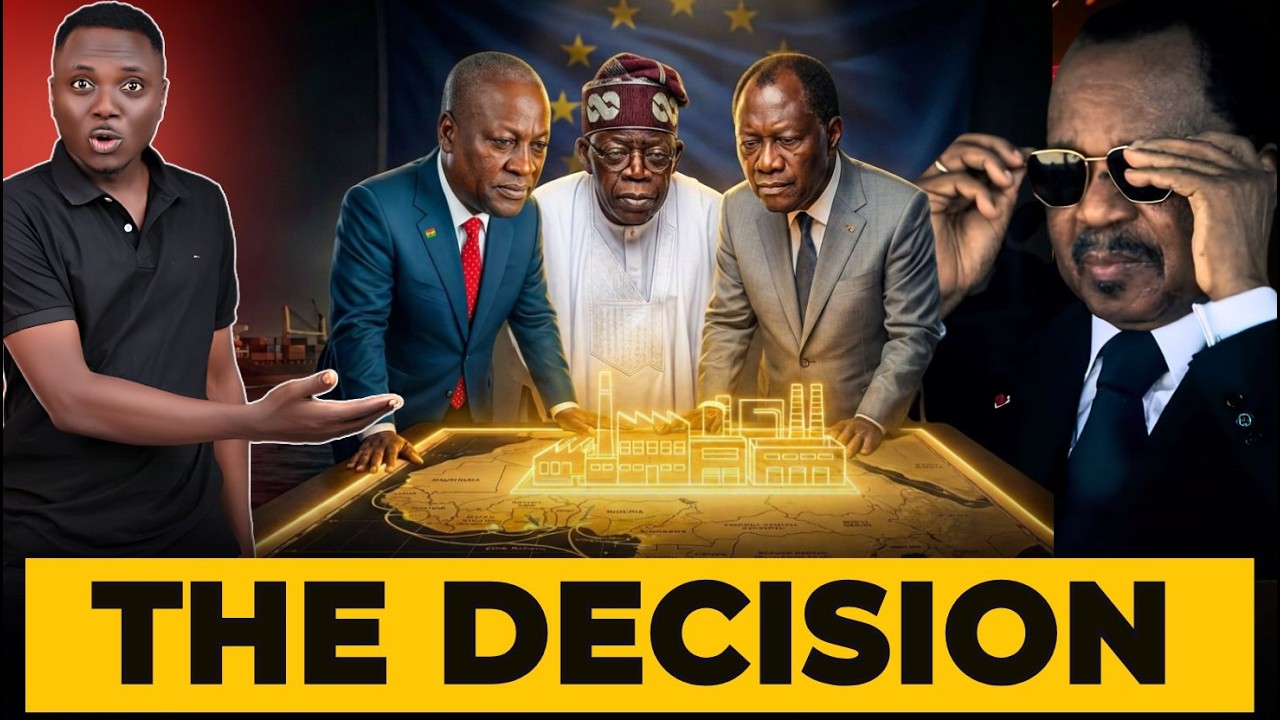
Title: Africa’s Boldest Gamble Since Independence: The Continent’s Push for a Unified Currency
Introduction For decades, the dream of a united Africa has lingered as a political fantasy—a relic of post-independence optimism. But now, a coalition of nations is taking what analysts call the continent’s most audacious economic step since the end of colonial rule: the creation of a single, s
Introduction
For decades, the dream of a united Africa has lingered as a political fantasy—a relic of post-independence optimism. But now, a coalition of nations is taking what analysts call the continent’s most audacious economic step since the end of colonial rule: the creation of a single, shared currency. This is not a theoretical proposal. It is a concrete, controversial, and potentially transformative initiative that could reshape global trade and challenge the dominance of the dollar and the euro. Here is what you need to know.
The Core Proposition: A Single Currency for a Continent
The proposed currency, tentatively referred to as the “Afri,” is designed to replace multiple national currencies across participating member states. The goal is simple: eliminate exchange rate volatility, reduce transaction costs, and create a seamless market for the continent’s 1.4 billion people. Currently, intra-African trade accounts for less than 15% of total continental commerce, largely due to the friction of converting between dozens of different currencies. A single currency would remove this barrier.
Why Now? The Economic Rationale
The push is not born from idealism alone. Several factors have converged to make this move urgent. First, the COVID-19 pandemic exposed the fragility of African economies when global supply chains froze and foreign currency reserves dried up. Second, the war in Ukraine triggered a spike in food and fuel prices, demonstrating how external shocks ripple through fragmented financial systems. Third, the African Continental Free Trade Area (AfCFTA), which launched in 2021, has already begun dismantling tariff barriers. A common currency is the logical next step to make that free trade area function efficiently.
The Technical Challenge: How It Would Work
Creating a single currency for a diverse continent is a monumental technical undertaking. The plan involves three phases. First, member states must harmonize their fiscal policies—meaning they agree on limits for budget deficits, inflation rates, and public debt. Second, a continental central bank would be established, modeled loosely on the European Central Bank, to manage monetary policy and issue the currency. Third, a convergence council would monitor compliance, imposing penalties on nations that fail to meet the agreed-upon macroeconomic targets.
The Skeptics’ View: A Recipe for Crisis?
The project has drawn sharp criticism from many economists. They point to the European Union’s eurozone crisis as a cautionary tale. When Greece, Italy, and Spain joined the euro, they surrendered control over their interest rates and exchange rates. When their economies faltered, they could not devalue their currencies to regain competitiveness. Africa’s economies are far more diverse than Europe’s—ranging from oil-rich Nigeria to agricultural Ethiopia to mineral-dependent Zambia. Critics argue that a one-size-fits-all monetary policy would devastate weaker economies. If a drought hits East Africa, for example, the central bank cannot lower interest rates to stimulate recovery without risking inflation in the oil-exporting West.
The Political Hurdle: Sovereignty vs. Unity
Beyond economics, the greatest obstacle is political. A single currency requires member states to cede significant control over their national budgets and monetary policy to a supranational authority. Many governments are reluctant to hand over such power. Furthermore, the legacy of colonialism still influences perceptions: some nations fear that a unified currency would be dominated by the region’s largest economies, such as Nigeria or South Africa, repeating the old pattern of regional hegemony.
The Potential Payoff: What Success Would Look Like
If implemented correctly, the benefits are staggering. A single currency would make Africa the world’s largest free trade zone by population. It would attract foreign investment by eliminating currency risk. It would reduce the cost of remittances, which currently cost Africans an estimated $2 billion annually in fees. Most importantly, it would give Africa a collective voice in global financial institutions like the International Monetary Fund and the World Bank, where the continent currently holds minimal voting power.
The Timeline: A Decade to Decide
The African Union has set an ambitious target: a single currency by 2034. This timeline is deliberately long, allowing for gradual convergence. However, history suggests that such deadlines are often missed. The original goal for a common currency was 2023, a target that has already been abandoned. The real question is not whether the deadline will slip, but whether the political will can survive the inevitable economic shocks and nationalistic backlash.
Conclusion
Africa’s boldest move since independence is not a matter of if, but of how. The continent stands at a crossroads: retreat into the safety of separate currencies and slow growth, or take the risk of integration for the chance at transformative prosperity. The world is watching. If Africa succeeds, it will rewrite the rules of global finance. If it fails, it will serve as a sobering lesson in the limits of economic ambition. Either way, the decision made in the next decade will define the continent’s future for generations.
Related Coverage
Uganda’s $X Billion Oil Bet: Can One Budget Fix a Broken Economy?
Uganda is preparing to begin commercial oil production later this year, and the government has unveiled a massive 2026/27 national budget aimed at reshaping the country’s lopsided economy.
Modi Bets $8.8 Billion on Deep-Sea Oil and Chips to End Import Addiction by 2047
India’s Prime Minister Narendra Modi has vowed to turn the country into a developed economy by 2047, leaning heavily on a $8.8 billion deep-sea oil gamble and a domestic push for semiconductor and nuclear power production to break foreign dependency [219670][214591]. The plan comes amid growing student protests and a stark warning from Modi that India must build a "strong and capable" military through self-reliance [219678][215497].
AI’s $1.6 Trillion Gamble: Nvidia’s Chips Are Now Collateral for a $500 Billion Loan
The artificial intelligence boom is entering a new, riskier phase as the world’s biggest tech players bet billions on infrastructure—and one chipmaker is putting its own hardware on the line to fund the next wave of growth.
South Africa’s Migration Crackdown Could Cost the Economy Billions for Decades
South Africa’s latest crackdown on migration is a high-risk bet that could backfire hard, with precedents from across the continent showing tighter border controls often trigger lasting economic and diplomatic damage that drags on for decades.
Nigeria’s 2027 Race Kicks Off: 100 Million Voters, Peace Deal Signed, But Economy and Security Loom Large
Nigeria’s 2027 presidential election campaign is officially underway, with political heavyweights already hitting the trail five months before the vote.
Hong Kong's 150% Yuan Bet: Can It Beat Sanctions Chaos to Win the Middle East?
A quiet but strategic shift is underway as Hong Kong positions itself as a neutral financial bridge between China and the Middle East, while simultaneously launching a massive yuan lending tool to boost global currency use—all as African businesses get crushed between US and Chinese sanctions.
Related Editorials
Paris Makes African Economic Decisions—Not Africans
For decades, the economic policies of many West African nations have been written not in their own capitals, but in Paris. This is not a conspiracy theory; it is the legacy of a colonial-era monetary system that persists into the present day.
Title: Namibia’s Rare Earth Gambit: How a Tiny African Nation Is Rewiring the Global Tech Supply Chain
Introduction For decades, the narrative of China–Africa relations has followed a predictable script: Beijing finances massive infrastructure projects in exchange for raw commodities, leaving African nations as passive suppliers in a global system they do not control. Namibia, a sparsely populat
Title: Africa’s Silent Giant: The $5 Billion Megaproject Reshaping the World’s Economy
Introduction While global attention fixates on trade wars and energy crises, a quiet revolution is underway in North Africa. Morocco has just completed a project that analysts are calling the most consequential infrastructure development for the continent in decades—yet it has barely made headl
China’s Arctic Silk Road: The Race for the Frozen North
For centuries, the Arctic was a realm of ice, isolation, and a handful of intrepid explorers. Today, it is the stage for one of the most ambitious geopolitical and economic projects of the 21st century: China’s "Polar Silk Road.
Title: Iceland’s Quiet Revolt: The End of Europe’s Political Illusion?
For decades, the European Union has sold itself as a project of perpetual integration—a political and economic engine designed to smooth over national differences and deliver shared prosperity. Yet, according to two of Europe’s most prominent economic thinkers, the recent actions of a small Nordic
Title: The Sahel Alliance Just Redrew West Africa’s Geopolitical Map—And ECOWAS Is Scrambling
Introduction In a move that has sent ripples through West African diplomacy, the Alliance of Sahel States (AES) has unveiled a significant new project that regional bloc ECOWAS did not anticipate. The development marks a decisive step in the consolidation of the AES as a standalone geopolitical