Putin Wins U.S. Support for His Key Demand in Ukraine Peace Talks
Russia and Ukraine have restarted peace talks in Abu Dhabi with the United States as mediator, and Washington has agreed to discuss Moscow's long-standing demand for a new European security framework.
Russia and Ukraine have restarted peace talks for the first time since February, with the United States acting as mediator. The negotiations took place in Abu Dhabi.
The breakthrough came because U.S. envoys for President Donald Trump agreed to discuss one of the Kremlin's main demands: a new security framework for Europe. This topic includes Russia's long-standing request to push North Atlantic Treaty Organization (NATO) forces away from its borders and to block Ukraine from joining the alliance.
Russian analysts say they are pleased that Washington is finally addressing a concern they used to justify the invasion of Ukraine. European countries argue that the current security system in Europe already works. Western analysts fear the talks may reward aggression and allow Putin to rebuild his influence in Eastern Europe.
According to Ukrainian sources at the Abu Dhabi talks, the Russian delegation demanded several limits on NATO. These include an end to NATO expansion, a reduction of military forces in countries that joined the alliance after 1997, and less cooperation between NATO and Ukraine and other former Soviet states.
The year 1997 is important in Russia-NATO relations. That year, both sides agreed not to treat each other as adversaries and not to place permanent combat forces or nuclear weapons in new member states. Moscow has always viewed NATO's eastward expansion with suspicion.
Ukraine's growing ties with NATO after 2014 angered the Kremlin. Moscow says it presented an ultimatum to NATO allies in December 2021, weeks before the full-scale invasion. Russia demanded that Ukraine be barred from joining NATO, that troop and weapon levels return to 1997 levels, and that Eastern European members not receive the same guarantees as founding members.
"The post-Cold War system, centered on NATO, had never inspired enthusiasm in Moscow, and as the alliance expanded, it began to be seen as an increasingly direct threat," wrote Fyodor Lukyanov, a foreign policy expert close to the Kremlin, in the government newspaper Rossiyskaya Gazeta.
Analyst Sergei Poletaev said everyone knows "the special military operation began precisely because they refused to discuss this question of security architecture with Russia." He added that "it is impossible to end the conflict without fundamental decisions on a common system."
Mikhail Rostovsky, a columnist for Moskovsky Komsomolets, said Ukraine "became a battering ram used to push Moscow out of a sphere it had always perceived as a zone of vital national interests." He argued that removing this "battering ram" is a "technical measure" and part of a "much grander plan."
Vladimir Medinsky, head of the Russian delegation in the United Arab Emirates (UAE), confirmed this after the talks. "Many years have passed and, finally, this question has begun to resonate and be understood: it must be resolved," he said. He added that the war "has shown that the entire current security system in Europe works very badly." He compared the situation to an infection: "The whole organism is sick and in Ukraine the source of infection has simply burst. The whole organism must be treated: a simple bandage is not enough."
For Lukyanov, the fact that the United States has agreed to discuss a new security order on the continent is "revolutionary." He noted that Russia "has never removed" this demand from the agenda and celebrated that now, for the first time, "the other side mentions it in the context of an agreement." However, he warned: "This change does not mean we should expect major progress. There are many obstacles to moving forward on this issue."
Russian researcher Tatiana Stanovaya of the Carnegie Russia Eurasia Center said the Kremlin sees this U.S. move as an "opportunity" worth pursuing, even though its expectations are "low." "If the talks fail, Russia is prepared to keep fighting until another opportunity presents itself," she said.
Other analysts, such as Poland's Slawomir Debski, argue that Putin cannot sell a peace deal as a victory if the only gain is limited territory. According to him, this "helps explain Moscow's determination to turn negotiations about its war against Ukraine into negotiations about a new European security architecture." He said: "Russia needs a bigger prize than the Donbas. Weakening NATO, pushing the Americans out of Europe and gaining a veto over its neighbors' sovereign decisions would allow it to achieve this."
Medinsky revealed on Russian state television the goal that pro-government media have long dreamed of: "a modern Yalta and Potsdam," referring to the international conferences where Allied powers divided zones of influence after World War II. "If we manage to create this security system, we will guarantee peace in Europe for decades, perhaps even centuries," he predicted.
According to Axios, the United States has asked Russia to present proposals for this new security framework. A senior Russian Foreign Ministry official, Alexei Dobrinin, outlined three possible formats this week in Moscow: a collective defense alliance or bilateral mutual assistance agreements, like those Russia has with North Korea or Belarus; commitments not to support the other side's adversaries in case of aggression, like the one the Kremlin signed with Iran; or bilateral non-aggression pacts, similar to the one Moscow has with Beijing.
Former Russian diplomat Boris Bondarev argues that dealing with Russia separately is a mistake European countries could make by agreeing to "negotiate the non-negotiable: their own collective defense." He predicted that "countries that pursue individual pacts with Moscow will end up as Russian satellites."
Meanwhile, exiled Russian political scientist Ilya Matveyev blames Putin for destroying the European security system. He argues that before 2022, a "common architecture" already included Russia, and that the invasion of Ukraine "provoked a new Cold War." This breakdown of trust, he says, has caused defense spending to surge, becoming the only "indicator" of protection. "However the war ends, the militarization of Europe will continue and gain momentum," he predicted.
Western analysts worry that this debate about the continent's strategic balance is a Kremlin pretext to threaten countries in its area of influence. "The problem is not whether European security should be discussed in future negotiations. It clearly should. The problem is the assumption that Russia's dissatisfaction with the European security order is a fundamental cause of its aggression, rather than potentially an expression, an instrument and a justification of its ambitions to dominate its neighbors," wrote Dmitri Minic, director of the French Institute of International Relations.
"And what if the problem is not primarily the European security architecture, but the Kremlin's refusal to accept the sovereignty and strategic autonomy of its neighbors? And what if what Moscow presents as a security problem is actually a problem of lost dominance? And what if its perception of a hostile security environment is itself shaped by ambitions that no reasonable security agreement could satisfy?" he asked.
One of the most controversial points in Putin's vision of post-war guarantees for Russia is that it implies veto power over any defensive intervention by allies in Ukraine. "It is not even about neutrality, but about ensuring that Ukraine can never reclaim the territories occupied by Russia, as well as ensuring that no Western nation is capable of providing it with significant support," said exiled Russian journalist Anton Barbashin.
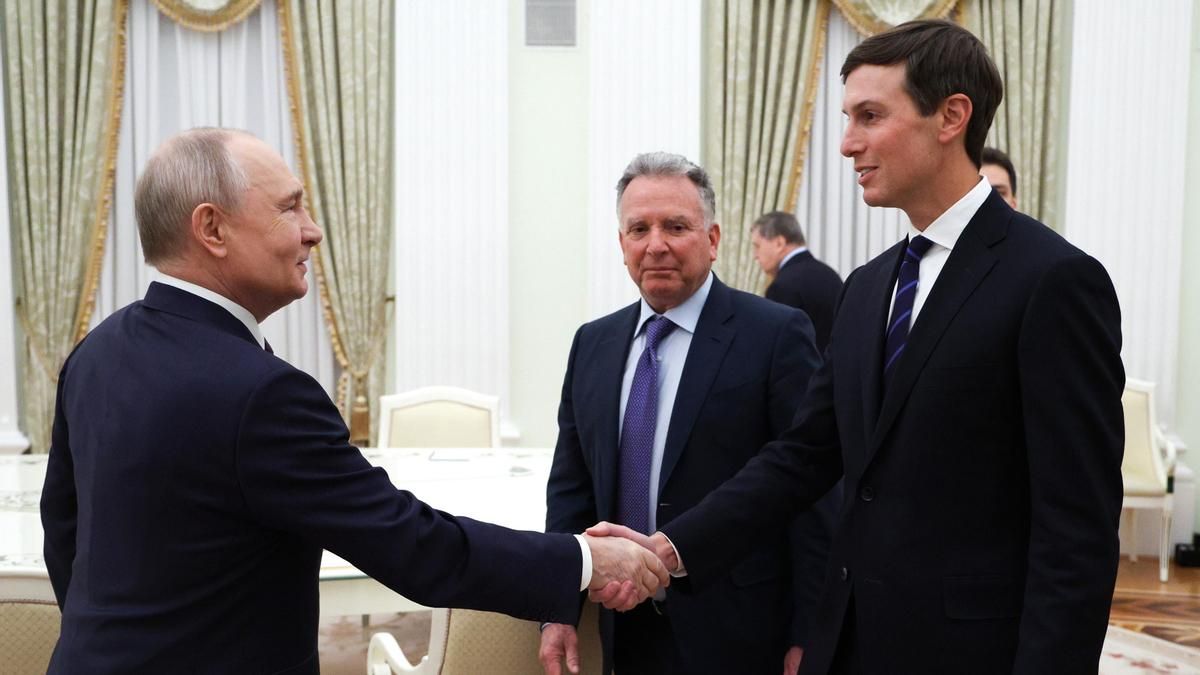
In a meeting on Thursday with White House special envoys Steve Witkoff and Jared Kushner, Putin made clear that Moscow would consider the presence of foreign troops on Ukrainian territory "unacceptable" and that they would immediately become "legitimate targets" for the Russian Army.
According to Politico, Washington hopes Putin will allow Ukraine to receive security guarantees similar to NATO's Article 4, which provides for consultations and political coordination in case of aggression, or Article 5, which facilitates military assistance to an attacked country. The Kremlin has rejected such proposals before.
U.S. administration sources told Axios that the United States would not grant Russia veto power over the continent's defense and would not accept an agreement without the approval of Kyiv and Brussels.
Debski does not understand why U.S. envoys are pushing to revise a model that, if implemented, would amount to "surrendering their position" and weakening their influence. "Whatever commercial opportunities Trump, Witkoff or Kushner may see in a deal with Moscow, those opportunities do not prove that such a retreat benefits the United States," he said.
"Despite European governments' concerns, Washington has no specific plan for the continent's security," Stanovaya added. She believes Trump's only goal is for Europe to "take greater responsibility" for its own defense and to be able to abandon the conflict in Ukraine.
In an effort to involve allies in the negotiating process, Kushner asked Putin to accept including European representatives in the next rounds of talks. With this move, the White House hopes to soften Brussels' refusal to discuss the new security architecture while fighting in Ukraine continues.
European leaders maintain that the defensive framework remains in place and, according to the Financial Times, would only be willing to discuss reviving Cold War-era conflict prevention mechanisms, such as agreements limiting the deployment of certain types of missiles, as well as the Open Skies Treaty, which allowed the United States and the Soviet Union to monitor each other's military facilities.
In any case, Axios stressed that in Abu Dhabi, European officials opened the door to addressing this debate in parallel with talks on resolving the conflict in Ukraine.
Although in recent weeks Putin has not ruled out dialogue with European leaders — as shown by his phone conversation with the leaders of Finland and Norway — Russian diplomats are reluctant to welcome their representatives to the negotiating table.
Medinsky was very harsh with them at the press conference after the talks in the Emirates. "We don't understand what they were doing here or what we can talk to them about; if they came as tourists, let them meet in the hotel lobby," he said, adding: "Until their conscience wakes up, they cannot participate in peace negotiations. Until then, they are participants in the collective deception of the Ukrainian people and accomplices in the deaths of civilians."
Kushner downplayed the Kremlin's intransigence and urged Brussels to choose a single representative to transform the trilateral talks into multilateral ones. "If Europe could identify one person who speaks on its behalf, that would be a greater achievement than getting the Russians to agree to include them in the negotiations," he said.