Will Russia Finally Accept Europe at the Peace Table?
Russia, Ukraine, and the United States met in Abu Dhabi for the first time in nine months, producing the war's largest prisoner exchange and a new push to bring Europe into peace talks.
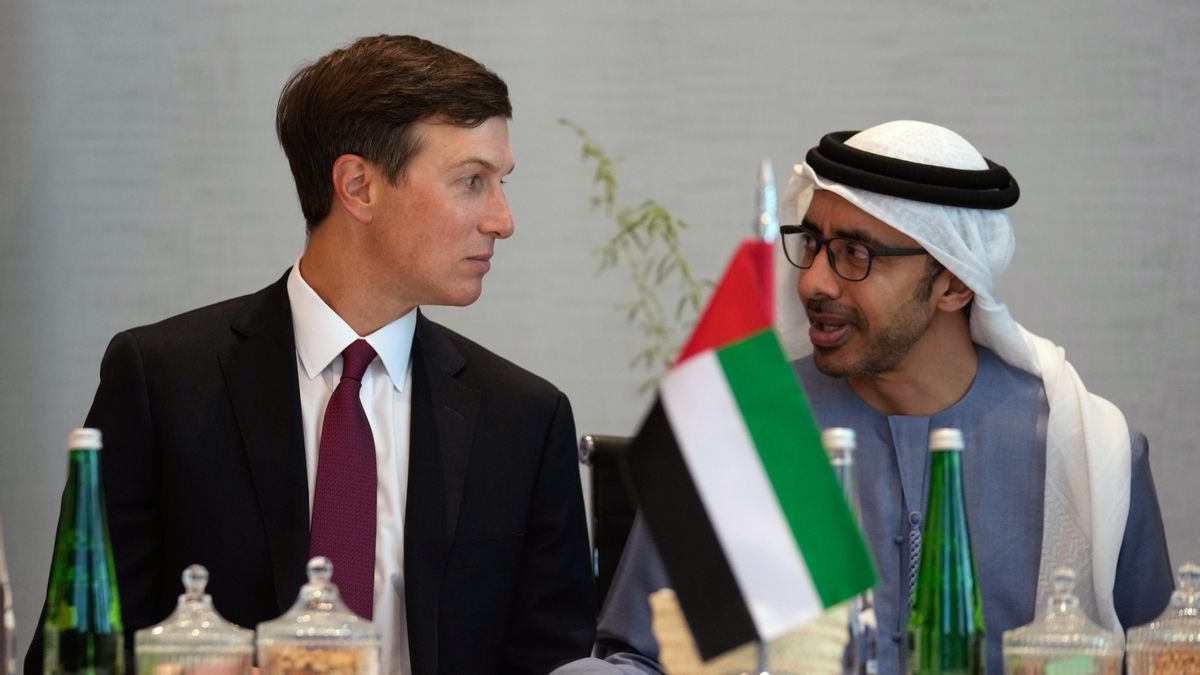
Delegations from Russia, Ukraine, and the United States met in Abu Dhabi this Tuesday and Wednesday. It was the first time in nine months that Russians and Ukrainians sat at the same table with American mediation to discuss ending the war. Jared Kushner and Steve Witkoff jointly led the US delegation. Vladimir Medinsky represented Russia and expressed hope that the meeting would advance toward peace in the interest of both peoples.
The Abu Dhabi round produced a tangible humanitarian result: Russia and Ukraine agreed to what will likely be the largest prisoner exchange of the war, with numbers still to be confirmed. Kushner described the talks as "substantive," "quite tough," and "a good first step." He also admitted that trust between the parties is absent and that territory "will be the hardest part."
That remains the core disagreement: Moscow demands that Ukraine hand over the part of Donetsk it still controls, while Kyiv wants to freeze the line of contact. No progress was made on ceasefires regarding energy infrastructure or Black Sea navigation.
The political news comes now. Kushner and Witkoff travel to Moscow on Thursday to ask President Vladimir Putin for his "blessing" on Europe's entry into the negotiations and to finalize the prisoner exchange. They will then meet President Volodymyr Zelensky in Dublin, where an informal European Union (EU) summit on Friday will debate who represents Europe. Kushner went so far as to say it would be an even greater achievement if Europe designated a single interlocutor.
The order of negotiations remains pending. Washington maintains that post-war security will not be applied until there is agreement on territory and other bilateral issues. Europeans accept discussing the continent's security in parallel but refuse to sign anything before peace. Ukraine wants a ceasefire by New Year because it fears another winter of attacks on its energy grid.
Each Party's StrategyRussia maintains a maximalist stance and arrived with a rigid mandate. It proposes an all-or-nothing game in which fighting will only cease with a complete agreement. It also wants negotiations to cover the entire European security architecture and is reluctant to sit with Europeans, though the Kremlin says it is open to contacts with the EU.
Ukraine seeks to include Europe in negotiations to avoid facing Moscow and Washington alone. It prioritizes a ceasefire, requests a second round as soon as possible, and uses attacks on Russian refineries as leverage.
The United States mediates from a position of strength. It combines gestures to build trust, such as the prisoner exchange, with a package approach that seeks to "resolve everything at once." It tries to move the conversation from territory to security guarantees, including the idea of a North Atlantic Treaty Organization (NATO)-type collective defense pact for Ukraine, and to reconstruction, where each party can gain something. It also shuttles between Moscow and Kyiv, pressuring the latter.
The Territorial QuestionRussia's strategy uses territorial control as a negotiating lever: dominance of a territory, or the threat of conquering it, becomes a bargaining chip for concessions. But in this case, the human cost is disproportionate to what is gained.
Russia already controls practically all of Luhansk province and about four-fifths of Donetsk. Ukraine retains approximately 5,000 square kilometers of Donetsk—about 19% of that province. That is less than 1% of Ukrainian territory. Moreover, it is not empty steppe but probably the most difficult terrain remaining under Ukrainian control in the entire Donbas: a chain of cities, industrial zones, rivers, forests, heights, mining towns, and prepared defensive positions.
The pace of advance confirms this. According to Ukrainian sources, between January and October 2026, Russian forces gained only 119 square kilometers. What sense does it make for Russia to send tens of thousands of soldiers to their deaths to increase its territory by 0.03%?
Reasons for OptimismThe dispute over the last piece of the Donbas is, at bottom, a symptom of a larger problem: distrust between Russia and the rest of Europe. Still, there are grounds for cautious optimism.
That the three countries have sat together again after nine months of silence is an important advance in itself, because it reopens a channel that seemed closed and does so with a first concrete result. More importantly, the Abu Dhabi talks point in the right direction by putting on the table an issue that will be decisive: the need to build a new security architecture for the entire continent.
Moscow demands it, Washington accepts it, and Europe shows willingness to discuss it. It is the first time in years that all three parties agree that the underlying distrust must be addressed, not just the front line. If Putin accepts on Thursday that Europe enters the negotiation, the format will be complete, and the debate on shared security could become the framework that makes a territorial agreement possible.
Without jointly addressing the future of European security, there will hardly be a definitive peace—only a truce awaiting the next war. The war will not end overnight, but for the first time there is a visible path toward peace. A partial ceasefire before winter and a new round in the coming weeks are achievable goals.
A Possible Way ForwardThe war has led Europe to abandon the concept of shared security and to a rearmament of unknown dimensions. That rearmament feeds on fear and distrust and simultaneously aggravates them. The narrative of an imminent Russian threat against some neighboring country has spread, but it is unrealistic. If Russia has not been able to impose itself militarily in Ukraine, it could hardly do so against several countries at once. The Kremlin itself has repeatedly denied that intention and on November 27, 2025, declared itself willing to "formalize" a non-aggression commitment toward any European country.
In negotiation practice, there is a resource for such cases: "taking the other at their word"—converting their declaration into a firm commitment. The proposal would be a brief and simple European Non-Aggression Treaty, signed by all heads of state on the continent without exception, including Russia. A neutral actor with moral authority—for example, the Vatican, which has not taken sides in the war—would promote and guarantee it. Such a solemn gesture would help ease tensions, could slow the arms race, and would open a stable channel for addressing pending disputes.
Two Complementary NegotiationsA European diplomatic initiative to end the war through a negotiated peace—rather than waiting for a military victory considered unviable and increasingly costly—could be articulated in two complementary negotiations.
The first would be a peace agreement starting from acceptance that Russia retains the occupied Ukrainian territories, with guarantees for the rights of their inhabitants and displaced persons. That agreement would include an immediate ceasefire verified by an international mission, reciprocal security guarantees that would not give Russia veto power over sovereign decisions of Ukraine or other states, progressive and conditioned lifting of sanctions, and an international reconstruction and humanitarian program.
The second would consist of convening a European Security Conference with the participation of Russia, Ukraine, the United States, the EU, the United Kingdom, and Turkey. Inspired by the Helsinki Final Act, the Paris Charter, and the Organization for Security and Co-operation in Europe (OSCE), this conference would seek to build a new shared security architecture based on indivisible security, overcoming blocs, strengthening the OSCE, arms control and disarmament, and permanent conflict prevention mechanisms.
Territorial cession would represent a far-reaching concession. In exchange, Russia would have to assume binding commitments of non-aggression, such as the treaty proposed above, and respect for the sovereignty of its neighbors. The initiative would not aim to legitimize border changes by force but to end the war and lay the foundations for a European security built with Russia and with Ukraine—not against either of them.