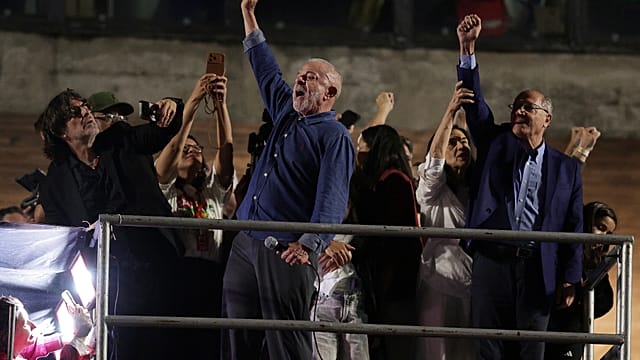
Lula Wins Fourth Term as Bolsonaro Refuses to Concede and Flees to U.S.
Lula defeats Flávio Bolsonaro 51.79% to 48.21% in Brazil's runoff election, sparking market turmoil and a Supreme Court standoff as the defeated candidate flees to the United States.
Brazil's President Luiz Inácio Lula da Silva won re-election on Sunday, completing a dramatic comeback to secure a fourth non-consecutive term [272316]. The leftist leader took 51.79 percent of the vote in the runoff, according to official results, while his rival, Flávio Bolsonaro, received 48.21 percent [272316][271818]. Lula is the first candidate in Brazil's history to lose the first round and win the second [271818][271805].
Bolsonaro has refused to concede the race and has called for the vote to be annulled [272316][271754]. The result contradicted prediction markets, which had pointed to a clear Bolsonaro victory [271993]. World leaders, including German Chancellor Friedrich Merz, have congratulated Lula on his win [271754].
Brazil's financial markets fell sharply on Monday following the surprise result [271678]. Investors had expected a victory for the right-wing candidate, who was seen as more willing to tackle the country's budget deficit [271503]. The main stock index fell to a two-month low as concerns grew that the new government will increase public spending, adding pressure to Brazil's finances [272015][271503].
Brazilian Senator Flávio Bolsonaro has left Brazil for the United States after losing Sunday's election, two sources said. He refused to comply with a Supreme Court order to hand over his passports before departing [272364].
In his victory speech, Lula declared, "Brazil is not anyone's backyard" [271797]. He announced he will not run for re-election and outlined goals for education, artificial intelligence, and the protection of the Amazon rainforest [271797]. Analysts had warned that a Bolsonaro presidency could have led to a dangerous consolidation of authoritarian rule, with potential extensions of presidential terms and packing of the Supreme Court [271832]. Lula's win is also seen as critical for the environment, as the Amazon rainforest faced irreparable destruction under Bolsonaro's policies [271832].
Popular mobilization transformed the race. Student protests, mass demonstrations, and a 10-million-member WhatsApp channel called "Lula's Army" energized supporters [271832]. Nearly 3 million more Brazilians voted in the runoff compared to the first round [271805]. A massive social media campaign drove an unprecedented surge in young voter turnout, helping Lula overturn what looked like a likely defeat [271728]. Lula gained ground across the country, especially in major cities and his northeastern strongholds [271805].
Lula also addressed voters' immediate economic concerns, pointing to his record of reducing poverty and inequality and increased benefits under Bolsa Família, the landmark welfare program he launched in 2003 [271805]. He framed the election as a choice between protecting social gains and democratic institutions, or returning to the Bolsonaro family's attacks on both [271805].
A political movement energized by weeks of street protests helped carry Lula to victory, said Prof. Biroli of the University of Brasilia. She warned that tense days lie ahead as democratic institutions face another test, but noted that a mobilized political movement on the left is now in place [271769].
The elder Bolsonaro, Jair Bolsonaro, is imprisoned for plotting a coup after his 2022 defeat [271805].