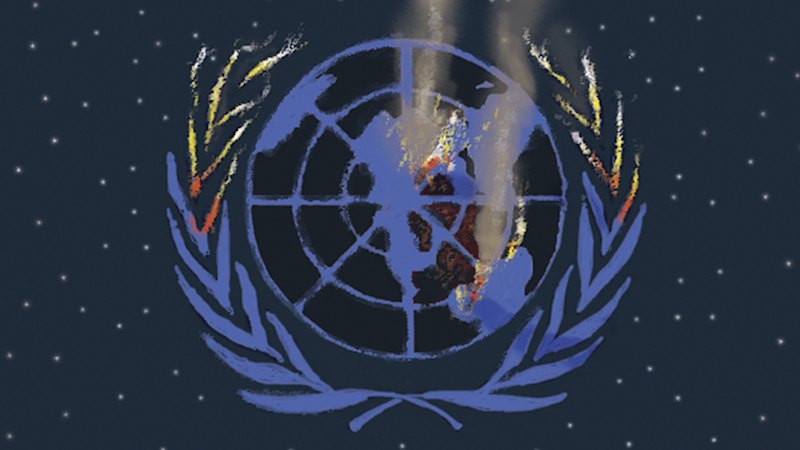
UN in Crisis: Trump Threatens to 'Annihilate' Iran as Leaders Skip Summit and Peacekeeping Runs Dry
The United Nations General Assembly opened this week with US President Donald Trump threatening to destroy Iran while major world leaders stayed home, deepening what officials call a "triple crisis" at the 80-year-old institution.
The United Nations faced a stark display of its own irrelevance this week as US President Donald Trump threatened to "annihilate" Iran during his address to the General Assembly, while the leaders of Russia, China, India, and Africa's three largest nations all stayed away [248673]. The empty seats told their own story: the world's most powerful nations are increasingly treating the UN as optional [248673].
Trump, 80, stood before world leaders on Tuesday and threatened to destroy a fellow member state, saying he wondered aloud whether to "annihilate the Islamic Republic and do it quickly" [251188][251145]. Even as he projected power abroad, domestic troubles followed him into the building. The US president is facing falling approval ratings, and even some Republicans are now straying from his script [251188].
Iran's President Masoud Pezeshkian traveled to New York to respond, delivering his message despite opposition from the host country. "They threaten us every day," Pezeshkian said in an interview with a major American television network [250731].
The absences of major leaders reflected both Trump's disruptive influence and the wider struggles the UN now faces [248673]. Russian President Vladimir Putin has not attended in over a decade. Chinese President Xi Jinping was also absent — a notable snub given he was in Washington to meet Trump. India's Narendra Modi did not come, nor did the leaders of South Africa, Nigeria, and Egypt [248673].
Norway's Foreign Minister Espen Barth Eide told the assembly the UN is facing a "triple crisis" of values, finances, and institutions. "Reform is necessary," he said. "Not because the UN has failed, but because it is needed" [250694]. Eide argued that using military force to achieve political goals has limits, leading to loss of life and destruction, and that military power can also be a sign of weakness [250694].
The crisis extends beyond the assembly hall. Mothers are being denied food for their malnourished children. Thousands of peacekeeping troops are being called home. The Security Council is paralyzed [248245]. As the 81st General Assembly opens, UN peacekeeping faces a critical moment: the Security Council is deadlocked, the budget is short of funds, and no new peacekeeping mission has been approved in twelve years [249623].
UN Secretary-General António Guterres, who is stepping down, called for "a world built on interdependence" in his final address to world leaders on Tuesday. The annual gathering faces major challenges, including climate change, war, inequality, and the rise of artificial intelligence [247907].
Maria Fernanda Espinosa, Ecuador's former defense minister and a top candidate to lead the organization, said in an exclusive interview that "very few understand how extensive the crisis facing the UN is" [248229].
French President Emmanuel Macron, in his final UN speech, offered a contrasting vision to Trump's message of domination. Macron showed resolve, and his firmness appeared to spread among leaders of other "middle powers." For smaller nations watching, the message was simple: you do not have to stay silent [251145].
Uruguayan President Yamandú Orsi defended the United Nations on Thursday, saying the body has "more reason to exist every day." He called for multilateral institutions that are "more effective, more representative" and closer to people's needs [250675].
The leaders of Brazil, Portugal, Kenya, and Canada issued a joint statement arguing that cooperation between nations must be strengthened, not replaced. Working together through international institutions is a practical need, not a distant ideal, they said [246028].
Colombia called on the international community to share the fight against transnational drug trafficking. Restrepo, delivering the message, said the effort cannot rest on Colombia alone. "Drug trafficking is a transnational problem, and it requires the international community to do its part," Restrepo said [249239].
Former UK Prime Minister Tony Blair warned that Europe cannot win wars without US support, calling the United States "indispensable" to security and urging British leaders to keep their alliance with Trump [250976].
The UN was founded to "save succeeding generations from the scourge of war," according to its charter. Yet this week, its most powerful member threatened to destroy another member state, its top leaders stayed home, and its peacekeeping operations faced collapse [248673][249623].