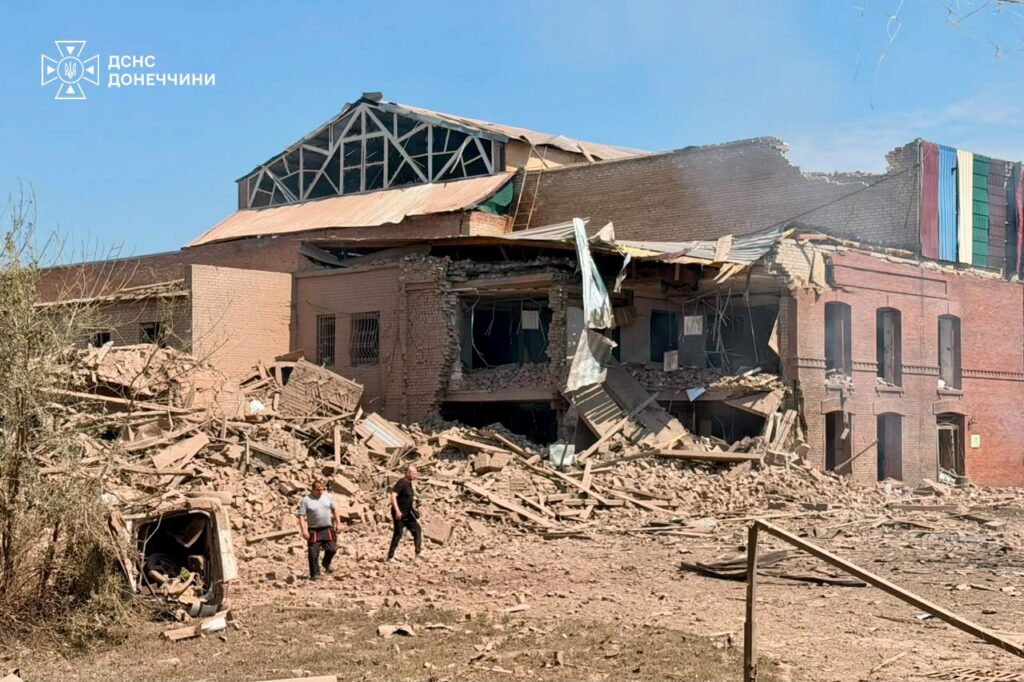
Ukraine Puts Azov Commanders in Charge of ‘Fortress Belt’ as Russia Closes to 12 km From Sloviansk
Ukraine is reshuffling its eastern defences, placing battle-hardened Azov commanders in charge of key fortress cities as Russian troops push within 12–13 kilometres of Sloviansk and Kramatorsk.
Ukraine’s President Volodymyr Zelenskyy has appointed Andrii Biletskyi, leader of the Third Army Corps, and Denys Prokopenko, commander of the First Corps (Azov), to oversee new military groupings defending the “fortress belt”—a chain of industrial cities in the Donetsk region [228382]. The move comes as Russian forces intensify pressure on three critical strongholds, with open-source mapping group Deep State reporting troops pushing deeper into Kostiantynivka, where Ukrainian forces are clearing them from houses, basements, and ruins [228382].
The appointments follow the dismissal of General Oleksandr Syrskyi, who was criticised for “Soviet-era” micromanagement [228382]. Ukrainian military analyst Mykola Bielieskov called the changes “the right move,” saying they give the new commander in chief, Mykhailo Drapatyi, more room for strategic planning [228382]. Robert Brovdi, head of Ukraine’s drone forces, praised the shift as a step towards “network-centric warfare,” adding: “This is exactly what ‘Smart War’ is” [228382].
The Azov commanders bring direct experience from earlier sieges, including Mariupol, and are tasked with organising defensive positions in cities expected to face heavy assault [228263]. A Ukrainian official described the strategy as “smart war,” signalling a deliberate shift to hold fortress cities against the advancing Russian push [228268].
Russian forces are now within 12 to 13 kilometres of Sloviansk and Kramatorsk, and could begin entering the fortress belt by late 2026, according to a new military analysis [226010]. The analyst’s assessment warns that Ukrainian intelligence units will not be able to turn the tide, and that once Russian troops break into these cities, reinforcements would only postpone the outcome [226010].
In the past day, Ukraine struck 16 sites inside Russia, including oil facilities, airfields, a missile unit, and logistics hubs, Zelenskyy said [228382]. One strike set fire to a Lukoil refinery in the city of Kstovo, which can process 125 million barrels of oil annually [228382]. Long-range Ukrainian drones also burned down a Wildberries warehouse in the Tambov region, according to Russian authorities [228382].
Meanwhile, a Russian guided bomb attack seriously damaged a combined heat and power plant in the southern city of Kherson, said Ukraine’s energy company Naftogaz [228382]. Explosions were heard in Kyiv early on Thursday, and Russia launched ballistic missiles at an industrial facility in Kryvyi Rih, injuring two people [228382].
Separately, Ukraine has announced a financial incentive program offering cash rewards for capturing Russian soldiers or eliminating them in close-range combat. A group that captures a Russian soldier will receive 100,000 hryvnias (roughly $2,225), and each confirmed kill achieved through small-arms or hand-to-hand combat will bring in 15,000 hryvnias (about $335), with troops required to provide video evidence [223747].
Belarus is also expanding a military logistics base near the Ukrainian border, adding a rail platform designed to handle up to 60 wagons of military equipment in a single operation. The ramp is designed for rapid offloading of wheeled and tracked vehicles, and analysts note such infrastructure is rarely built for purely defensive purposes [228270].