Young Spaniards Are Losing Faith in Democracy — and Data Shows Why
Fifteen years after the 15-M protests demanded democratic renewal, Spaniards under 35 are now the age group most willing to accept an authoritarian government in some circumstances. The frustration behind both moments is the same.
In 2011, young people led the largest citizen movement in Spain since the transition to democracy. The 15-M protests, which began on May 15 of that year, filled squares and streets across the country. Most participants were under 35. Fifteen years later, their demands remain unmet. Housing, a central issue of those protests, is now in worse condition. Democratic reforms have not materialized.
Meanwhile, the world is moving in a different direction. Political parties are less pluralistic and tolerate criticism poorly. Electoral systems remain unchanged. Public trust in institutions has fallen. No new spaces for citizen debate and participation have been created. Many democratic governments are led by politicians whose agenda reduces citizen control — Donald Trump being the clearest example.
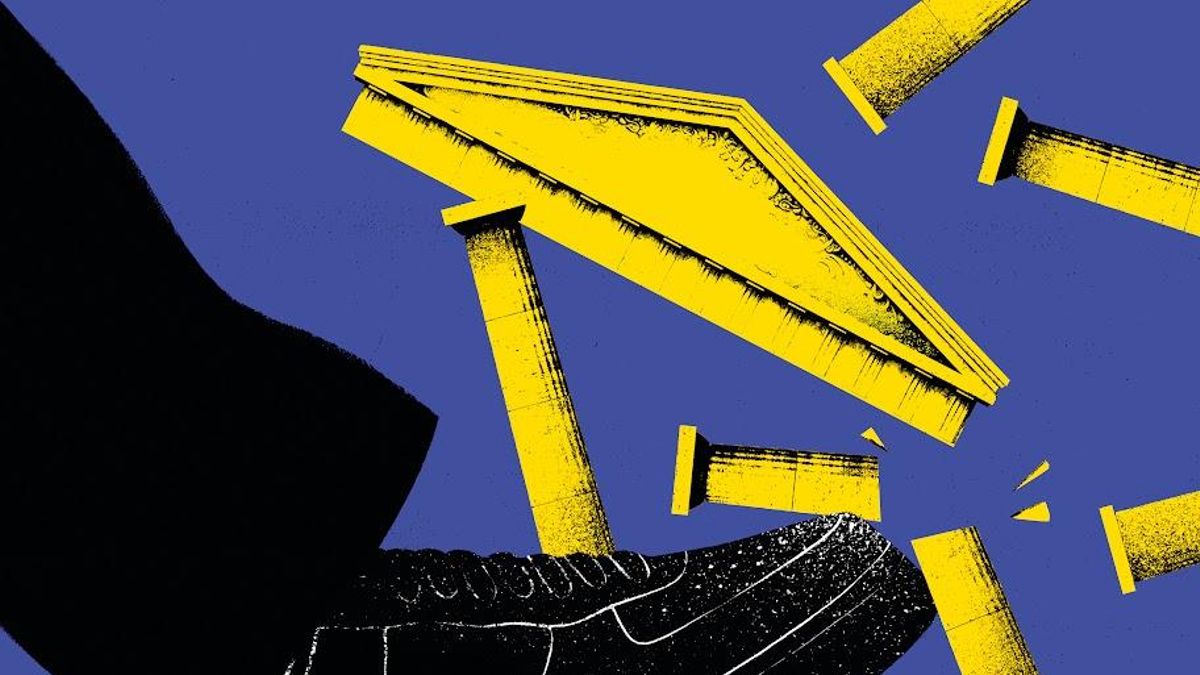
The major international powers competing for global leadership are autocracies — China and Russia — or are moving toward autocracy, like the United States. The European Union is absent from this contest. Societies seem to be looking in the mirror of ancient Sparta, abandoning the dream of a modern Athens shaped by Enlightenment values. That dream is giving way to a world of strong leaders where force dominates over reason. To use another historical parallel, the Republic appears to be yielding to the Empire.
**What Do Young People Actually Think?**
In this context of authoritarian pressure, it is worth asking: what do young people think about this drift?
Nearly a year ago, some media suggested that Spanish youth might feel nostalgia for the Franco dictatorship. On October 13, 2025, El País reported: "More than 21% of the population considers the dictatorship years 'good' or 'very good,' according to the CIS." The article cited a survey by the Center for Sociological Research (CIS) asking citizens about their preferences for democracy versus Francoism.
Broken down by age, 18.1% of those under 35 rated the Franco years as "good" or "very good" — three points below the general population. Among those over 65, who lived through the dictatorship, the figure was 24.3%. In other words, young people show the strongest rejection of Francoism, not nostalgia for it. The demographic data contradicts the idea that Spanish youth long for dictatorship.
**The Real Alarm: Support for Authoritarianism**
A different picture emerges when asking about forms of government. In April 2025, the CIS conducted a survey on the quality of Spanish democracy, asking about preferences for democracy compared to other systems. Only 8.6% of all respondents preferred an authoritarian government. Among those under 35, 15.2% said they would prefer an authoritarian government over democracy in some circumstances — nearly double the general population.
This figure, not any supposed nostalgia for Francoism, should raise alarms. It is not the dictatorship but authoritarian sentiment that appears to be growing among Spain's youngest citizens.
**Rejection of Taxes**
In the forthcoming book *Generación 15-M* (EnDebate), I explore public opinion data to understand what is happening among young people. One key finding: those under 35 are the only generation that considers democracy harmful for correcting inequality. This belief does not stem from personal experience — they do not necessarily perceive that inequality has risen recently. Rather, it reflects a cultural shift regarding the role of the state.
In recent years, rejection of taxes has grown among young people. The Institute of Fiscal Studies regularly publishes its Study of Fiscal Opinions and Attitudes of Spaniards. In 2024, 31.6% of those aged 18 to 24 and 30.6% of those aged 25 to 39 agreed that "if no taxes were paid, we would all live better." Fewer than 10% of those over 65 shared this view.
The 2025 study shows these figures have risen. Now, 35% of those aged 18 to 24 and 38% of those aged 25 to 39 agree with that statement — an increase of 3 to 8 percentage points among young people, while the figure for those over 65 remains virtually unchanged.
**Why Rejecting Taxes Matters for Democracy**
Rejecting taxes is not a minor issue in democratic terms. It means opposing the idea of citizenship built in Europe since the end of World War II. In 1950, sociologist T.H. Marshall published the influential essay *Citizenship and Social Class*, tracing the evolution of citizenship in European societies. In the 18th century, European revolutions focused on civil rights such as habeas corpus. In the 19th century, demands shifted to political rights: voting, association, free expression. In the 20th century, especially after World War II, socioeconomic rights took center stage — the foundation of welfare states with rights to education, healthcare, unemployment benefits, scholarships, and pensions.
Citizenship thus implies three types of rights: civil, political, and socioeconomic. Marshall tied the idea of the citizen to individuals, not to social class. This concept of citizenship has persisted in our societies. Questioning some of these rights puts our Enlightenment-based conception of citizenship in crisis. Challenging taxes is therefore a way of objecting to what it means to be a citizen in contemporary European democracies — a profound questioning of the societies we have built and the political systems that structure them.
**Where Does This Rejection Come From?**
For those who favor generational debate, the answer seems simple: the welfare state transfers income from young to old. Rising pension spending would be one form of transfer. The housing rental market would be another, where owners are older generations and tenants are younger people.
This answer has gaps. Not all young people are alike, nor are all older people. Some high-income young people are not trapped in the housing market, just as not all pensioners own multiple properties. Moreover, income transfers within the welfare state are far more complex than pension spending alone. Spain's welfare state has been among the least redistributive in the OECD for decades. This is not new — it has been happening for a long time. If the redistributive problem is longstanding, it cannot fully explain the recent generational debate.
**A Deeper Political Crisis**
I believe the political crisis among young people runs deeper than a generational debate about inequality. According to Metroscopia data, 84% of those under 35 believe Spain does not function adequately — 8 points higher than the general population and the highest figure among all generations. Young people overwhelmingly perceive that the state does not work. Their refusal to pay taxes is not simply the result of a more conservative generation — a trend also visible in ideological self-placement data. It is also the result of perceiving that their country does not function as they expect.
**Frustrated Expectations**
This opens a deeper reflection on what is happening to young people regarding democracy. One interpretation is the frustration of expectations that modern societies have created. Around 2011, people spoke of the possible emergence of the first generation to live worse than their parents — captured in the slogan "Youth Without Future." This was one of the citizen platforms that led the 15-M movement.
This lack of expectations may have intensified with social media. Platforms present places we will never visit, clothes we will never wear, and bodies that are very difficult to attain. This unreachable world can deepen frustration and hopelessness. New technologies, consumed overwhelmingly by young people, contribute to this frustration by reinforcing the idea of the unattainable. Frustration is the step before anger. And anger often drives citizen mobilizations throughout history. The rejection of taxes and the belief that the state does not work are consequences of frustration, lack of expectations, and anger — channeled into rejection of democracy.
**No Emotional Bond with Democracy**
Younger generations also lack an emotional bond with democracy that their elders, especially their grandparents, possess. Older generations fought to bring democracy to Spain and lived under an authoritarian regime without rights and freedoms. Their life experience is intimately tied to achieving a democratic system. This has likely produced very different emotional connections to our political system. That is why authoritarian sentiment can more easily emerge among the young. Beyond films or books, their view of the dictatorship differs greatly from their elders'.
This difference in emotional bonds with democracy is one more explanation within the anger and frustration observed among young people.
**Conclusion**
At a moment when the world moves toward more authoritarian systems and weaker democracies, young people do not currently appear to be the brake on autocracy. In public opinion data, they appear most "tolerant" of authoritarian political systems — though this remains a minority view. But this authoritarian sentiment reflects anger and frustration toward a state they perceive as dysfunctional, one that fails to meet the well-being expectations they project onto their future.
Sometimes anger produces these results. Part of Donald Trump's victory is explained by the losers of globalization living outside major cities. They too were angry, and their protest vote carried Trump to the White House.