Trump’s Immigration Crackdown Scares Off International Students, Costing U.S. Universities Millions
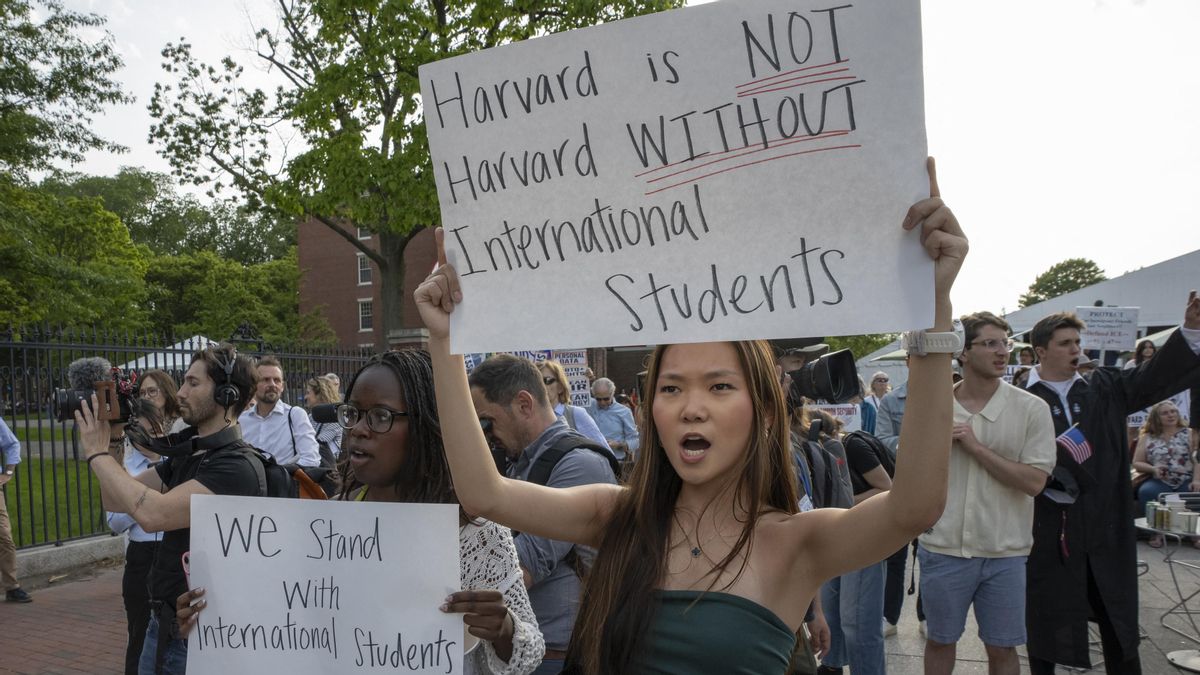
International student enrollment at U.S. universities has fallen sharply as the Trump administration’s immigration crackdown discourages applicants. The decline costs universities millions of dollars and deprives American students of valuable cross-cultural experience.
At Indiana University’s Bloomington campus, a full scholarship for foreign students was once eagerly accepted by students from Brazil, Nigeria, Thailand, Turkmenistan and Zambia. That changed in January 2025, when Donald Trump began his second term and launched a wide immigration crackdown.
Christoph Irmscher, who directed the Wells Academic Program for 13 years, awarded the scholarship to a South African and a Central American woman. Both declined. “People are more careful and weigh the pros and cons,” said Irmscher, who came to the U.S. from Germany in 1993 on a Fulbright scholarship.
The number of new international students at U.S. universities fell 15% this fall compared with last year, according to the Institute of International Education. The figure had already dropped 18% in 2025 from the year before.
More than 1.1 million international students came to the U.S. in the 2023/24 academic year, a record. But university officials say interest has declined since Trump returned to power and directed Immigration and Customs Enforcement (ICE) to carry out raids, arrests and deportations of undocumented immigrants. Images of masked agents patrolling cities spread worldwide and created unease.
Bloomington’s campus saw a 15% drop in international enrollment, from 4,428 in fall 2025 to 3,768 this year, according to university data. Indiana, governed by Republicans, also passed a law this year requiring colleges to run background checks on students from China, Iran, North Korea and Russia before admitting them. Irmscher called the requirement “totally unnecessary” because the federal government already conducts such checks during visa applications.
“In the culture of social media and TikTok, these videos of ICE committing brutalities against people in the street have a big impact,” Irmscher said. “If you look different, if you feel different, I’m sure that influences your decision.”
At Cleveland State University, international enrollment fell 46%, from 1,542 to 828, from last year to this year. The main reason was candidates’ difficulty obtaining visas, according to Provost Nigamanth Sridhar.
The Trump administration ordered its embassies in May 2025 to stop scheduling visa interviews for foreign students while preparing a system to screen applicants through social media. “Some people want to go to Harvard or other colleges and can’t get in because there are foreign students,” Trump said at the time.
The State Department announced in January that it had canceled 8,000 student visas. The Department of Homeland Security (DHS) proposed in October a rule requiring universities to pay a $70,000 fee for each international student participating in a training program that allows students to work in jobs related to their studies during or after their courses.
The enrollment drop costs Cleveland State between $2 million and $4 million, Sridhar estimates. International students often pay more than domestic students in tuition.
Foreign students also shape university life in less tangible ways. Sridhar, a former computer science professor who came to the U.S. from India in 1999 to study at Ohio State University, said foreign students “bring unique perspectives to conversations inside and outside the classroom” that create “intellectual richness and diversity.”
After the 2025 earthquake in Myanmar, which killed thousands and left millions dependent on humanitarian aid, a Burmese student at Indiana University organized a fundraiser, bringing food from her country and speaking about its traditions. “It was a culturally enriching act, but also a way of putting yourself in someone else’s shoes that is not normally accessible to students in the American heartland,” Irmscher said.
Some students who go to the U.S. end up staying and contributing positively to society, like Irmscher and Sridhar. The Trump administration has tried to hinder these paths with a rule approved in July that prohibits visa holders from staying in the country more than four years without federal permission. Completing a degree often takes longer.
Veena Dubal, legal director of the American Association of University Professors and a law professor at UC Irvine, is the daughter of an Indian immigrant who came to the U.S. in the 1960s to study and work. Her father, a biochemist, ran a blood analysis lab in Houston; her mother, a doctor, ran pain clinics in Lexington, Kentucky. “She spent her entire career helping people from poor and underserved communities, from rural areas, who had work-related illnesses from mining and factory work,” Dubal said. “Both she and my father dedicated their lives to contributing immensely to their communities.”
DHS denies that its actions have significantly influenced foreign students’ decisions not to come to the U.S. or that they negatively affect universities. “This ‘journalism’ is completely manipulative and backed by no real evidence,” a government spokesperson wrote to The Guardian in an email. “The staged outrage is incredible. Where was the outrage when foreigners abused the system, violated their visa terms and mocked our immigration laws? If the media really cared about legitimate international students, they would thank President Trump for going after the rampant fraud to ensure that only those who truly want to study in the U.S. are granted that privilege.” The administration did not respond when asked for evidence of this “rampant fraud.”
The Trump administration announced in October that it would investigate nine universities to determine whether they had committed fraud in a student visa program. “Something strange is happening at these universities,” Vice President JD Vance said. “They are using these visas far more than necessary. They do it to undercut the wages of American undergraduate students.”
The administration has not fully implemented the new restrictions on foreign students. A federal judge blocked this week the rule limiting stays in the U.S. to four years. “Bluntly put, DHS seeks to prevent or discourage the very activity — providing educational opportunities in the U.S. to foreign students — that Congress intended to permit and encourage,” the judge ruled.
Dubal is optimistic — especially after the Democrats’ midterm election victories — and believes the university community can push back against the Trump administration’s treatment of foreign students. She argues that instead of trying to keep them out, lawmakers should focus on reducing the cost of education. “If the Trump administration cares about Americans accessing higher education, the answer is not expelling immigrants,” she said. “It’s making it more accessible. And how do you do that? By lowering prices.”