Anthropic IPO Creates Thousands of Millionaires—While 7 Founders Keep Total Control
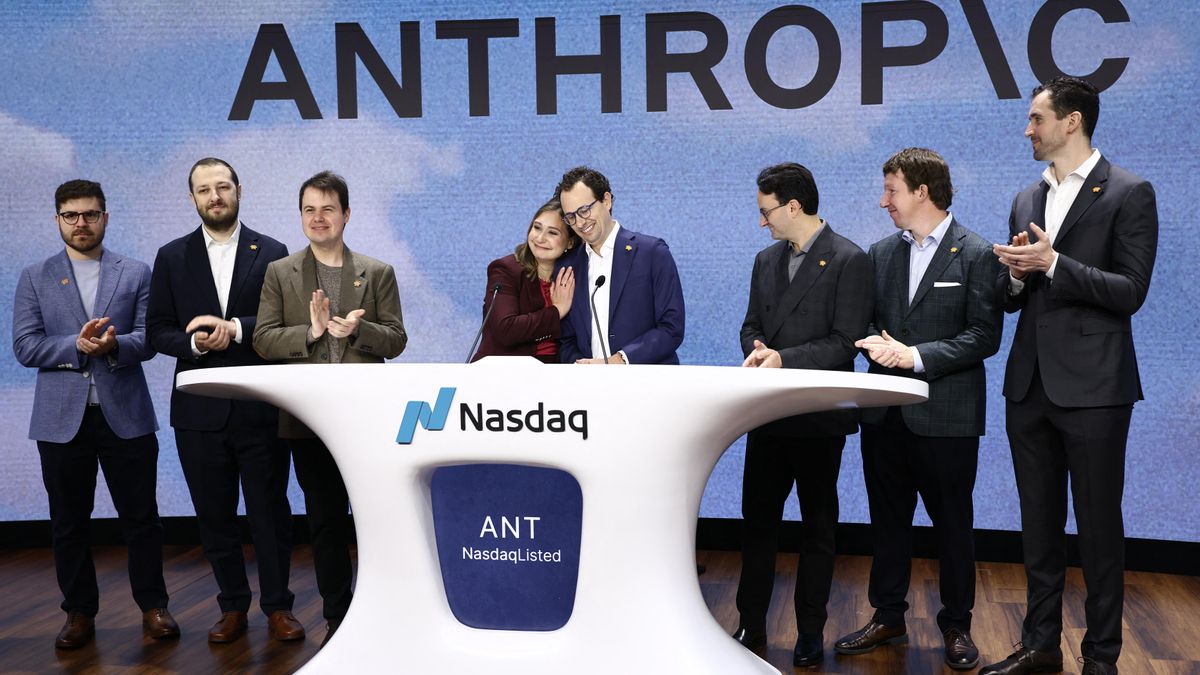
Anthropic has completed the largest initial public offering (IPO) in history, raising $81 billion for a total valuation of $1.5 trillion. The maker of the Claude chatbot has unleashed an unprecedented wave of wealth in Silicon Valley, creating thousands of millionaires. But the story behind that money reveals how AI billionaires are rewriting corporate governance rules—what the industry calls "paper millionaires": fortunes locked for months and a mass of shareholders with no voice or vote in the company.
Founded in 2021, Anthropic grew from about 940 employees at the end of 2024 to roughly 5,300 by September. To build its workforce amid the AI race, the company led by Dario Amodei used stock options as a key strategy to recruit staff from rival OpenAI, as well as from Google, Microsoft, and other tech giants.
According to the IPO prospectus, as of September 30, employees with shares held about $119 billion in company stock options. More than 60% were already vested. But those contracts include fine print. Non-founder employees could sell a maximum of only 10% of their shares on the first trading day. They can sell another 35% after fiscal year 2026 results, while the rest unlocks in stages over 180 days. What they ultimately earn will depend on how AI company stock prices hold up.
The official document does not break down how much each worker receives. Market analysis firm Sacra estimated that around 2,800 employees hold at least $1 million in vested shares. That distribution has gone not only to top researchers but also to junior workers and administrative staff.
Then there are cases like Krishna Rao, the chief financial officer hired in 2024 who has made Anthropic more money from interest on its capital than many small banks. To convince him, brothers Dario and Daniela Amodei offered him a package of 14 million stock options at $1.30 each. After the IPO, that portfolio is worth more than $1 billion.
It is a boost for a stock-based compensation policy that tech startups use both to attract talent and keep it committed to the project—but one that has not always been well received by Silicon Valley's workforce. Those shares "can function as 'golden handcuffs' by limiting the mobility of employees at successful startups until a liquidity event (sale or IPO) occurs," explain researchers Yifat Aran and Shai Murciano-Goroff in an Oxford University study.
"Startup founders, investors, and their lawyers have systematically exploited information asymmetry in stock grants for their own benefit," summarizes corporate law expert Anat Alon-Beck in the same research.
**No Voice, No Vote**
This logic of money without transparency or decision-making power emerges throughout Anthropic's corporate and shareholder design. In a conventional publicly traded company, buying shares gives the right to vote to elect the board of directors and to support or reject changes in its leadership.
It is a counterweight that big tech companies began bypassing two decades ago, when Google created different types of shares to protect its founders. Now, Anthropic has taken it to the extreme. In practice, the AI era brings a change to corporate structure: shareholders have neither voice nor vote in the company's direction.
Anthropic has divided its capital into five different classes of shares: A, E, N, T, and F. The rights each grants are very different. Class A shares are the only ones investors can buy on the stock exchange and do not allow their owners any influence over board composition or strategic decisions. Class E shares correspond to employees and, although they do include voting rights, these are very limited to specific disputes or changes affecting the trust that oversees the company.
Then there are Class N shares, reserved for the big tech companies that have invested in Anthropic, such as Google and Amazon, which together hold approximately 30% of it. These grant dividend rights but have also been stripped of any voting rights on the lab's management.
Finally, there are T and F shares—the only ones that grant the power to decide the lab's future. T shares are held by the trust that controls Anthropic and grant the authority to elect the majority of the board of directors. F shares, meanwhile, are a single share held by the seven co-founders that guarantees them 50.1% of voting rights regardless of how many other types of shares exist now or in the future.
**In the Hands of 7 People**
In the IPO prospectus, Anthropic explains that it designed its control structure as a guarantee that it can maintain its "mission" to develop AI "responsibly" and "for the benefit of humanity" against investor pressure. But the complex castle built by the founders to protect their technology from third parties has one more wall.
Anthropic is not a conventional company. It is constituted as a public benefit corporation, a legal figure that obliges its board to balance the profits shareholders obtain with the positive impact the organization has on the rest of society. The trick? There are no official standards to measure that social benefit, so in practice this type of constitution also serves as a shield for management's power.
"This does not protect society from the harms of AI; it puts power in the hands of a few (the founders and the trust members they choose) at the top of Anthropic, hoping they will use that power well," warns Aswath Damodaran, professor of Finance at New York University and one of the world's leading experts in company valuation.
"Given the concerns people have about AI as a force of destruction, a worry that Dario Amodei has actively cultivated, this protection against shareholder power may seem like a good thing, but we must open our eyes to what this structure really does," Damodaran adds.
And who is part of that inner circle? At the center are the seven founders who share the F-class share, alongside the trust that controls the majority of the board. They are led by brothers Dario and Daniela Amodei, but behind them is a hard core of researchers and former OpenAI safety officials who left that lab en masse in 2021 to found Anthropic. They all share the same "vision": AI poses a great danger to humanity, so the best way to avoid its worst consequences is for them to lead the race, not OpenAI.
"Anthropic believes its business depends on accelerating AI progress to stay ahead of competitors. But it also acknowledges that accelerating progress risks pushing its models' capabilities beyond the limits imposed by current safety measures. It is a race to the bottom on safety: Anthropic recognizes the danger but claims it cannot afford to stop," explains Brian McGrail, director of public policy at Encode, an organization that analyzes AI safety.
"There are many ways this can go wrong," warns Bloomberg financial analyst Matt Levine about this structure, raising what would have happened if the Jensen Huang scandal at Nvidia had erupted at Anthropic. Unlike the lab, Nvidia still operates as a conventional public company: Huang is its co-founder, but he held barely 3.4% of shares, lacked special voting rights, and answered to a board made up of independent directors.
"Anthropic has a much more nuanced view of what Anthropic wants than 'whatever Dario wants,' but it is also not an ordinary board of independent directors," Levine explains. His argument is that Huang's sudden departure—after revelations of his relationships with an alleged Chinese spy and two subordinates—and the board's subsequent refusal to reinstate him would have been much more complicated under the AI lab's shield.
**The Control of AI**
Anthropic's case represents a trend among the new group of AI giants. At SpaceX, the structure guarantees Musk's absolute control over the company and its board. At OpenAI, when the board tried to fire Sam Altman in 2023 for lack of transparency, investor and employee rebellion returned him to his post in a weekend and swept away almost all the directors. "He has the heads of the former directors stuck on pikes outside his office," Levine quips.
"The CEOs of big tech companies are, in a sense, almost as big as their companies and much bigger than their boards. (Certainly bigger than their own companies' ethical standards!) They want a corporate governance structure that reflects that; they can't quite believe that their companies' will can be expressed through the vote of independent directors," the analyst concludes.
With its stock market debut, Anthropic takes that logic to the largest stock market operation in history. It distributes among the market the weight of its losses and computing commitments approaching $900 billion, turns thousands of workers into millionaires tied to the bubble, while control of AI remains under lock and key.