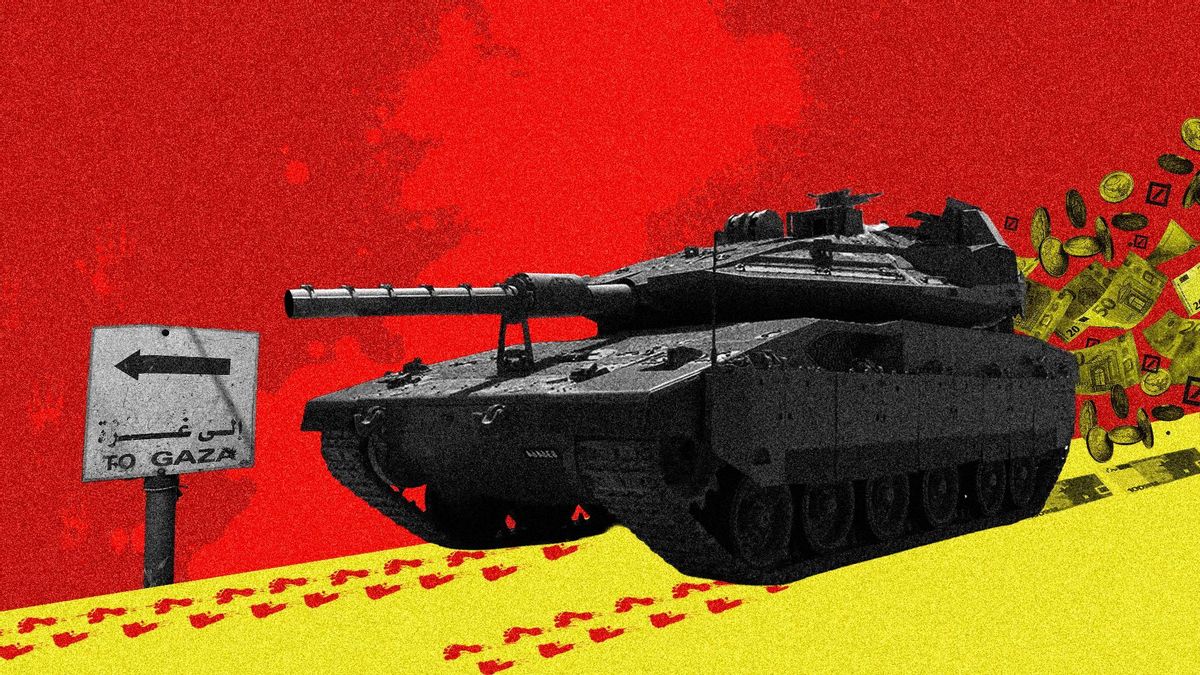
Deutsche Bank Helped Fund Israeli Tanks Used in Gaza Killings
Deutsche Bank approved an 11.4 million euro advance payment guarantee to German defense manufacturer Renk GmbH in January 2022, helping finance gearboxes for Israeli Merkava 4 tanks later used in attacks that killed Palestinian civilians in Gaza, according to a leak of 15 million internal bank files.
**The Decision**
A Deutsche Bank committee in Frankfurt discussed the deal at a January 12, 2022 meeting. The document had been under review since December 16, 2021. Renk was to produce gearboxes for the Merkava 4 tank, with the first delivery planned for September 2024.
A deputy legal advisor at the bank called it a "standard commercial financing product" with no notable reputational risk. The advisor said the chance the deal would become public was "very low." The advisor noted the risk would be even lower if the financing guarantees were issued through an Israeli bank on Deutsche Bank's behalf.
The advisor added that the gearboxes are not considered weapons under German military weapons law and that Renk would obtain an export license. "I support the transaction," the advisor concluded. The deal went ahead.
**Hind Rajab**
Two years later, in January 2024, six-year-old Palestinian girl Hind Rajab called emergency services begging to be rescued. Rajab and six family members had been fleeing Israeli attacks in Gaza when the car they were traveling in was shot at. She was the only one still alive.
After hours of negotiation for safe passage, an ambulance sent to rescue the girl was intercepted. Days passed before the bodies of Hind, her family and the emergency workers could be recovered. Rescuers found 335 bullet holes in the family's car.
Israel initially said none of its forces were present, then claimed the bullets came from crossfire. An analysis by Forensic Architecture, a research group at Goldsmiths, University of London, found only Israeli Defense Forces (IDF) present at the scene. In an October 2025 filing to the International Criminal Court, the Hind Rajab Foundation alleged the tanks were Merkava 4s. A tank shell was found among the remains of the ambulance that tried to rescue Hind Rajab.
The IDF first denied being in the area, then said it "carried out raids against terrorist targets" in the neighborhood. On August 19, 2026, more than two years after the incident, Israeli forces acknowledged their soldiers had opened fire on the car carrying Rajab and on the rescue ambulance. They blamed "coordination failures" in the ambulance's movement, a claim the Palestinian Red Crescent Society (PRCS) denied. The IDF said a criminal investigation would be held.
**Al-Tahliya Roundabout**
This was not the first documented case of Merkava tanks — Israel's main battle tanks in Gaza — being used against civilians since January 2022, when the bank's reputational review committee backed the deal.
Major incidents involving Merkava tanks include the siege of Gaza's Al Shifa hospital in November 2023 and the deadly attack on civilians waiting for food aid at the Al-Tahliya roundabout in June 2025, as famine in Gaza worsened. That attack came about nine months after the planned delivery date of the new Renk gearboxes, and one month after the IDF published photos of Renk gearboxes being prepared for assembly.
Sufian Kawareh, 43, had no choice but to go to the aid distribution point east of Khan Younis in southern Gaza to wait in the crowd for trucks loaded with flour. At the Al-Tahliya roundabout, where Kawareh and thousands of hungry people sat waiting for the trucks, shells fired from Israeli Merkava tanks hit the area.
Kawareh felt "as if an iron saw" was "cutting off my leg" and collapsed. After a week of suffering, doctors amputated his foot to save his life.
Khaled Walid, 40, wounded in the Al-Tahliya incident, recalls that a Merkava 4 tank fired at the crowd. He said it was easily distinguishable from other tanks used by the Israeli army. "It had a turret, a cannon, a machine gun and metal structures surrounding its hull," he said in an interview.
Palestinian authorities said at least 59 people waiting for aid were killed. The IDF said a crowd had gathered near an aid truck stuck next to its troops, that details were being reviewed and that it "regrets any harm caused to uninvolved people."
The incidents in Gaza did not affect the Deutsche Bank-Renk deal, according to the information obtained.
**Nasser Hospital Attack**
Nasser Medical Complex, the hospital that treated victims of the Al-Tahliya attack, was itself hit by a Merkava tank a couple of months later, on August 25, 2025, killing Reuters journalist Husam al-Masri. When rescue teams and journalists arrived, the same tank returned and fired at the hospital again, according to eyewitness and journalist Osama Hisham, whose tent was opposite the complex. Israeli military members cited by local media at the time also said the same tank had fired twice. A total of 22 Palestinians died, including five journalists — some from Reuters and the Associated Press — rescue team members and a health worker.
The next day, Israel's armed forces said their target was a camera used by Hamas, but Reuters confirmed the camera belonged to the news agency.
Shown photos of the shells from the incident in an interview, explosives engineer Mohamed Salem, experienced in clearing explosives in conflict zones, confirmed the attack used 120 mm artillery ammunition designed for Merkava tank guns. The shell bears the standard "CRTG 120" marking.
Several high-profile Merkava 4 incidents took place before the planned September 2024 delivery of the first batch of supplies backed by Deutsche Bank.
**The Merkava 4**
The Merkava 4, a cornerstone of Israel's tank fleet, has played a significant role in ground operations in Gaza since October 2023.
According to Alwan Al-Abousi, an expert interviewed by the outlet Daraj, its main armament is a 120 mm smoothbore gun that fires shells and laser-guided missiles, and it is equipped with three 7.62 mm machine guns on the roof plus a 60 mm grenade launcher. It reaches a top speed of 64 km/h and has a range of 500 km. According to Al-Abousi, the Merkava 4's most important feature is its "Trophy" protection system, which detects anti-tank missiles and fires a projectile to detonate them before they reach the tank.
"The Merkava 4 main battle tanks (MBTs), being the most advanced variant, usually serve in IDF Armored Corps brigades: the 7th, 188th and 401st. Merkava 3 MBTs are usually deployed in one of the seven reserve armored brigades or in one of the three companies that make up an armored battalion," explains Leone Hadavi, a senior weapons specialist working as an international open-source researcher.
In Gaza, the tank operated as part of armored formations working with infantry, engineering, reconnaissance and aviation units. Its main role was to provide direct fire support to advancing Israeli forces, protect assault units in residential areas, break Hamas and allied groups' defenses and attack positions firing at Israeli forces. However, the war has also shown that the tank's technical superiority does not make it immune to losses, especially in complex urban environments under threats from multiple directions, according to Abbousi.
Asked about various defense deals, including the Merkava 4 gearboxes, the bank says it does not comment on specific clients or transactions and evaluates defense sector business "case by case, in accordance with applicable law and internal guidelines."
"The assessment takes into account, among other factors, the goods and their intended purpose, the end users, the situation in the recipient country — including any armed conflict — and relevant human rights and reputational risks. Where grounds for particular concern are identified, the bank applies enhanced due diligence and may reject a transaction if the risks cannot be adequately mitigated," it adds.
**Reputational Risk**
A December 2021 internal memo on reputational risk noted that, given rising tensions between Israel and Palestine and between Israel and Lebanon during that year, "including cross-border attacks and violent treatment of protesters," the transaction was not without risk.
However, rejecting the deal could also bring "negative press" for the bank, given the "historical relationship between Germany and Israel."
"If our non-participation becomes public, we could face criticism from the media or the government for denying Israel the support it needs to defend itself," the memo reads. "Former Chancellor Angela Merkel just stated during her last visit to Israel in October 2021 that Israel's security is part of our 'reason of state' and that Germany is not neutral on the question of Israel's security."
All Deutsche Bank departments consulted in the review said the transaction should ultimately go ahead.
Deutsche Bank kept its commitment to Renk as violence intensified in Gaza. On February 7, 2024, when Renk listed on the Frankfurt Stock Exchange, Deutsche Bank acted as one of the coordinators of its initial public offering alongside Citigroup, Goldman Sachs and JP Morgan.
**Legal Proceedings**
One justification Deutsche Bank used to support the Merkava 4 deal in 2022 was that exports would still have to be approved by the German government.
However, for most of 2024 Germany approved almost no export licenses for Israel, affecting Renk and Rolls-Royce, maker of the Merkava 4's supply engines, according to sources familiar with the sector. They said supply problems endangered Israel's ground offensive. Israel had significantly intensified its offensive after Hamas's October 7, 2023 attack on southern Israel, in which 1,200 people died, including 815 civilians.
In August 2025, the German government suspended arms exports to Israel.
Around the same time, a regional appeals court in Hesse, Germany, was hearing an appeal by a Palestinian from Gaza seeking to block German export licenses for Renk tank transmission parts destined for Israel. He argued the licenses violated Germany's constitutional duty to protect his right to life. A Frankfurt court had dismissed his application in December 2024, finding he lacked standing, and in September 2025 the appeals court upheld that ruling.
Two months later, the German government lifted its partial suspension of military exports to Israel, citing the ceasefire announced the previous month.
A year later, a UN commission investigation concluded that Israel was still committing "genocidal acts with the intent to destroy, in whole or in part, Palestinians in Gaza." Israel rejects the accusation. More than 1,600 Palestinians — mostly civilians — have died in Israeli attacks since the ceasefire.
In an earnings conference, Renk said shipments related to Israel resumed in late the second quarter of 2026. Contacted, Renk declined to comment. Rolls-Royce did not respond to journalists' questions.
**A Bomb to Break Fortifications**
Renk is not the only defense manufacturer whose products were used by the IDF against civilians, nor the only one backed by Deutsche Bank, raising questions about the bank's compliance with its own human rights policy.
"Our principle is not to participate in any business activity where Deutsche Bank has substantiated evidence of significant adverse human rights impacts and where it is determined, through the bank's internal processes, that such adverse human rights impacts cannot be adequately avoided or mitigated," the bank says in its human rights statement.
Another defense manufacturer linked to Deutsche Bank is Italian arms maker Leonardo S.p.a (partly state-owned). In October 2018, the bank was involved in a multi-million euro transaction related to Israel and Leonardo. It had been asked to issue commercial guarantees to the Italian defense company, internally described as a "platinum client."
Leonardo made the "76/62 Super Rapid" multi-feed naval gun mounts, a weapon capable of firing 120 rounds per minute, for Israel's Sa'ar 6 class corvettes — Israel's newest and most advanced warships. The IDF has used these warships to bombard Gaza from the sea since 2023. The "76/62 Super Rapid" naval guns were manufactured and delivered under an agreement guaranteed by Deutsche Bank.
Leonardo, through a subsidiary, also makes automatic loaders for the Trophy active protection system, which protects ground vehicles against attacks, including the Merkava 4.
Leonardo currently faces a lawsuit brought by a Palestinian citizen and several Italian advocacy groups for allegedly violating the Italian Constitution by supplying Israel with weapons used to violate human rights.
Leonardo's CEO last year rejected accusations that his company was complicit in the Gaza conflict. In response to questions from Barracuda Media, the company acknowledges its relationship with Deutsche Bank. It says it has always operated in strict compliance with national and international rules governing defense and dual-use exports, and with authorizations granted by competent authorities. It notes that, after the escalation of the Israel-Palestine conflict, Italian authorities suspended the granting of new licenses for defense exports to Israel.
In 2024, BankTrack and 18 other civil society organizations detailed how commercial banks financed companies supplying weapons to Israel. Deutsche Bank was found to have granted about 4 billion euros in loans and guarantees to defense manufacturers Boeing, Leonardo, Lockheed Martin, Rolls-Royce, RTX Corp and General Dynamics between January 2021 and August 2023, though not all their products were used in Gaza.
Rolls-Royce has not responded to requests for comment.
One bomb made by Boeing, whose key components were supplied by a joint venture 25% owned by Leonardo, is the small-diameter GBU bomb. This bomb was used by the Israeli army through its air force to attack homes and urban areas. According to two weapons experts who analyzed photos of the damage, it was likely used in the attack on the Al-Mutanabbi school near Khan Younis in July 2024, in which 29 Palestinians died.
Analyzing photos of the attack's effects, explosives engineer Muhammad Salem says the bomb fragments observed at the site undoubtedly come from precision-guided GBU-39 bombs, or their precision suspension and control system, judging by the serial number printed on the metal.
The fragments also reveal the manufacturer code registered to Woodward Inc, one of Boeing's suppliers of electromechanical systems and guidance actuators. The numbers also indicate the exact manufacturing date of the part: March 31, 2022 (2022-03-31), Salem says. The expert adds that the bomb is designed to penetrate fortifications.
Weapons expert Hadavi agrees. In the photos of the damage, at least one of the four control surfaces mounted on the tail of the small-diameter GBU bomb, or the tail fin, can be seen, he says.
Boeing also makes the larger, more powerful GBU-31, which was dropped on displaced people in tents in the al-Mawasi area of Khan Younis on July 13, 2024. That attack wounded more than 300 and killed 91 Palestinians, according to Palestinian Health Ministry statistics at the time.
On November 12, 2026, the US-made 114-kg GBU-39/B bomb was used in an Israeli airstrike on Nasser Medical Complex that killed at least six people — including a child and prominent surgeon Dr. Rizk Abu Shaira — and wounded 52. In a statement, the Israeli army said its target was Hamas militants hiding inside the hospital, but Hamas denied it.
Since October 7, 2023, Israel has killed more than 75,000 people in Palestine in what the UN Independent International Commission of Inquiry has called genocide. The dead include hundreds of journalists and humanitarian workers, more than 1,700 health workers and medical personnel and at least 20,000 children. According to a UN investigation, children were deliberately targeted "using quadcopters, drones and sniper rifles… aiming at the head and upper body."
Ryan Brightwell, human rights lead at BankTrack, says financial institutions have clear human rights responsibilities. "They must demonstrate how they respect human rights and are expected to use their influence over clients to ensure they do not cause or contribute to harm," he says.
If a bank maintains relationships with an arms company, it "should consider divesting or ending the relationship if the client does not change its behavior," he adds.
Boeing has not responded to our questions.
**Controversial Weapons**
In March 2019, Deutsche Bank expanded its defense policy, which it said "makes clear" it would avoid "establishing or maintaining any kind of business relationship" with entities having "clear and direct links" to controversial weapons.
Controversial weapons policies "may include landmines, cluster munitions, nuclear weapons or any type of weapon that can cause indiscriminate harm. And white phosphorus would clearly fall into that category," says Brightwell of BankTrack. White phosphorus is known for setting buildings ablaze and burning flesh to the bone.
As of June 30, 2026, the bank held 0.14% of ICL Group, a white phosphorus supplier, through shares worth $8.98 million. It also held bonds of Israel Chemical Ltd (ICL) until August 2019, months after expanding its policy. Two ICL subsidiaries, ICL Performance Products and ICL-IP America, have supplied white phosphorus to a US Army plant in Arkansas dedicated to filling artillery shells on multiple occasions since 2008, according to public Army contracts. The Washington Post and Amnesty International have reported that shells from that plant were exported to Israel.
Since 2023, the IDF has used artillery shells made with white phosphorus in Gaza and southern Lebanon more than a dozen times, according to Human Rights Watch (HRW).
Deutsche Bank's internal correspondence suggests the bank may be exploiting a loophole in its own policy by distinguishing between a parent company and its wholly owned subsidiaries when defining "direct links" to companies involved in producing and supplying controversial weapons.
In December 2019, a Deutsche Bank reputational risk officer in London told colleagues that transactions involving multinational giant Bayer Group did not have to be flagged as related to controversial weapons. Instead, only transactions involving Monsanto Co, a wholly owned Bayer subsidiary, should be flagged. ICL supplies phosphate to Monsanto for white phosphorus production, which is then used to make munitions, according to arms trade watchdog Corruption Tracker.
ICL, Bayer Group, the IDF and Deutsche Bank have not responded to our questions about white phosphorus.
**A Lucrative Business**
After about two decades investigating global arms procurement, Andrew Feinstein believes financial institutions are driven mainly by two things when it comes to defense deals: profit and reputation.
"Frankly, they couldn't care less how many people may die, violations of international humanitarian law, war crimes […] unless that is going to affect their reputation," says Feinstein, executive director of Shadow World Investigations, a UK-based nonprofit dedicated to investigating corruption in the arms trade.
Operationally, he explains, this can lead to clashes between bank executives and compliance officers — often "underlings" — to secure their own annual bonuses.
"If you generate a certain revenue [for the company], that is reflected in your annual bonus. So we are talking about people making decisions that will personally determine whether they earn tens of thousands of euros or millions of euros at the end of that financial year," he says in an interview.
In January 2021, Deutsche Bank considered a potentially lucrative deal with Israeli defense manufacturer Israel Aerospace Industries (IAI), despite IAI having been excluded from its portfolio for making controversial weapons.
IAI made the Harpy in the 1980s, a drone that loiters over battlefields looking for enemy radar signals before autonomously attacking targets. The Harpy was one of the lethal autonomous weapons systems (LAWS) flagged by the bank's internal intelligence unit in April 2019, when the Sector Reputational Risk team considered drafting a policy on LAWS ahead of the bank's shareholder meeting that year.
In December 2019, an internal policy was launched to exclude LAWS "without human intervention," the bank reported. But in 2021, a senior corporate relations officer for Central Europe and Israel pushed for IAI to be given a second chance. One reason: annual revenue of $1.5 million.
He first brought the case to two of the bank's reputational risk specialists, but both rejected it due to IAI's involvement in controversial weapons.
Undeterred, he sought support from senior management. "We are currently working on a potential trade credit business opportunity worth $150 million, with major defense manufacturer Israel Aerospace Industries Ltd. (IAI), valued at $4.1 billion, as seller and the Government of India and its agencies as debtors. The annual revenue potential of this transaction is 1.5 million euros and additional trade credit opportunities could arise later," he wrote to a trade finance officer.
"We are reaching out to you for your opinion, as this is a large transaction and a sensitive reputational risk issue, which would require senior management support in the reputational risk committees," he said. He said IAI's CEO had given assurances that the company was not involved in manufacturing controversial weapons and would not be in the future.
"We need to appeal the decision to a Regional Reputational Risk Committee and then to the Global Reputational Risk Committee," he wrote to another trade finance specialist.
But, after what appeared to be offline conversations, the trade finance specialist replied by email: "We should reject this transaction, given the public allegations and uncertainty about the outcome of the BIU report."
"Copy the PR risk team," he concluded. "Thanks and good luck."
In response to journalists' questions, Deutsche Bank did not comment on IAI. IAI has not responded to our questions. The IDF declined to comment.
*This report was produced by Aidila Razak (Barracuda Media), Parth MN, Mohamed Abu Shahma (Daraj), Cecilia Anesi (IrpiMedia), Jana Barakat (Daraj) and Martin Hesse (Der Spiegel).*