A 1,000-Year-Old Tree Could Save Spain’s Forests
Part of composite article Spain's Drought Is Forcing a Radical Rethink—and a 1,000-Year-Old Tree Could Show the Way View full article →
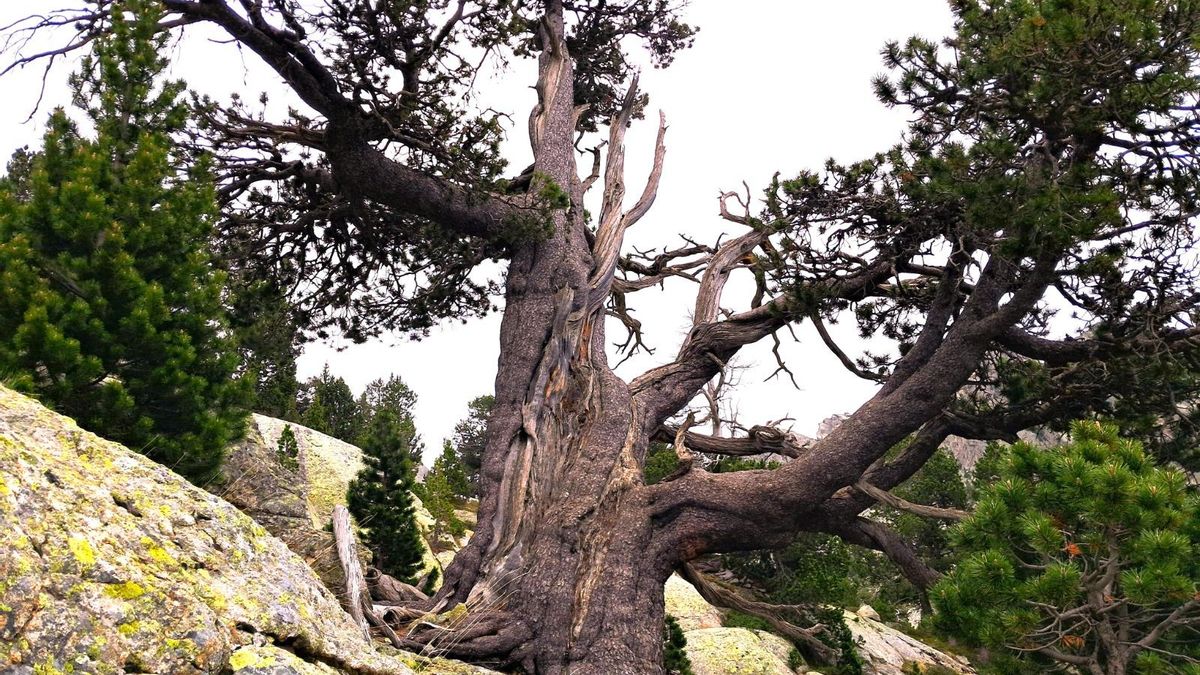
Scientists in Spain are studying one of Europe’s oldest trees to learn how to protect younger forests from climate change. Deep inside the Aigüestortes i Estany de Sant Maurici National Park in Catalonia grows a remarkable black pine. It is 1,000 years old, half-fossil and half-living—a biological anomaly found nowhere else in Europe.
The tree survived because the park has allowed its forests to grow old naturally. Lluís Florit, the park’s director, says researchers searching for the oldest forest patches discovered that this park holds Spain’s largest concentration of mature forests. These old forests contain complex structures, dead wood, and many different species. According to Florit, this gives them “high resilience”—the ability to absorb shocks, including droughts, extreme heat, and severe wildfires linked to climate change.
Jordi Vayreda, a researcher at CREAF, says the lessons from this park apply to other regions of Spain. Mature forests resist fire better because large trees rarely burn completely, and a mix of species slows a fire’s spread. “Fire won’t burn the whole mature forest,” Vayreda says. “Parts will burn, so it has a greater capacity to resist and recover.”
Diversity also creates microclimates that hold moisture and store large amounts of carbon, keeping it out of the atmosphere. This helps the ecosystem survive long periods of heat and drought.
Mature forest is the opposite of a plantation. Plantations are uniform and grown for commercial use. “Plantations are very clear candidates for being highly vulnerable to fire or windstorms,” Vayreda warns.
Now scientists are studying how to add “elements of maturity” to younger forests to make them more resistant. Florit describes this as “accelerating evolution”—promoting maturity faster than nature would. The work involves letting new species enter, selectively reducing competition around large trees, and encouraging plant regeneration. Vayreda calls these “microsurgical interventions”: cutting a small number of trees or letting them die standing to create dead wood, so rarer, more resistant species like rowans and ashes can thrive.
The research also highlights the value of legal protection. Florit says the national park status prevented the usual forest management interventions, allowing natural evolution. Vayreda adds that mature forests need strict protection: “If we have mature forests, we must move to strict protections because, otherwise, it is very difficult for these forests to be conserved”—and the benefits they provide to humans would disappear.
Florit notes that some forests—those from replanting or rural abandonment—have fewer mature characteristics and do need preventive management. But for mature forests, protection is key.