Thirty endangered birds fly 2,640 km behind a microlight to Spain
Part of composite article Thirty endangered ibises fly 2,640 km behind a plane to Spain View full article →
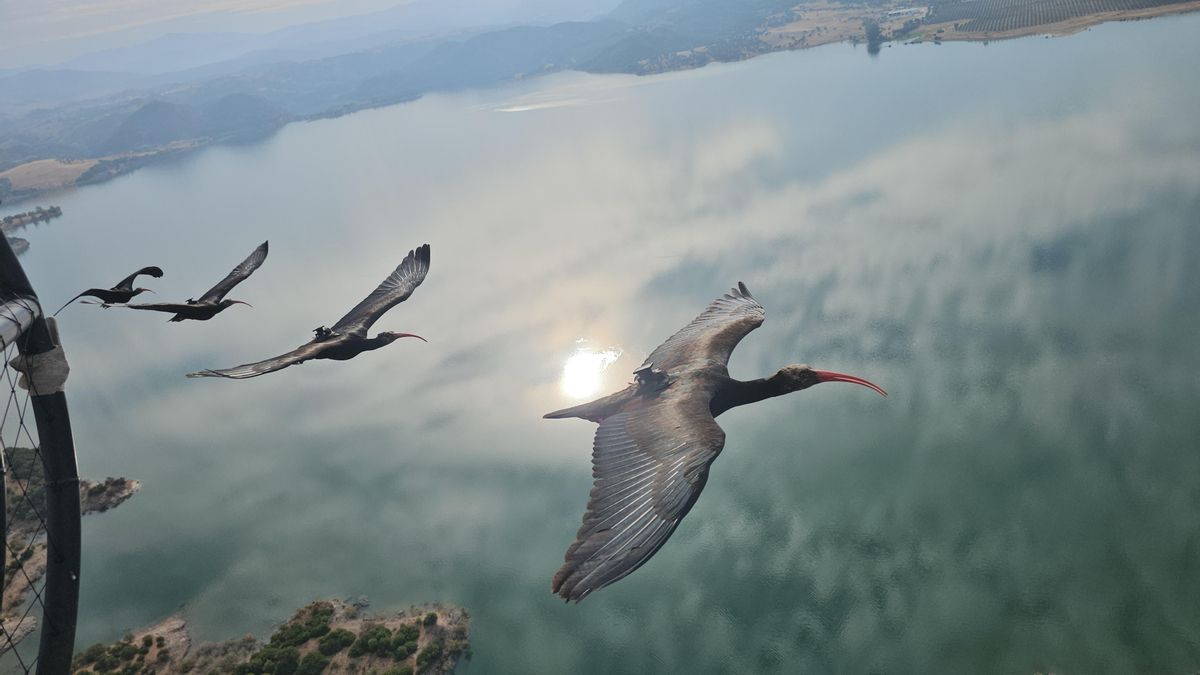
Thirty young northern bald ibises have completed a 2,640-kilometer migration from Germany to Spain, following a microlight aircraft piloted by conservationist Johannes Fritz.
The birds left Binningen airfield in Baden-Württemberg, Germany, on August 23. They crossed France and Catalonia before reaching Andalusia in southern Spain. The journey took 40 days and 19 stages.
The migration is run by Waldrappteam, an organization working to save the northern bald ibis, a species at risk of extinction. The birds are taught their migration route by following the aircraft.
Fifteen of the birds now stay in Catalonia, cared for by the Fundació Alive. The other fifteen continued south and arrived in Barbate, in the province of Cádiz, on September 27. All thirty are currently kept in an aviary with other young birds to help them adapt to the local environment. They will be released into the wild together.
The final part of the trip faced problems. Strong winds forced an early landing during the last stage to Cádiz, and the birds had to be moved by road to finish the route. Later, better weather allowed two more orientation flights from Medina Sidonia. These flights covered much of the birds' future wintering area, from Villamartín in the north to the Atlantic coast near Barbate, helping the birds learn the landscape where they will spend the winter.
**Hunted despite protection**
Hunters are one of the main threats to these endangered birds. In August 2019, a man shot and killed five young northern bald ibises born under a reintroduction program run by the Andalusian government and the Jerez Zoo. He was sentenced to one year in prison and fined 20,000 euros. In Fregenal de la Sierra, in the province of Badajoz, a hunter shot and killed a bird named "Hel," one of the ibises that had arrived in Spain a year earlier on a trip led by Fritz. No one has been found responsible.
In Italy, birds from the same program face a new threat. Authorities in Tuscany have allowed unlimited hunting of the sacred ibis (*Threskiornis aethiopicus*), a species that looks very similar to the northern bald ibis (*Geronticus eremita*). Experts say the two species are easily confused, which will lead to more protected birds being shot. The number of such deaths was already high.
**A better training method**
Waldrappteam says the trip's success confirms that a new training method works. The method was developed after problems in 2025, when young birds did not follow the microlight consistently. That year, the birds had to be moved by road, stage by stage, from southern Germany to Catalonia. The second part of the route, the leg to Andalusia, had to be cancelled.
The team redesigned its training program based on established learning theories and added new techniques. By early August, the young birds, all from the Rosegg Zoo in Carinthia, Austria, formed a highly motivated group that responded reliably during flights.
"After last year's experience, this migration was much more than a trip south," Fritz said. "It was a decisive test to see whether our completely renewed training program would work under the real conditions of a migration."
He said the fact that all 30 birds reached their destinations confirms the new method works and can be repeated. "This gives us a much stronger basis for future human-guided migrations," he said.
The 15 young ibises now in the acclimatization aviary in Cádiz will also be released into the wild in the coming months. When they reach sexual maturity at three years old, the birds that took part in the human-guided migration are expected to return on their own to their breeding areas in Baden-Württemberg, Germany.
Preparations have already begun for the next human-guided migration. In 2027, Waldrappteam plans to lead another group of young northern bald ibises from Germany to Cádiz.