China Rejects US Call to Slow AI: "A Trick to Keep Silicon Valley Ahead"
Part of composite article China and the US Are Racing to Rule AI — and Neither Side Is Slowing Down View full article →
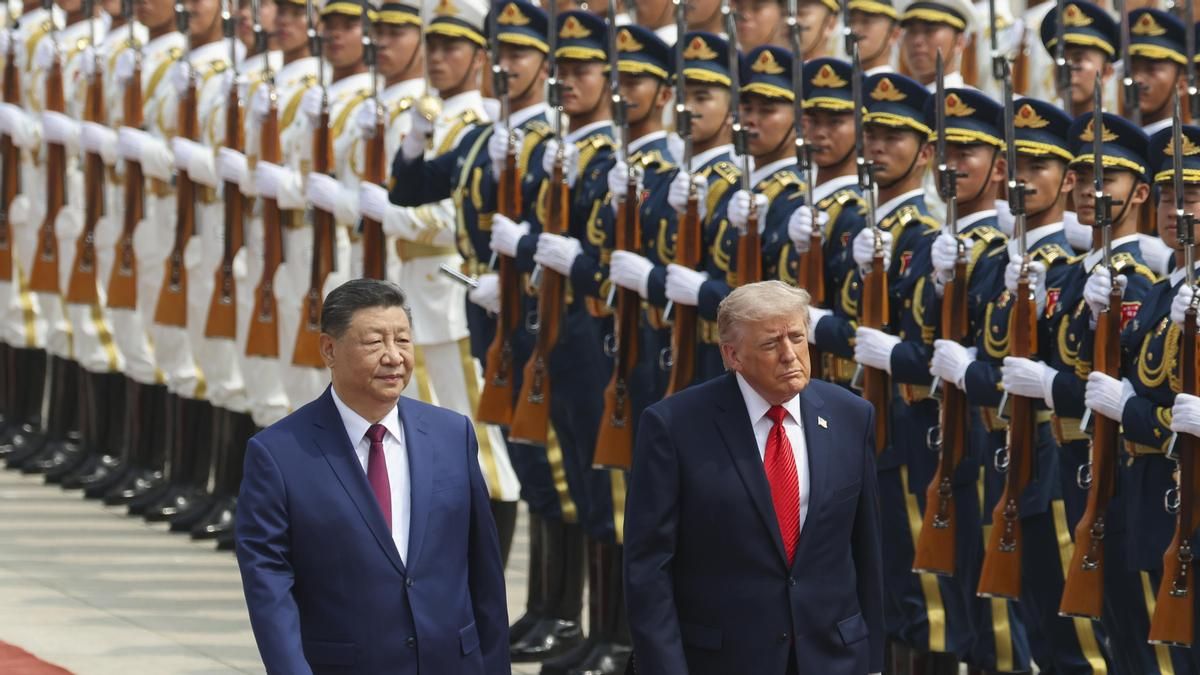
China is ignoring US warnings about the dangers of artificial intelligence. Beijing believes calls to slow down AI development are a plan to protect America's lead in the technology, not a real safety concern.
The debate began when Dario Amodei, CEO of the US company Anthropic, proposed a "global slowdown" of advanced AI. He said this would "require cooperation with China." Amodei also argued that democracies must keep their AI advantage over autocracies as large as possible.
China's Foreign Ministry rejected this view. It said that "fear-mongering, confrontation and fierce competition will only disrupt the global governance of AI."
Analyst Lian Jye Su of the research group Omdia explains China's position. For Beijing, AI is a "core sovereignty capability." China does not want to slow its progress in closing the gap with top US models. "It sees these calls as an attempt to lock in the US advantage," Su says.
**A brake or a geopolitical move**
The US already limits exports of advanced chips and machinery to China. For Beijing, these controls are already a forced, one-sided "speed limit." Analysts say it would be a mistake to think China rejects all safety concerns, however.
This week, China published the third version of its AI safety governance framework. Gabriel Wagner, a researcher at the Beijing-based AI safety consultancy Concordia, describes the document as a "map of the AI risk landscape and what should be done about it." The update covers risks from AI agents, cybersecurity threats from frontier models, and "recursive self-improvement" — a still-hypothetical situation where AI becomes advanced enough to improve itself.
"In many ways, there is more common ground than people might assume between what Amodei says and what the Chinese government says," Wagner notes. This contrasts with US President Donald Trump, who called fears that AI could destroy humanity a "sick conspiracy."
Trump is expected to meet Chinese President Xi Jinping in Washington this week. AI is expected to be on the agenda, though analysts doubt any major breakthrough.
**China's protections**
The Chinese Communist Party is careful about risks to its political control. It has acted early to make sure the new technology develops within state-set limits. According to Su of Omdia, centralized authority over critical infrastructure and business activity means China is generally better placed than the US "to handle any AI-related disaster."
However, Chinese companies do less voluntary monitoring and evaluation than US companies, according to Leia Wang of the Carnegie Endowment for International Peace. She says neither government seems ready for a loss-of-control incident of the kind described in recent weeks. Still, Chinese regulation is "iterative — they adapt quickly and publish new measures," she adds.
China has had an algorithm registry since 2022. But this year's warnings about AI agents suggest a shift, "from controlling what AI says to controlling what it does," according to Concordia AI. This year, Beijing also issued national rules to curb emotional dependence on companion AI.
At the same time, China is actively promoting AI across its economy to drive growth, a goal written into its latest Five-Year Plan. Local governments are offering funding and low rents to help companies. Entrepreneur Boris But was recently invited to present his company, Hampshire Education, to a small city three hours from Shanghai that wants to build a reputation as a tech hub.
Factories across China's huge manufacturing sector are also being encouraged to adopt AI. "Safety and controllability are certainly important topics, and they are actively discussed," says a representative of Black Lake Technologies, an industrial agent platform that says it has worked with 40,000 factories worldwide. "But in manufacturing, these concerns tend to be much more concrete and operational… what companies care about most is whether the AI is reliable."
**AI as a daily tool**
Daily life in China is already highly digitalized. Traditionally less debate about data privacy is helping AI spread. For example, the digital health service A-fu, which offers AI chatbot versions of prominent doctors trained on real clinical studies, recently reached 150 million users.
"Most people see AI as an already useful everyday tool, not an abstract threat, so the practical attitude is to learn to live with it," said Ni Tao, founding editor of the tech website yangtzeer.com. "There is real concern about jobs and disinformation, but this coexists with a firm belief that China must master AI rather than slow its development."