Canada to Trump: "If you attack, you are at war"
Part of composite article Trump to EU: Drop Canada Deal or Face Massive Tariffs View full article →
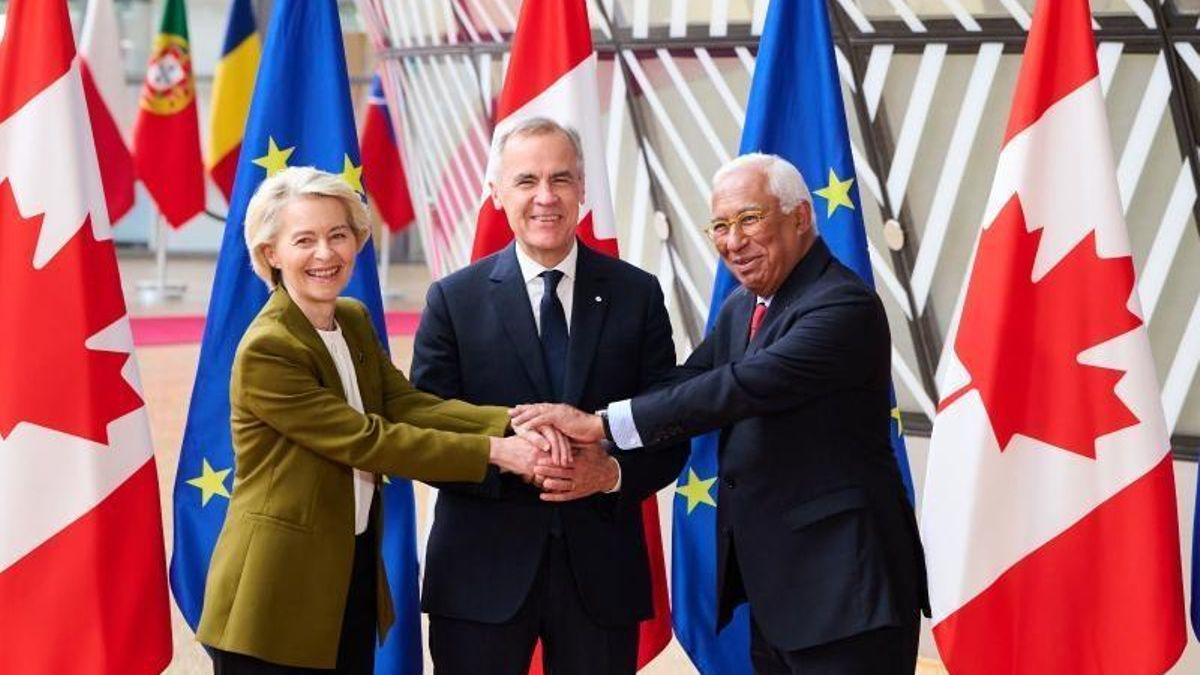
Canadian Prime Minister Mark Carney will speak at the European Parliament in Strasbourg this week. His visit sends a strong message to U.S. President Donald Trump, who has pressured Canada with tariffs and threats.
Carney wants to build a closer economic alliance with the European Union. Canada has asked the EU to explore a "special status" that would create a privileged partnership between the two sides. Other countries, including Australia, have said they might follow the same path as relations with the U.S. worsen.
The EU faces a problem: not all member states have ratified the trade agreement signed with Canada nine years ago. Carney told the Financial Times that ten EU countries still need to approve it. Spain has already ratified the deal.
EU-Canada trade in goods reached 82 billion euros in 2025. The EU is Canada's second-largest trading partner, and Canada ranks twelfth for the EU.
Last week, EU diplomats from all 27 member states agreed unanimously to strengthen trade and other ties with Canada, despite its conflict with Trump.
Carney has stood up to Trump, who once called Canada "the 51st state" of the U.S. Carney said: "We were not willing to compromise Canada's sovereignty." He promised to match new U.S. tariffs "dollar for dollar."
Philipp Lausberg, an analyst at the European Policy Centre, said: "Canada is offering Europe a lesson on how to deal with Trump: economic dependence does not have to mean political submission." He noted that about 70% of Canada's exports go to the U.S., but Carney believes giving in repeatedly would only make Canada more vulnerable.
Canada is now seeking new trade partners and investments, including from China. This has drawn criticism from Washington.
The EU and Canada are negotiating expanded agreements in trade, defense, critical minerals, energy, financial systems, and visa liberalization. They will meet in Montreal in late October to speed up talks.
In defense, both sides are discussing security coordination in the Arctic and partnerships between military industries. Anand Sundar, a researcher at the European Council on Foreign Relations, said European defense projects should open to countries outside the EU. He noted that Canada's military has strong experience in Arctic warfare, which is increasingly important to Europe.
Carney has also said Canada will stop sending 70 cents of every defense dollar to the U.S., creating opportunities for Europe's defense industry.
Carney also wants to create a global body to oversee artificial intelligence (AI) and ensure its safe development. Henna Virkkunen, the European Commission's executive vice president for technological sovereignty, told elDiario.es that slowing down AI development is unrealistic. She said the focus should be on international safety rules, especially for cybersecurity.
European Parliament President Roberta Metsola announced that the Parliament will open an office in Ottawa to strengthen ties with Canada.