Far-right at the gates: Sweden votes in high-stakes election
Part of composite article Sweden Election: Center-Left Takes 3-Seat Lead, Ending 4 Years of Right-Wing Rule View full article →
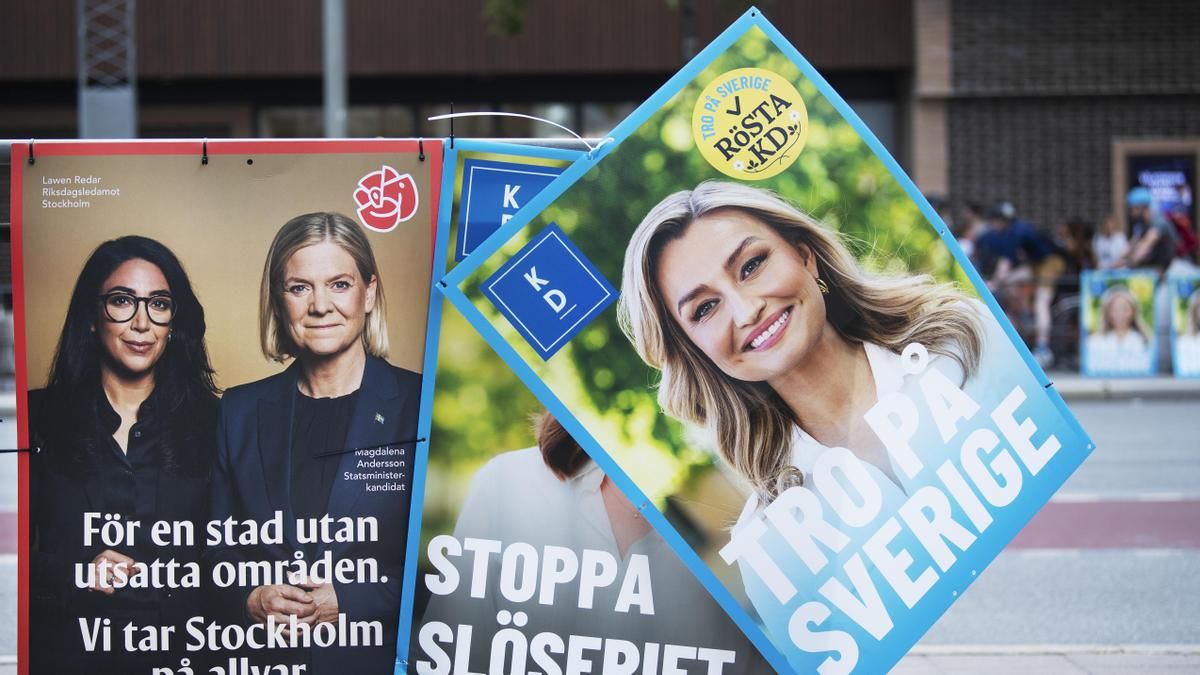
Sweden votes this Sunday in a close election that has become a referendum on whether the far-right Sweden Democrats (SD) will enter government. Their possible inclusion would complete the transformation of a party once treated as a political outcast into a trusted governing partner.
According to polls released on Friday, SD would win about 18% of the vote. The center-right bloc led by Prime Minister Ulf Kristersson has promised to bring the far-right party into government to renew its mandate. But Kristersson faces an uphill battle: polls give the Social Democrats 28.6% and suggest a possible left-green coalition. The center-right's gap with the left has narrowed with each new poll.
Kristersson, 62, became prime minister in 2022 as leader of the Moderate Party, heading a coalition with the Christian Democrats and the Liberals. His government survived thanks to parliamentary support from the Sweden Democrats. Though outside the government, SD has wielded significant influence over its policies.
Over the past four years, the government has abolished permanent residency for asylum seekers, tightened rules for immigrant welfare benefits, and increased deportations of people with no right to stay in the country. Kristersson argues Sweden needs a stable majority government to tackle national security and organized crime — and says that requires bringing SD into the executive, which would mark the far right's first entry into a Swedish government.
The far-right party has spent two decades under Jimmie Åkesson, who has turned a group born on the fringes of the extreme right — with neo-Nazi links in its early years — into the leading force on Sweden's right. In late June 2025, the party published a report detailing its past ties to fascist and Nazi organizations and the xenophobic and antisemitic views of some members. Åkesson apologized on the party's behalf, but continues to fuel hostility toward the Muslim population in his speeches.
**Migration debate loses ground**
In this campaign, law and order — for years among Swedes' top concerns — has lost prominence to health care, education, and the economy, issues where analysts say the Social Democrats have the advantage. At the same time, shootings and gang violence, two of the far right's main vote-winning arguments, have fallen sharply in recent years.
According to police data, shootings dropped by nearly half in 2026, and for the first time in many months, no gun deaths were recorded in Sweden in May. The decline paradoxically highlights how severe gang violence had become.
Kristersson credits his government's actions for the drop — though the gang problem persists. His administration has toughened penalties for violent crimes and given police more powers against organized crime. The Moderates also campaign on economic growth measures such as lower energy and food prices, alongside record-low asylum arrivals.
Jonas Hinnfors, a political scientist at the University of Gothenburg, says the migration debate has lost weight this campaign, though it still mobilizes SD's base. With asylum applications falling, he says, the focus has shifted. "Parties no longer argue about how to stop arrivals, but about integration and what to do with those already in Sweden," he told elDiario.es.
**A divided left bloc**
Some ideas that took hold during four years of government backed by the far right — ending the Nordic country's culture of welcoming migrants — have seeped into the center-left opposition. Social Democratic candidate Magdalena Andersson has pledged to maintain increasingly restrictive immigration policies if she takes power. "But despite this consensus on immigration, many Swedes still feel deep unease about the far right entering government," Hinnfors stresses.
Asked about her stance, Andersson said Sweden's previous migration policy was unsustainable. She has also said her party would be open to supporting "return centers" for rejected immigrants in non-EU countries.
Andersson, 59, already served as prime minister from 2021 to 2022, becoming the first woman to hold the post in Swedish history. During her term, she led the country through the COVID crisis and took the first steps toward Sweden's later NATO membership. A former financial manager, she earned a reputation as an impatient, direct politician frugal in budget talks with the EU. Her campaign is built on a fierce defense of the welfare state against the liberal-conservative shift of recent years.
For months, polls treated an Andersson victory and a left-green majority as nearly certain, with the left leading the center-right by as much as 12 points in some spring surveys. But in recent months the left has lost ground, and Sunday's vote will show how that translates at the ballot box.
In a campaign message on Facebook, Andersson warned the election is not just a choice between her and Kristersson. Also at stake, she says, is the far right's influence over defense, education, culture, and finance. "That would produce a very different Sweden," she said.
An Andersson victory would not guarantee a stable government. The four parties in the progressive bloc — the Social Democrats, the Greens, the Left Party, and the Center Party — broadly agree on strengthening the welfare state and raising public spending, but disagree on key issues such as a wealth tax and building new nuclear reactors. The Center Party has ruled out joining a government with the Left Party, a stance that could complicate coalition talks.