German Far-Right Surges in State Vote, Falls Short of Majority
Part of composite article AfD Wins Big in German State Vote—But Still 3 Seats Short of Power View full article →
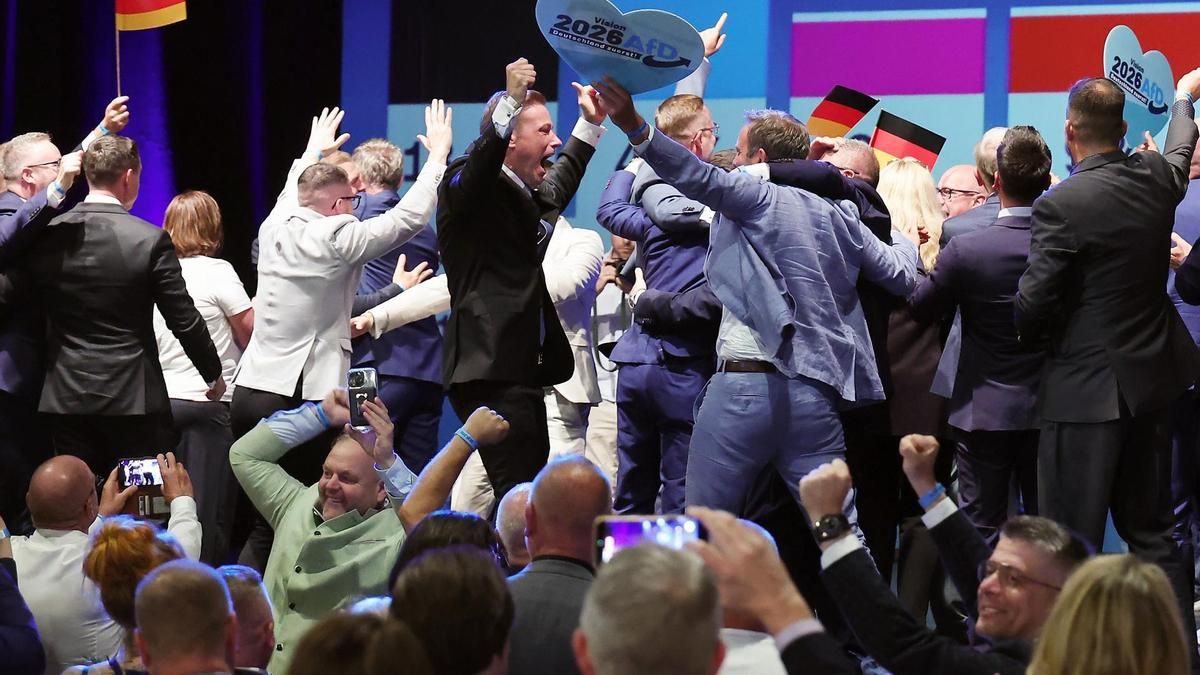
Saxony-Anhalt, Germany – The far-right party Alternative for Germany (AfD) won a sweeping victory in the state’s regional elections on Sunday, capturing 43.8% of the vote. The result more than doubles the party's share from the 2021 elections and marks a historic high for the AfD in the eastern German state.
Despite the strong win, the AfD failed to secure an absolute majority. The party won 39 parliamentary seats, three short of the 42 needed to govern alone.
The center-right Christian Democratic Union (CDU), which currently leads the state government, suffered a major defeat. Its support fell to 17.2%, a loss of more than half its previous voters. The CDU remains the second-largest party.
The Social Democrats (SPD) came in third with 9.3% of the vote, followed by the Greens with 8.9%. The Left Party (Die Linke) fell to 8.6%. The newly formed BSW party, led by Sahra Wagenknecht, won 5.3% of the vote, just enough to enter the state parliament. The liberal FDP party lost all its seats.
Voter turnout was exceptionally high at 77.8%. This is the highest participation in a state election since Germany's reunification, surpassing the previous record of 71.5% set in 1998.
AfD candidate Ulrich Siegmund called the result a “clear” mandate to govern and said his party had made “history.” He stated he is seeking support from other parties but has so far been unsuccessful. He also vowed there would be “no concessions to our values” in exchange for power.
CDU leader Sven Schulze, who is the state's minister-president, conceded defeat and congratulated the AfD on its victory. He attributed his party's loss to the policies of the federal government led by Friedrich Merz.
The BSW party now holds a key position in the state parliament. No other party has a majority. BSW co-leader Amira-Mohamed Ali said her party supports a government of non-partisan experts that would work with shifting majorities. She also left open the possibility of supporting an AfD minority government on a case-by-case basis.
Another possible outcome is that Siegmund could become minister-president in a third round of voting in parliament. In such a vote, only a simple majority is required, which could be achieved if other parties fail to form a coalition.
The election results in the state capital, Magdeburg, mirrored the statewide trend. The AfD received 32.6% of the vote there, while the CDU fell to 15.4%.