US Claims It Beat Iran’s Strait Blockade. Experts Say It’s a Trap.
Part of composite article Iran Vows to Close Strait of Hormuz for Good Unless US Ends War — Threatens to Attack Oil Routes of US Allies View full article →
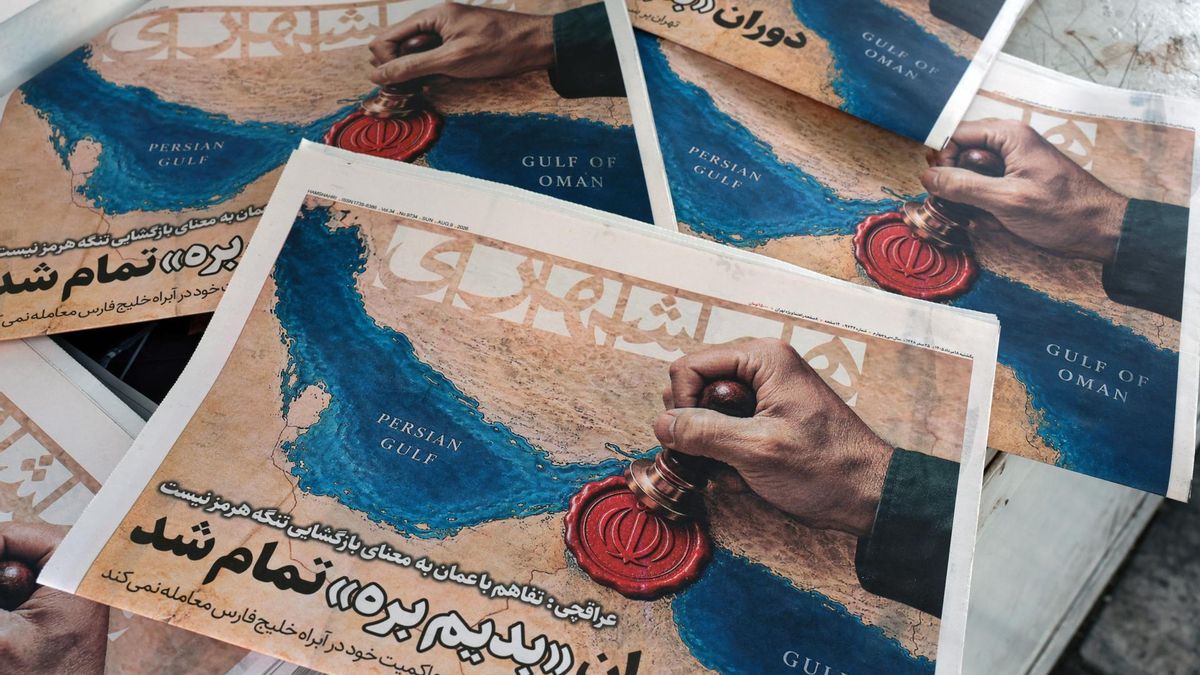
Washington says it has broken Tehran’s chokehold on the Strait of Hormuz, the vital waterway for 20% of the world’s oil. Iran says the US is lying. With no peace deal in sight, analysts warn that America’s economic "victory" is a temporary patch that could trigger a new wave of open war.
The deadline for a US-Iran memorandum of understanding has passed with no results. The conflict has moved from direct bombing to a fierce propaganda battle. Both sides claim they control the Strait of Hormuz, a passage that narrows to just 40 kilometers at its most confined point.
The US argues it has redirected shipping toward Oman, using massive tankers capable of carrying two million barrels of oil—far more than the standard 350,000 to one million barrels—to bypass Iranian attacks. According to Trita Parsi of the Quincy Institute, this keeps global crude flowing enough to avoid an economic shutdown.
However, Parsi admits that measuring the actual volume is difficult. Many ships turn off their transponders to avoid detection by Iran, making precise tracking impossible. US sources cited by Axios claim between 15 and 20 vessels pass through the area daily.
**A Patch, Not a Solution**
Dennis Citrinowicz of Israel’s Institute for National Security Studies calls this a "significant achievement" if the numbers are accurate, but warns it is not permanent. He fears Iran will respond militarily if it concludes the US is blocking Iranian tankers while allowing others to pass. Without a return to negotiations, he says, escalation becomes harder to prevent.
The US strategy also relies on global alternatives to Iranian oil. Brazil has increased production, and China—Iran’s main buyer—has reduced purchases to avoid a spike in oil prices that could trigger a global recession.
**The Real Cost**
This economic pressure reveals a deeper weakness. Reuters reported earlier this month that US forces have nearly exhausted their long-range precision missiles, which cost about one million dollars each. The military has also used 65% of its Patriot interceptors, 40% of its THAAD anti-aircraft batteries, and roughly half of its Tomahawk cruise missiles.
This explains the shift in Donald Trump’s rhetoric. The president no longer threatens to send Iran "back to the Stone Age." Instead, he boasts on social media of "the most devastating economic operation ever waged against any country," posting maps of the Strait painted in US flag colors. He has also threatened to bomb Oman if it negotiates alternative transit routes with Iran.
**Can Iran Be Broken?**
Experts doubt it. Ali Vaez of the International Crisis Group tells Politico that Iran’s regime fights for survival and has never hesitated to transfer economic suffering to its population. "The question is whether there is a breaking point," he says. "I would say there isn’t."
Brett Erickson of Obsidian Risk Advisors notes that Iran has already exceeded its projected oil sales for the year. The Iranian rial has not collapsed against the dollar, keeping inflation from spiraling out of control.
Iran’s parliament speaker, Mohamad Ghalibaf, mocked US Treasury Secretary Scott Bessent and Defense Secretary Pete Hegseth on X, calling them "completely overwhelmed" and part of a "gang of clowns." He posted an image of himself blocking the Strait of Hormuz with his own head.
**A Losing Game?**
Tehran believes US calculations are wishful thinking. It expects diplomats back at the negotiating table within two to three weeks. Parsi points out that while oil flows more freely, Qatari liquefied natural gas and fertilizers remain trapped in the Arabian Peninsula—essential goods for the global economy.
Robert Pape of the University of Chicago focuses on US strategic petroleum reserves. These have fallen below 300 million barrels in August, a level not seen since the early 1980s, when the reserves were created precisely to counter supply shocks. "This is much more important than whether hawks or doves are in charge," Pape said recently.
He believes the reserve depletion will prevent the US from maintaining its standoff. Iran, he argues, will push hard to influence the November midterm elections, where Republicans risk losing control of Congress. Sina Toossi of the Center for International Policy agrees: "Tehran may escalate more firmly to maximize the cost for Trump."
**Ready for Offensive**
If the US pressure does begin to hurt, analysts see a more aggressive Iranian response as likely. The regime has promoted hardliners to key positions. Mohsen Rezaei, a former Revolutionary Guard leader from the 1980s Iran-Iraq war, now heads the Supreme National Security Council. He opposed negotiating the memorandum.
Ahmad Vahidi has been confirmed as the permanent head of the Revolutionary Guard, with the official justification being preparation for "powerful offensive operations against the enemy." Hamidreza Azizi of the Clingendael Institute tells CNN that Vahidi’s mandate is clear: "Reviewing Iran’s military strategy in a more assertive and offensive direction."
Azizi warns that the current state of "neither war nor peace" could push Tehran to escalate, betting that the cost of another war is lower than the gradual erosion of its capabilities under sanctions and blockade.
Vali Nasr of Johns Hopkins University summarizes the Iranian calculus for the New York Times: "Iran can choose between total surrender and continuing to fight. They are betting that the only way to get a better deal is to push Trump and the global economy to the limit."