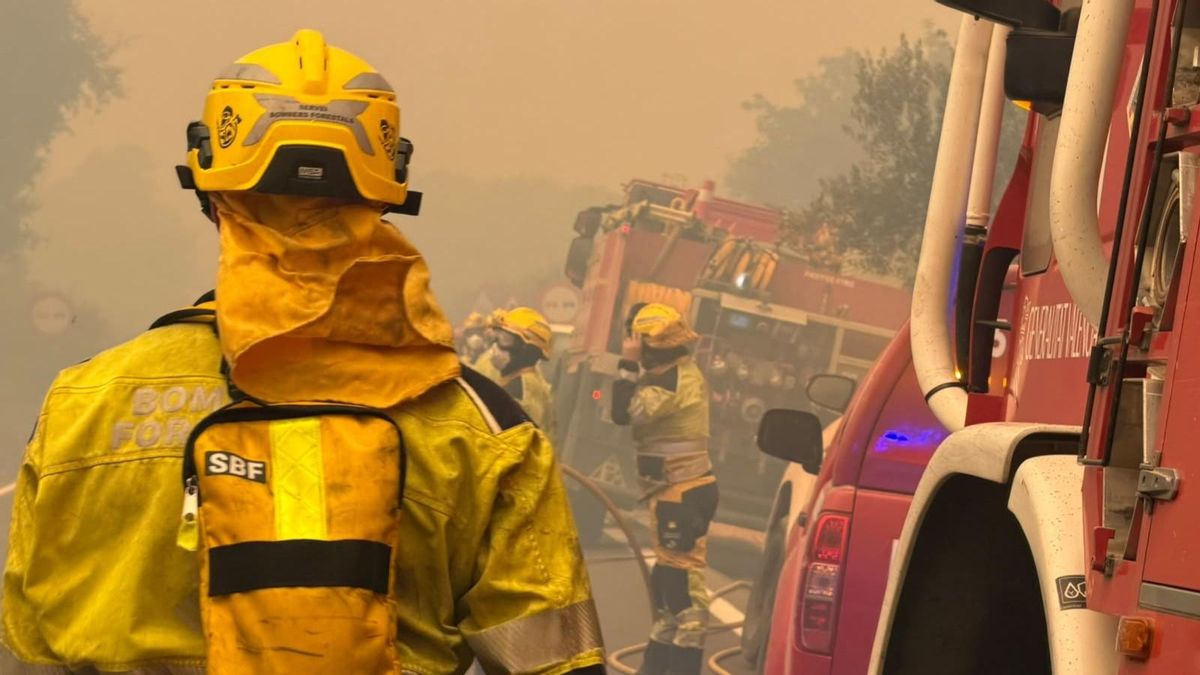
Valencia's Firefighters Short-Staffed as Wildfire Risk Peaks
The Valencian regional government is relying on volunteer firefighters and overtime shifts to cover critical staffing shortages in its wildfire prevention and response units, a situation that has sparked political conflict during one of the highest-risk periods of the summer.
The debate centers on the Sociedad Valenciana de Gestión de la Seguridad y las Emergencias (SGISE), the public agency responsible for firefighting. The region currently has 4,400 personnel dedicated to fire prevention and extinction, a number the regional president calls the "largest operation in history." Of that total, SGISE employs 1,133 forest firefighters out of a global workforce of 1,259.
However, opposition lawmakers argue the system is under severe strain. Socialist deputy Alicia Andújar claims the agency needs roughly 300 more firefighters. She points to a recurring problem: regulations require 12 hours of rest after a shift, meaning units mobilized one day cannot return to work the next, reducing operational capacity.
The staffing gaps are most visible in the province of Castellón, the area hardest hit by fires this summer. According to Andújar, of the 18 deployed units designed to have five members each, only two are fully staffed. Seven have four members, seven have three, and two have just two firefighters. In total, the province is missing 27 personnel for a single shift out of three.
Airborne units face even larger deficits. One of the two helicopter bases, located in Tírig, operates with only three of its nine potential firefighters. Andújar states that on August 8, eight of the 18 units in Tírig were inoperable, forcing the redeployment of resources from Alicante.
The Socialist Party also accuses the regional government of overworking staff. Andújar alleges that in recent fires, such as those in Tales and Vall d'Uixó, the lack of available regional personnel led authorities to request military intervention from the Unidad Militar de Emergencias (UME) shortly after fires began. She claims UME troops covered 75% of mobilized personnel in those incidents.
The regional Emergency Department rejects these accusations. Officials argue that using overtime and off-duty volunteers is not a sign of structural deficit but a "flexibility tool" agreed upon with union representatives.
"Voluntary reinforcement is being used because the risk is extraordinary and requires extraordinary measures," said a department spokesperson. "A service without capacity would struggle to cover ordinary operations; this service covers daily needs and increases staff when circumstances require."
The Generalitat defends its record, noting the addition of more than 250 professionals to the overall emergency system during its term, the consolidation of 56 permanent operational units year-round, and increased budget and material resources.
Officials accuse the Socialist Party of "fabricating headlines and generating unfounded alarm."
Adding to the tension, unions STAS-Intersindical, UGT, and CCOO have called a strike for August 30 and 31 among fire prevention workers at the public company Vaersa. The unions demand a change in the prevention model, including 12-month contracts for mobile units, a minimum of nine months for forest observation posts, seven-hour continuous shifts, and financial recognition for the hazardous nature of their work.