Title: China Makes 90% of the World’s Humanoid Robots. The US Is Panicking.
Part of composite article Chinese Robots Smash Bolt’s 100m Record—Then Slam Into a Wall View full article →
**Article:**
China now produces roughly 90% of the world’s humanoid robots. This dominance is shaking Silicon Valley and the White House, forcing a global rethink of what these machines can do.
The race for artificial intelligence is really a series of smaller races. One involves generative models that create text and images. Another focuses on advanced computer chips. But the race that has just shifted from science fiction to reality is the one for humanoid robots.
China holds the lead in this specific field. While the US excels in chips and software, China is the world’s top power in industrial robotics. Its massive factories, huge internal market, and government subsidies have created a perfect environment for building androids.
This week, Chinese robotics firm Unitree debuted on the Shanghai stock exchange. Its share price jumped 460% on the first day, showing intense investor interest. Beijing also sees these robots as a solution to its aging population and a future replacement for factory workers.
**The Hardware Advantage**
China’s strength lies in hardware. The country can reuse batteries and parts from its electric vehicle and smartphone industries. This has allowed companies to move into humanoid robotics quickly.
A report from the Mercator Institute for China Studies (MERICS) states that 63% of the key companies in this sector are Chinese. In 2025, Chinese firms produced 12,870 humanoid robots. That is about 90% of global production.
This progress has alarmed Washington. In late July, the Trump administration banned the import of Chinese androids. The Federal Communications Commission claimed the devices could create supply chain weaknesses and cybersecurity risks for critical US infrastructure.
**The “Small Brain” vs. The “Big Brain”**
Experts explain the recent leap in capability using two terms. The “small brain” controls a robot’s movement, balance, and walking. The “big brain” handles high-level thinking, understanding complex environments, and making independent decisions.
For years, the industry focused on the small brain. The goal was simple: make robots walk, run, and jump without falling. That problem is now largely solved.
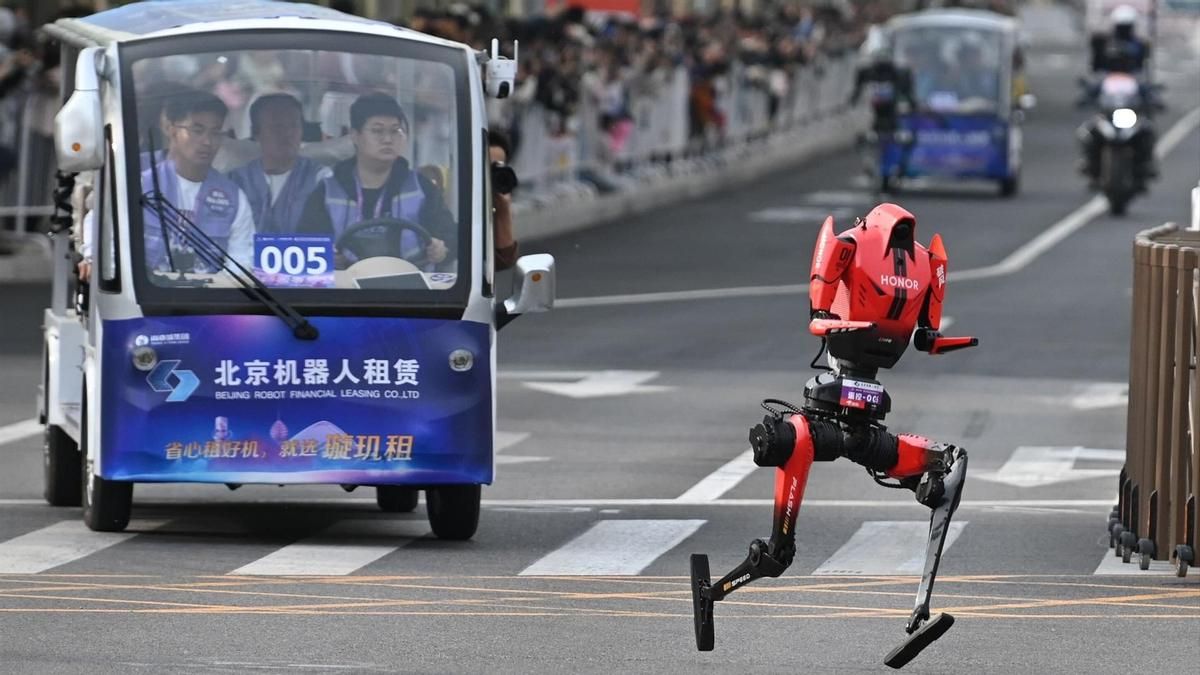
A clear example came at the Beijing robot half-marathon this year. The winning robot finished 21 kilometers in 50 minutes and 26 seconds, beating the human winner’s time. More importantly, the robot was built by Honor, a smartphone company spun off from Huawei. Honor’s robotics team was only one year old.
The cost of building the physical body of a robot has dropped to about 100,000 yuan (roughly $13,800). Analyst Poe Zhao, founder of Hello China Tech, says this proves that building excellent legs is now a simple engineering challenge. It requires capital, talent, and access to supply chains.
**The Next Challenge**
The real challenge now is the “big brain.” Robots need to work in spaces with people and perform tasks that were not planned in advance. Zhao Mingguo, a researcher at Tsinghua University, says the key question is moving from “run forward” to “complete an unspecified task in an unmapped space.”
Training the big brain requires massive amounts of data. ChatGPT and Claude learned from the entire internet. Robots, however, need data from the physical world. This data is expensive and difficult to collect.
Each hour of physical data capture costs about 200 yuan ($27). A leading AI robotics firm reportedly spends tens of millions of yuan annually just to train on a few hundred thousand hours. Scaling this up would break any budget.
Data collection is also fragmented. Every company uses its own formats and methods, creating alignment problems. This is why the US ban matters. It does not just block Chinese robots from the US market. It also stops them from collecting data about America’s physical environment.
**Reality Check**
Despite the hype, humanoid robots remain a niche technology. The 12,870 units built in 2025 are tiny compared to the over 550,000 industrial robots installed in China the same year. Zhou Jian, founder of UBTech, admits that androids are only “half as efficient as humans” at manual factory work.
There is also a hidden weakness. Chinese robot makers, including UBTech, Unitree, and AgiBot, depend heavily on Nvidia for their computing power. While simple chips can handle movement, deep cognition still relies on US components.
Finally, experts warn that corporate videos are misleading. Many show robots dancing or kickboxing. In reality, these machines are often preprogrammed or teleoperated. They are far from being intelligent, general-purpose robots that can decide their own actions in the real world.