Thousands still sleeping on Ceuta's streets two weeks after mass border crossing
Part of composite article 111 Arrested in New Ceuta Border Rush After Social Media Call View full article →
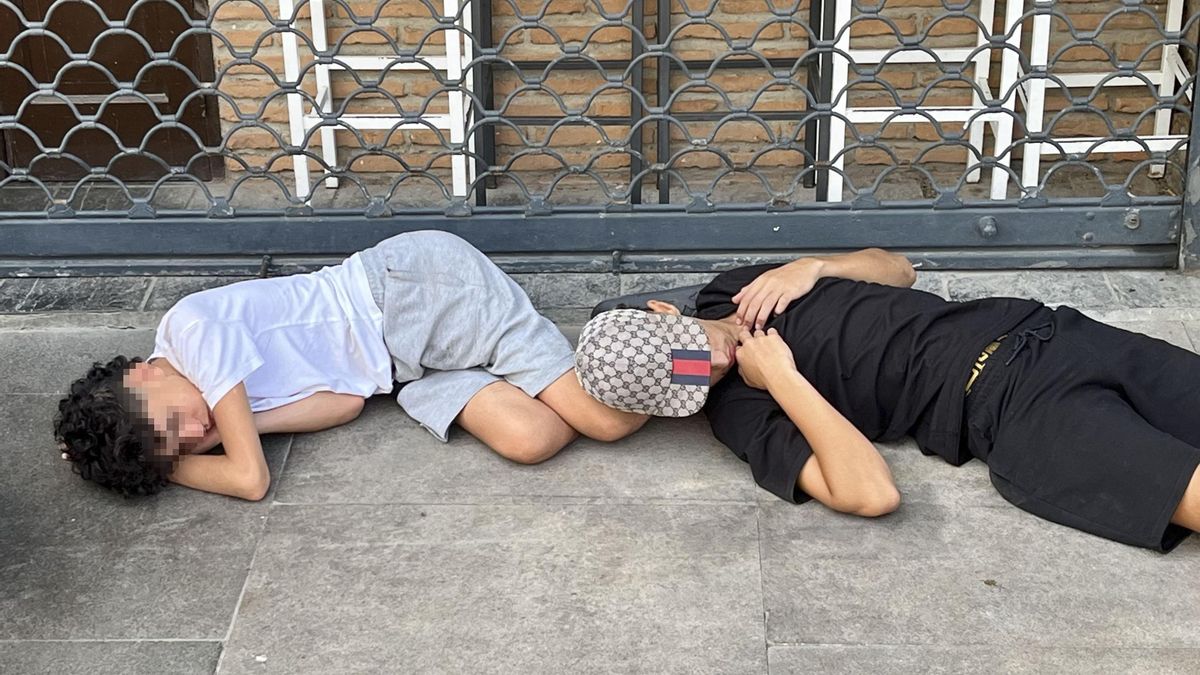
Two weeks after more than 80,000 people entered the Spanish enclave of Ceuta from Morocco, hundreds remain sleeping rough, with many still unidentified and without access to basic services.
Young Moroccan men gather near the Mercadona supermarket in the Juan XXIII neighborhood, waiting for food. Some sit desperately outside abandoned buildings hoping for money. Ahmed, from Chefchaouen, carries large cardboard milk boxes to sleep on at a makeshift camp in the Sarchal area, far from the main crossing point.
Funerals for unidentified bodies of those who died during the crossing were suspended on Thursday, as were plans to transfer four identified bodies to Morocco. A local funeral home source said Morocco has delayed the transfers for two days without explanation, despite all paperwork being complete.
Residents shouted insults at Interior Minister Fernando Grande-Marlaska as he arrived at the Assembly Palace. Defense Minister Margarita Robles received the same reception the previous day.
Rayan, an 18-year-old from Casablanca who arrived on July 30, sleeps in the open at the Tarajal industrial estate. He says security forces "cornered" him there. "I think they will send me back to Morocco," he said.
The government delegation confirmed that one industrial building will become a Temporary Attention Center for Emigrants (CATE). All remaining migrants, including around 4,000 sub-Saharan migrants camped at Trampolín Beach, will be processed there. Individual cases will lead either to deportation or asylum recognition.
Migrants can only stay at the CATE for 72 hours. Those with deportation orders would then go to an Internment Center (CIE) for up to 60 days pending repatriation. Government sources say no CIE is currently planned for Ceuta.
The local government is preparing facilities for unaccompanied migrant minors, whose care falls under municipal responsibility. Officials say they currently oversee about 1,400 children and teenagers, plus around 300 more in schools run by the Ministry of Childhood. Interior Minister Marlaska raised the number of minors in care to 1,898 on Thursday.
Ceuta's ordinary care capacity is just 29 places. The system previously held over 700 children before the July 30 influx. Despite adding 600 new places, many young people still sleep on streets and in camps in Sidi Embarek and Príncipe Alfonso neighborhoods.
Save The Children estimates around 4,000 unaccompanied minors in the city remain unidentified. Police and military mobilized hundreds of children to police stations for identification this week.
Volunteer camps in Príncipe Alfonso and Sidi Embarek provide safe spaces for women and girls, supported by the NGO Luna Blanca and the Social Services department. But community leaders have reached their limit.
On Thursday, Abdellah Mustafa, president of the Sidi Embarek Neighborhood Association, expressed frustration at the slow government response. He threatened to bring migrants to the city center so authorities "would have to deal with them." He also warned of infection risks from poor hygiene, noting a confirmed tuberculosis case this week.
Government sources said the Ministry of Childhood considered moving women with young children to an old flour factory in the Otero neighborhood, offered by the Defense Ministry, which owns nearly two-thirds of Ceuta's land. A neighborhood protest stopped the plan. New locations are being studied.
False rumors have spread through messaging apps, including claims that the government would lock down the city and send military and police to expel migrants to Morocco. The government delegation denied this, but some migrants believed the rumor and voluntarily returned to Morocco.
Sub-Saharan migrants remain cordoned off at Trampolín Beach, passing time with football and improvised haircuts. The main problem is hunger. Local association Elin criticized food distribution, saying people wait four to five hours in the sun for a bag from Red Cross containing juice, water, fruit, bread, cheese, and pastries—rations meant to last all day.
The nearby Migrant Temporary Stay Center (CETI) is saturated with over 700 people. More than 100 others sleep in the surrounding hills waiting to enter. The government wants to speed transfers to mainland Spain, but rules require migrants to stay at least one month and one day first.
The government has increased ministerial visits to Ceuta this week, with foreign affairs, childhood, defense, and interior ministers meeting local president Juan Jesús Vivas and promising to restore normality.
The government initially claimed the crisis was resolved after most migrants were returned to Morocco. It has since revised its position and updated official figures. The central government now acknowledges 80,000 people entered irregularly, with between 5,000 and 8,000 remaining in Ceuta—up from earlier estimates of 72,000 entrants and 2,000 remaining.
Health authorities admit "significant pressure" on public health services but deny the city is overwhelmed. The university hospital has 175 beds with around 63% occupancy. Medical consultations peaked at 1,149 on July 30-31 and have fallen to 300-400 daily.
The main health concern now is lack of sanitation in migrant areas. Authorities urge focusing efforts on "preventing the development of other health problems" while the situation is resolved.