Title: Italy and Denmark’s unlikely migration alliance: A hard-line push that’s reshaping EU asylum policy
Part of composite article Swedish PM’s Ceuta Rhetoric Plays Straight into Kremlin’s Hands View full article →
**Article:**
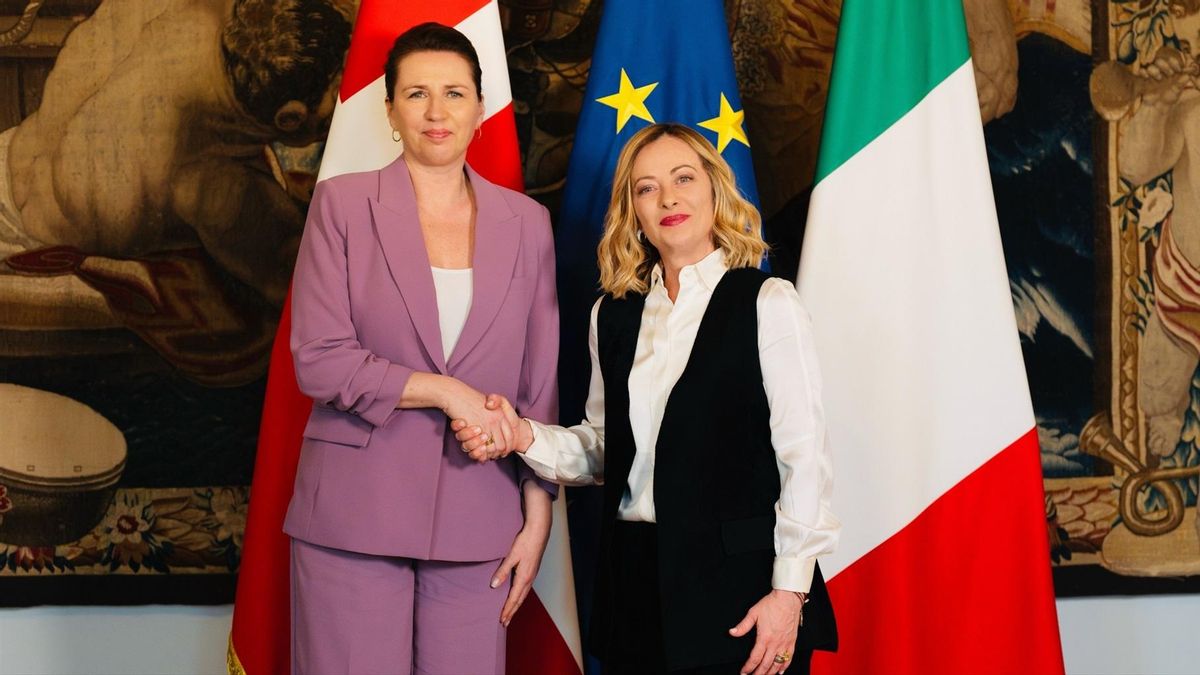
The events in Ceuta in late July have cemented an unlikely alliance within the European Union between Denmark’s Social Democratic Prime Minister, Mette Frederiksen, and Italy’s far-right leader, Giorgia Meloni.
Despite belonging to opposing political camps, the two leaders share a single goal: reducing irregular migration to zero through strict policies.
On Monday, Rome and Copenhagen issued a joint statement. In it, both leaders warned of the effects of “uncontrolled” immigration and voiced support for repatriation centers located outside the EU. They also called for the defense of Europe’s “Christian values.”
**A growing partnership**
Meloni and Frederiksen have strengthened their cooperation in recent years. Their aim is to reform Europe’s asylum system and boost the deportation of migrants to non-EU countries.
Their argument, stated in the joint communiqué, is that “no one can deny that illegal immigration has a negative impact,” citing rising crime rates, pressure on public services, and eroding trust in institutions.
For Meloni, migration control is a core identity of her government, a coalition of three right-wing and far-right parties. For Denmark, Frederiksen’s stance is more striking. She leads a center-left coalition, yet her policies on migration are among the strictest in the EU.
Since taking office, Frederiksen’s government has made it harder to gain asylum, revoked residence permits in some cases, and pushed for the return of refugees when conditions in their home countries improve.
**A shared identity-focused message**
The latest statement also highlights a strong cultural element. Meloni and Frederiksen stressed the need to preserve “European values” and protect “Europe’s Christian cultural heritage.”
This fits naturally with Meloni’s conservative profile. But it has raised eyebrows coming from Frederiksen, who is seen as progressive. Still, this is not new. A year ago, she surprised many by calling for Denmark’s “spiritual rearmament,” even though the country is one of Europe’s most secular.
**Joint efforts to reform EU asylum rules**
The political relationship between Frederiksen and Meloni began in April 2023, during a bilateral meeting in Rome focused on migration. By May 2025, they joined seven other European countries to push for a review of the EU’s asylum system.
Frederiksen acknowledged the odd pairing, saying they come from “two completely different political families,” but have built a “very, very close” cooperation. The two leaders have also criticized the European Court of Human Rights for rulings that blocked the expulsion of convicted foreigners in Denmark.
In March, they warned that the conflict in Iran could trigger a new migration wave, urging the EU to avoid a repeat of the 2015 refugee crisis.
**The push for offshore return centers**
Their most concrete proposal is to build migrant return centers in non-EU countries. Italy already tried this model in Albania, setting up reception and detention facilities. But the plan faced legal challenges from European courts.
Denmark explored a similar idea in 2018, reaching a preliminary deal with Rwanda. Frederiksen’s government later adopted the project, but legal hurdles forced it to pause and seek a coordinated European approach.
Their pressure paid off. In early June, the EU approved the Migration and Asylum Pact, which allows member states to sign agreements with “safe” third countries for deportations.
Under the new rules, return centers can be set up outside the EU for migrants whose asylum claims have been rejected. Potential host countries include Uganda, Rwanda, and Montenegro. These centers could become operational within a year.
For Frederiksen and Meloni, this brings their key policy goal closer to reality.