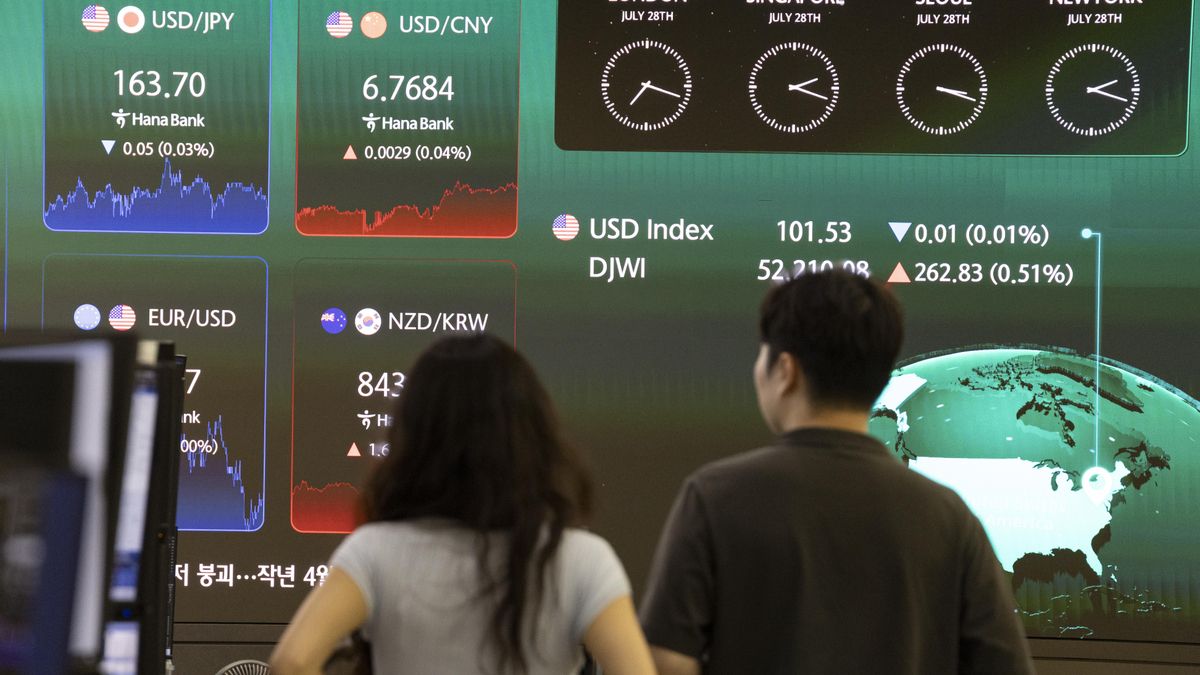
Korea’s AI Stock Crash: Is the $5 Trillion Bubble About to Burst?
South Korea’s government has set up a suicide prevention hotline. The reason? Hundreds of thousands of young people and retirees have lost their life savings in the stock market. They believed they were investing in a miracle. Instead, they lost everything.
The Kospi index, South Korea’s main stock market, had been rising for 18 months. It quadrupled in value. By June, the market for a country with an economy the size of Spain’s was worth $5 trillion. Many people borrowed heavily to join what seemed like a sure thing.
On June 22, the index hit its peak at around 9,200 points. In just one month, it has lost 40% of its value. Because many investors bought stocks with borrowed money, automatic systems forced them to sell when prices fell. This made the crash worse. On Tuesday, the index fell 10%. On Wednesday, it fell another 7%. The government in Seoul now says the country faces a catastrophic market event.
Will this crisis spread to other global markets? It is very likely. What is happening in Korea is not an isolated event. The epicenter of this earthquake is thousands of miles away, on Wall Street.
Between November 2022 and its peak, the S&P 500 (the index of the 500 largest US companies) nearly doubled in value, reaching $67 trillion. The seven biggest companies in the world, all closely linked to artificial intelligence (AI), tripled in value during the same period.
A bubble was inflating around the idea that AI would change everything. It would replace millions of jobs and boost productivity beyond imagination.
That did not happen. Over time, it became clear that the promises of AI were not showing up in real data. There was no explosion in GDP, no huge jump in productivity, and no massive job losses.
In October of last year, the bubble began to show clear signs of weakness. Big companies reported record growth, but the stock market punished them with sharp price drops. The bubble had not burst, but it was losing air fast.
The stock market has since been a fight between two groups: those who still believe in the AI revolution, and those who want to sell before the bubble explodes in their faces.
A few months ago, Anthropic, a major AI company, launched a product called Claude Code. It allowed programmers to use AI in a new way. The market was excited at first, but then started asking hard questions: How many programmers actually need this? How much can they charge for it? Can AI actually make money?
The most important question: Is there any way to justify the multi-trillion-dollar value of these companies?
The answer, according to several studies, is no. To be worth what the market says they are worth, these companies would need to replace 15% to 30% of all jobs. That is not happening.
Instead of facing this problem, the AI bubble changed shape. The business, promoters decided, was not in software. It was in data centers. A few American companies could own these centers and rent them out. The AI bubble became a real estate business, but for digital space.
The result? Software companies saw their stocks fall (Meta -10%, Microsoft -20%, Google +3%, SpaceX -50% since January). Meanwhile, chip makers (called "semis") and memory companies soared (Micron +200%, AMD +125%, Intel +142%).
But reality is like the tortoise in the story: slow but steady. Underneath the idea that AI was a real estate business was a huge crater: if the software is not profitable, who will pay for the data centers? Who is the tenant?
It took a few months, but now even the biggest fans of AI are asking: Where does the money come from in this bubble?
Recently, two Chinese companies launched new AI models. These models are as good as, or almost as good as, ChatGPT and Claude. Worse for the industry, they are free and open. Anyone can use them without paying. The result is huge: the US has lost its lead in the AI race.
The US government, with help from Anthropic, has threatened to ban these models. But it is too late. It is now clear that AI is a public good. You cannot monopolize it and sell it for profit.
Sensing the shift, almost all major US tech companies have signed a statement supporting open models. They do not share the government's interests.
Meanwhile, Meta and SpaceX have announced they will rent out their own data centers. This suggests they do not have enough customers to make them profitable. There is already too much computing power.
In a strange move, Nvidia has guaranteed a $500 billion loan to OpenAI to build the world's largest data center. That data center will be filled with Nvidia's own chips. It is a bad sign when the company at the center of the bubble has to lend its own clients money to buy its own products.
SpaceX, which launched to the stock market as the most valuable company in history, has already lost half its value in just over a month.
The result: no one is denying the over-investment anymore. Companies do not want to keep burning money on AI. The "circular financing" deals that kept the industry going are now being exposed.
This is why the Korean stock market crashed. It is full of chip makers. American chip makers also fell by up to 10%.
This might seem small, but it is huge. It means the idea that the AI bubble could survive by focusing on hardware, not software, is dead.
What comes next? A series of events that can only go wrong.
In the coming days, big companies will report their earnings. There is no good answer. If they say they are still investing, they admit they are burning more money on unused computing power. If they say they are stopping, they admit the party is over.
SpaceX will report earnings soon. Its stock is already half its peak. Investors who bought before the launch will be able to sell for the first time. The question is not if they will sell, but how many and how fast.
In October, Anthropic will go public. Later, OpenAI will too. Both need the market to buy their multi-hundred-billion-dollar valuations, just as everyone stops believing in them. If they sell at a realistic price, they admit the industry is collapsing. If they try to sell at a fantasy price, no one will buy. There is no third option.
Meanwhile, Chinese models will keep improving. And because they are free, every improvement will lower what everyone else can charge for this technology.
Finally, in November, the US has congressional elections. Trump, who has been the biggest supporter of this bubble, will likely lose much of his political power.
Since ChatGPT launched, the AI bubble has been like a ball thrown uphill with great force. While the momentum of hype and capital lasted, the ball rose easily. But it is on a slope. The moment the momentum stops, it can only fall.
These are the last days of artificial intelligence. Not the technology itself, which will keep improving. But the bubble, the threat, the delusion of what we called AI and was not real. It is the end of the collective madness that made us believe a machine could replace us.