NATO Leaders Fake Unity After Trump’s Attacks
Part of composite article Nato Allies Pledge £37 Billion for Massive New Missile Project View full article →
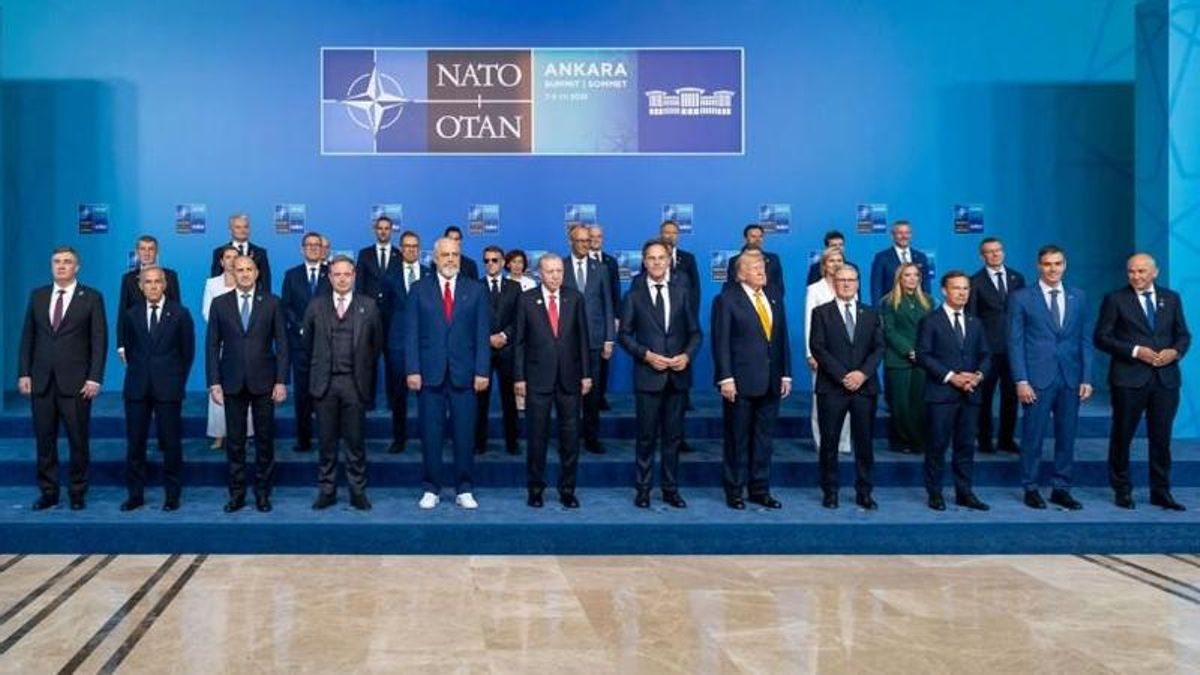
ANKARA, Turkey — NATO leaders agreed to project a false image of unity after US President Donald Trump’s outbursts destabilized the alliance’s summit in Ankara. Trump called Spain a “terrible ally,” threatened to cut trade ties, and renewed demands for the US to control Greenland, a Danish territory.
Despite the tensions, Secretary General Mark Rutte declared the summit a “great success” and praised Trump. “If there is one word that sums up what happened, it is unity,” Trump later said. “I have never seen anything like it.”
The summit was meant to showcase resolved conflicts and progress on military spending. Instead, Trump’s unpredictable comments overshadowed the agenda. He criticized European allies for not supporting the US war in Iran, specifically targeting Spain. US Ambassador to NATO Matthew G. Whitaker had said days earlier that such criticisms were “behind us.”
In response, European leaders publicly backed the unity narrative. French President Emmanuel Macron called the possibility of conflict among allies “political fiction.” Outgoing British Prime Minister Keir Starmer said NATO emerged “stronger and more united.” German Chancellor Friedrich Merz noted Trump approved of Spain’s defense efforts.
Spanish Prime Minister Pedro Sánchez, a main target of Trump’s criticism, downplayed the tension. He said he had an informal chat with Trump about football and golf, adding there was “no tension at all.”
Italian Prime Minister Giorgia Meloni summarized the summit’s spirit: “The Italian and European interest lies in strengthening Western unity.”
Behind the scenes, the 32 NATO members had already agreed on a joint declaration. It reaffirms the alliance’s collective defense commitment under Article 5, saying “an attack against one is an attack against all.” It also notes that European allies and Canada increased defense investments by more than $139 billion.
The declaration dropped a previous target of 5% of GDP on military spending. It instead focuses on removing barriers to defense trade between allies.
At the Defense Industry Forum, investments worth over $50 billion were announced. Separately, 12 NATO countries, including Spain, committed $50.66 billion over the next decade to develop long-range missiles, a capability the US is reducing for Europe.
On Ukraine, NATO members pledged to provide $70 billion in military equipment, assistance, and training this year, and maintain at least that level in 2027.