Ukrainian drones cut Crimea off: Fuel and food run out, tourists flee
Part of composite article Ukraine’s 660-Drone Blitz Cuts Crimea Off: Fuel Dried Up, Summer Camps Shut, Power Blacked Out View full article →
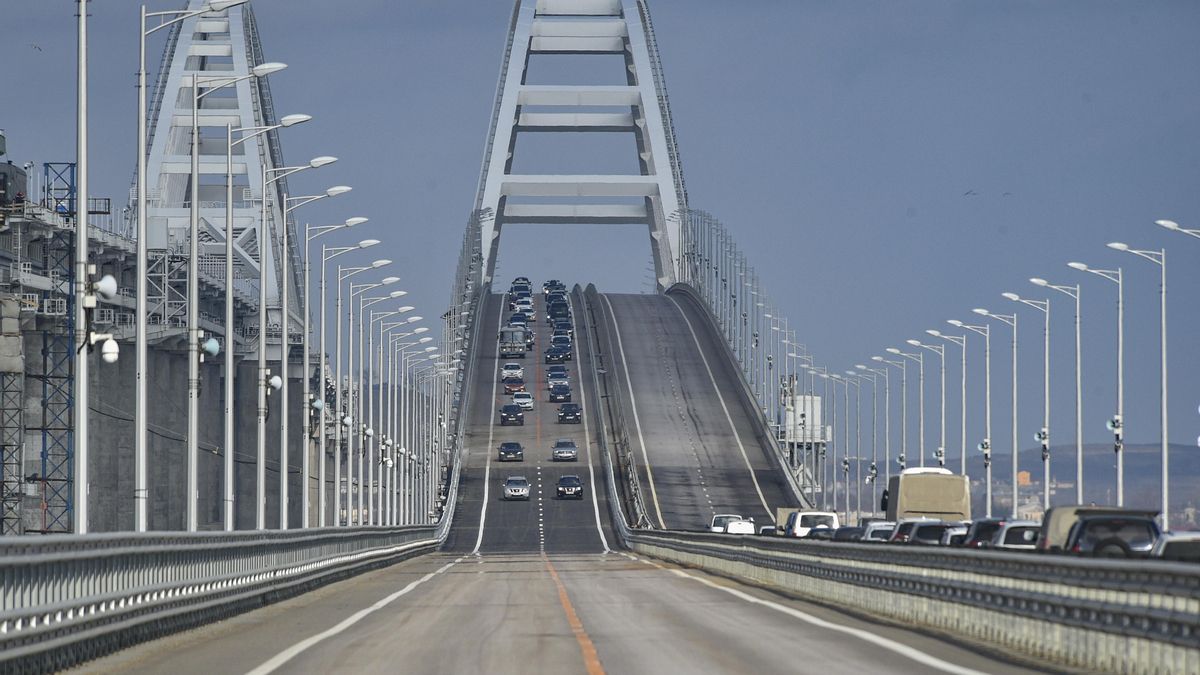
Ukraine is tightening its grip on Crimea. Drone attacks have turned the main highway from Russia into a dangerous route for trucks. In recent days, Ukrainian drones have also damaged key bridges linking the peninsula to the mainland.
The goal is to cut supplies to Russian soldiers on the southern front and exhaust air defenses. But the result is a fuel and food shortage that Crimea has not seen since Russia annexed it in 2014. The siege has also forced trains from Russia to run less often and caused a wave of tourist cancellations just as summer begins.
Residents are showing their anger in videos online. Some blame local authorities. Others say they want to leave.
Russia’s President Vladimir Putin has tried to keep Crimea safe from the war. The Kremlin sees the peninsula as a symbol of Russian history and military glory. It wants to stop people from wondering if life was better under Ukraine.
**Fuel crisis**
Three roads lead to Crimea. The safest is the Kerch Bridge, which connects the east of the peninsula to Russia’s Krasnodar region. In 2022, after the invasion of Ukraine, Russian troops opened another route along the northern coast of the Sea of Azov, through occupied areas. From there, vehicles can cross several bridges to reach Crimea, or drive 200 kilometers more to the Perekop Isthmus.
In recent days, Ukrainian medium-range drones have hit all bridges in the Kherson region repeatedly. This has blocked cargo traffic to Crimea. Experts disagree on how serious these attacks are, but it is clear they are hurting Russian logistics.
More than 400 trucks have been burned by Ukrainian drones while heading south. The head of Ukraine’s drone forces, Robert Brovdi, told Reuters he plans to “isolate Crimea in the near future.” He said it will be “as easy as shooting partridges in an open field.”
The most immediate result is a severe fuel crisis. Transporting fuel by sea is unreliable during war. The Kerch Bridge cannot carry enough to supply the whole peninsula.
Since early June, gasoline shortages have become normal. Local authorities are rationing fuel. In the largest city, Sevastopol, residents get a QR code to fill up with a maximum of 20 liters of fuel per week. The system only works with a state messaging app called Max, which many Russians refuse to download due to privacy concerns.
Even with a code, getting gasoline is not guaranteed. Last week, authorities told people not to line up at gas stations because fuel trucks would not arrive that day. The government has also banned taking photos of fuel trucks to avoid giving information to the enemy.
**“They are hoarding food”**
Supply problems have hit grocery stores and supermarkets. Some shops have limited sales of grains, pasta, and sunflower oil. Buckwheat, a staple of the Russian diet, has disappeared from some shelves. Sugar has also run out just as people start making winter preserves.
“People do not believe the authorities can fix the situation. They are panicking and hoarding food,” a local activist told the opposition outlet Krym.Realii, asking to remain anonymous. “Pensioners have taken almost all the sugar. Small shops that used to operate on the fly are closing in masses. There are no supplies.”
Russian-appointed leader of Crimea, Sergei Aksyonov, denies a food crisis. “Crimea fully meets its internal food needs: wheat, grain products, poultry, and pork. Milk and egg production has increased, and new orchards and vineyards are planted every year,” he said.
Economic analyst Viacheslav Shiryayev told elDiario.es that Crimea is just the first link in a crisis that will spread across Russia. “It is a vicious circle Russia is entering because all its refineries are being hit” by drone attacks. He says the rest of the country will follow “exactly the same timeline.” If large transport companies stop getting enough fuel, supermarkets and factories will face disruptions. The economy will shrink, and production and retail sales will drop.
**Locals and tourists fear the siege**
Transport problems in Crimea have worsened after Ukrainian attacks on railways. On June 8, a Ukrainian drone crashed into a passenger train on the Moscow-Simferopol route, killing the train driver’s assistant.
To reduce risk, authorities decided long-distance trains would stop running at night. This includes trains crossing the Kerch Bridge, where passengers must get off and continue by bus. The use of motorcycles and scooters has also been banned between 8 p.m. and 6 a.m. because their noise sounds like drones and makes detection harder.
With no flights, little gasoline, and few trains, many Russian tourists have chosen to skip Crimea this year, even though it has been a popular destination since Soviet times. According to the newspaper Kommersant, hotel bookings had dropped 31% by June 6 compared to last year. The business outlet RBC reports some tour operators saw 80% of cancellations in June and nearly 50% in July and August. In the coastal town of Alushta, 90% of June bookings have been canceled.
But it is not just tourists avoiding Crimea. Videos are circulating of residents who are fed up. “What is the point of living here if you cannot go anywhere, breathe the air, or see the sea? I do not understand. I am leaving. I hope they do not blow up the bridge before I go,” one woman from Sevastopol said on social media. Another said: “Do I want to leave? No. Do I have a choice? No. We are leaving because I am very tired. I am tired of being afraid 24/7. I am tired of crying.”
Even pro-war Crimean bloggers see no reason for optimism. “The situation in Crimea is only getting worse, not just with fuel but also with security,” said Aleksander Sergiyev. “The worst is yet to come. How can we prepare? Prepare for autonomous survival mode.” He recommends buying basic goods to survive a total siege.
Another pro-Russian blogger, Stepan Kiskin, blamed regional authorities for the shortages. “The Ministry of Agriculture of the Republic of Crimea has nothing of its own. All wholesale logistics have been auctioned off. There are no professionals in the bureaucracy, no fuel reserves, no food reserves. All that exists is empty but incredibly pompous and optimistic talk.”
Shiryayev says this is “the most difficult period for Crimea” since its annexation. He calls it a “semi-blockade” that could lead, in the worst case, to a forced evacuation of residents if the peninsula becomes an island. “This situation cannot continue for long,” he told elDiario.es.
**Was life better before annexation?**
The analyst thinks protests could erupt, despite the lack of free speech. “There could be some localized outbreaks of discontent when the shelves are completely empty and all transport stops,” he says.
He believes people know that before annexation “at least they did not have these problems.” But he doubts they will direct their anger at Putin. “Unfortunately, they will not demand that the war stop. They will appeal to the authorities to solve the problem.”
Ruslan Zhadnov, director of the NGO Crimea Active, told elDiario.es that these hardships will hit apolitical citizens the hardest, who are the majority in the region. In a territory that relies on subsidies and tourism, he predicts the socioeconomic situation will become “significantly less favorable.”
“We Crimeans remember well that before the occupation we did not face these problems,” Zhadnov said. “So the number of people who conclude they lived better before 2014 will only increase.”
Tatar activists, a minority originally from Crimea deported by Stalin who now form part of the pro-Ukrainian resistance, see an opportunity in this crisis. Refat Chubarov believes it could have “a significant impact on the collective consciousness of Russian society, which had come to believe that Crimea could have sacred importance for Russia.” He points out that “the weakening of the occupiers’ position in Crimea could become a turning point in the Russian-Ukrainian war.”
According to Zhadnov, “history has repeatedly shown that the stability of the peninsula’s defense directly depends on the ability to supply troops.” He says Ukrainian efforts to isolate it are of “fundamental” importance. “For us Crimeans, this is an important reason to keep hope,” he concluded.