Title: Gaza children find escape from war in UN tent classrooms
Part of composite article Gaza Widows and 300,000 Kids Find Refuge in UN Tents as Firebombs Torch Homes View full article →
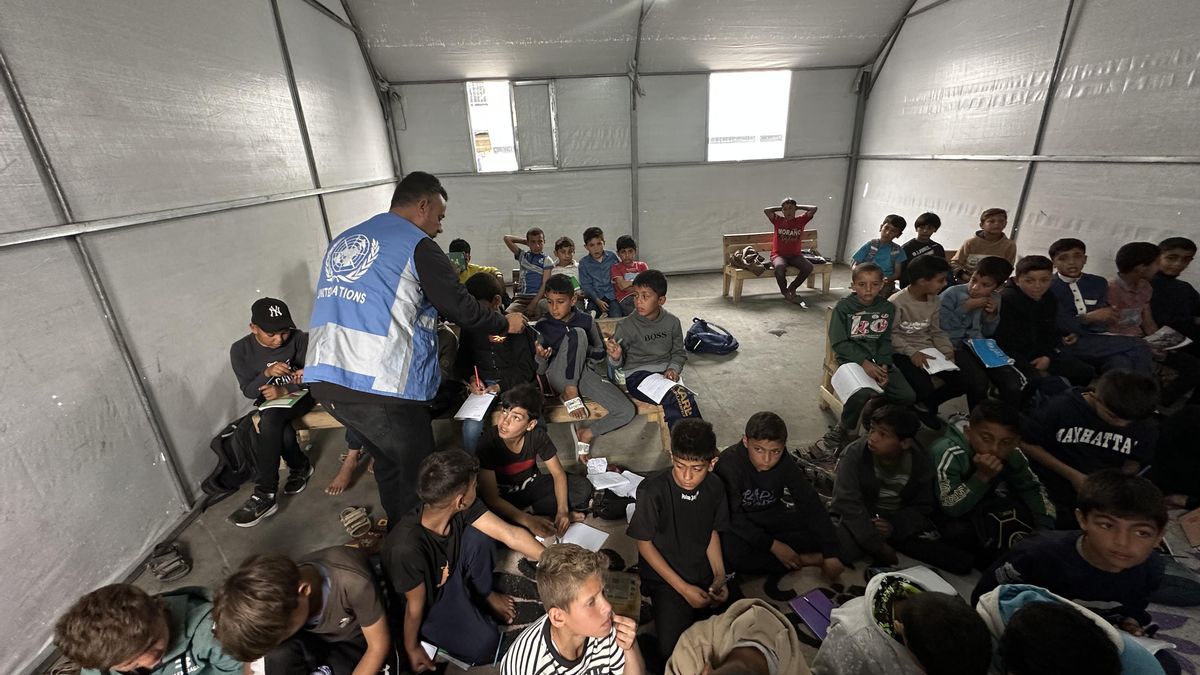
**Article:**
After two years of displacement, Layla al-Suwaisi, 30, has found a fragile pause. She and her two sons, Fadi, 9, and Mohammed, 7, now live in a narrow tent in Al-Zawayda, central Gaza.
Their home in northern Gaza was destroyed in an Israeli airstrike. The family lost everything. The burden is worsened by the absence of her husband, who left six years ago to find work abroad and cannot return.
But the tragedy goes beyond displacement and hunger. The violence has left deep scars on her children.
“During the entire war, my children lived in absolute terror and panic, made worse because their father is not here,” Layla said.
She says her sons were forced to grow up too fast. Instead of learning and playing, they spent their days searching for food, carrying water, and collecting firewood.
“I looked at them with immense sadness, thinking this was not the life I wanted for them,” she added.
The lack of safe schools added to the trauma. More than 70% of Gaza’s schools were destroyed by Israeli attacks. The remaining buildings became crowded shelters for displaced people.
Fadi, the eldest, lost much of his learning. Mohammed, who was only five, missed the chance to develop basic skills.
Their story is not unique. At least 660,000 Palestinian students were completely deprived of education during the first year of the Israeli offensive.
**A turning point: return to learning**
After the first temporary ceasefire in January 2025, UNRWA launched an online learning program for about 277,700 students. Later, the agency focused on opening temporary learning spaces in its shelters. The goal: let children learn, create a routine, and ease their trauma.
Layla tried to teach her sons herself. “It was a huge struggle. Survival tasks like washing clothes by hand and cooking on wood fires consume all my time,” she said.
Then, about four months ago, she heard that UNRWA would open an educational space near her camp.
“It was the most important change in my children’s lives since October 2023,” she said.
By late October 2025, UNRWA had established more than 350 temporary learning spaces across Gaza, serving over 300,000 students. The agency builds these improvised classrooms using interconnected tents and sturdy tarps.
On May 20, UNRWA set up a new temporary learning space in a displaced camp south of Khan Younis. Within a week, about 1,600 children came to enroll.
**More than education**
For families trapped in tents, these classrooms offer more than reading and math. They are refuges that help children regain normality and protect them from the weight of daily reality.
“I have noticed a huge psychological change in my children since they started attending classes,” Layla said. “They have stopped obsessing over bombings, displacement, and terror. This space has become their escape: a place to release tension, play, and have fun.”
The experiences of displaced families show that education has become an essential tool for trauma recovery. These temporary tent solutions must urgently give way to a full, international rebuilding of Gaza’s devastated education system.