EU split over China: Spain pushes for talks as France demands trade war
Part of composite article China’s Rare-Earth Squeeze Hits US Magnet Makers, Sparking New Trade Clash View full article →
EU leaders are divided on how to handle trade tensions with China. The debate is set for the EU summit in Brussels on June 18-19.
All 27 EU members agree the trade deficit with China is too high. In 2025, the deficit reached 360 billion euros. In the first three months of 2026, it grew to nearly 95 billion euros, up from 88.4 billion in the same period last year.
China's exports have risen over 40% since the pandemic. Its imports have stayed flat. Meanwhile, exports from major European economies to China have fallen since 2022, except for the Netherlands, according to the Jacques Delors Centre.
The European Commission said in May that the trade and investment relationship with China "is not sustainable." It said the approach is "de-risking, not decoupling."
**France leads the call for tougher action**
France wants tougher measures. President Emmanuel Macron said last month that the EU needs tools similar to the US Section 301 trade law. Section 301 lets the US investigate and punish unfair trade practices by other countries.
The EU has an anti-coercion tool, but it is slow and hard to use. France wants faster options.
Poland, the Netherlands, and Belgium support France. Germany and Sweden want the Commission to propose new trade tools.
**Spain argues for negotiation**
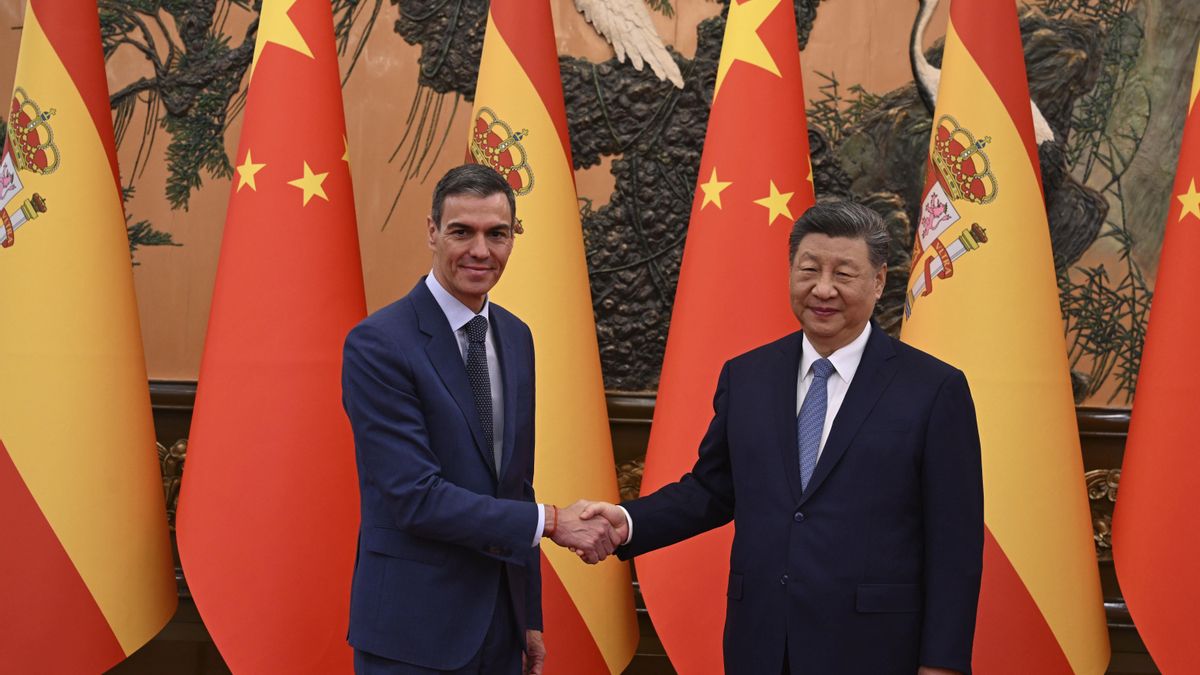
Spain disagrees. It says a direct trade war with China is not the best path. Spanish government sources say China is the world's second-largest economy. They argue for constructive dialogue to explain that some parts of the trade relationship are not sustainable.
Spain also points to other problems: the war in Ukraine, tensions with Iran, and trade issues with the US. Opening another front would be risky.
**China can hit back hard**
China has shown its power. On April 4, 2025, it imposed export controls on rare earth minerals. This was a response to US tariffs and EU taxes on Chinese electric cars. The move disrupted global supply chains.
European carmakers and electronics manufacturers warned they would have to stop production if the controls continued.
A report by the EU Institute for Security Studies called "Critical Materials as a Weapon of Beijing" said China's supply restrictions can force European factories to move production to China. The report called this "political coercion."
China controls 70% of global rare earth mining and 90% of processing capacity.
The G7 countries—the US, Japan, Germany, the UK, France, Italy, and Canada—signed a statement on Wednesday. They agreed that no country should control more than 60% of their rare earth imports by 2030. This is a direct message to China.
**What the EU has already done**
The EU has not been idle. It has imposed tariffs on Chinese electric cars, banned EU-funded renewable energy projects using Chinese parts, and launched the European Tech Sovereignty Package to block US and Chinese companies from accessing European citizen data.
Now, EU countries are debating the next steps. The outcome could lead to a trade war with China.