FIFA’s World Cup Turns Political as Infantino Ties to Trump Raise Questions
Part of composite article FIFA's $11 Billion Cash Grab: Infantino's "Servile" Reign and the World Cup's Dark Money Machine View full article →
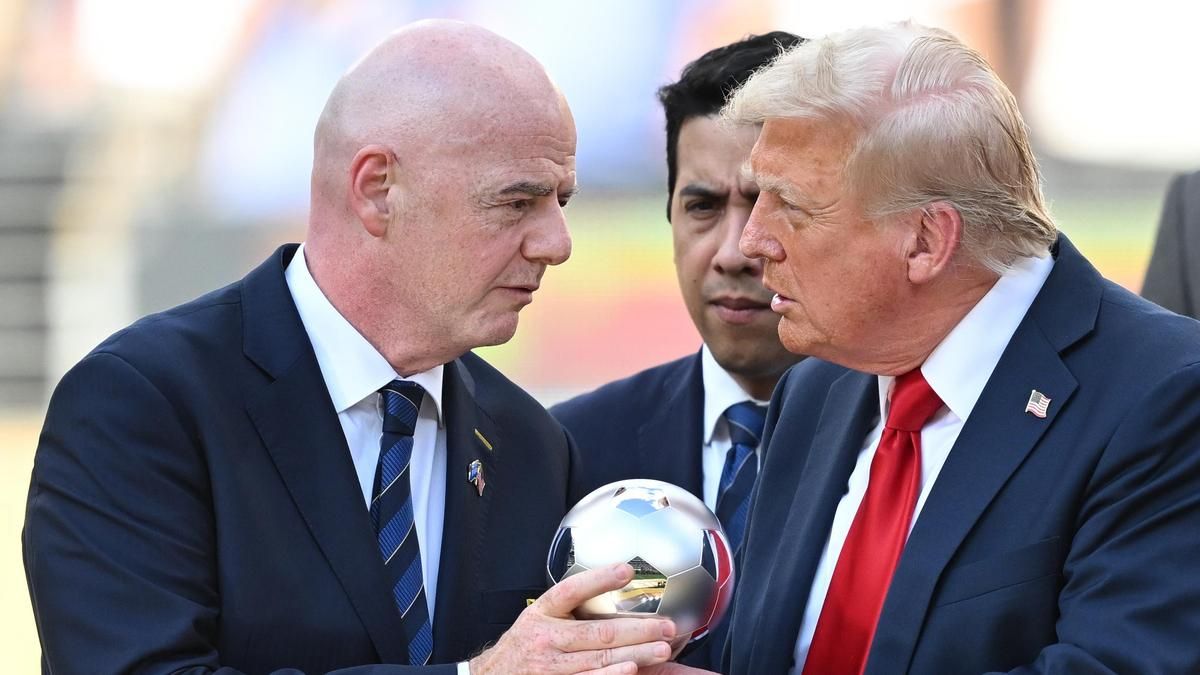
This World Cup is supposed to be about soccer, but it started as a political fight. The tournament is being played in the United States, Canada, and Mexico, and the politics surrounding it are impossible to ignore.
Soccer is simple: 11 players on each side, a ball, and a goal. The rules are clear. But behind the game, power struggles are real. This World Cup will end as a sports event, but it began as a political one.
U.S. President Donald Trump is a major reason. In the last year and a half, he started a trade war with Canada and Mexico. He also threatened to annex Canada and make it the 51st U.S. state. These actions have created new national feelings in Canada, which fans are now directing toward soccer.
Mexico is also under pressure. The U.S. is fighting drug cartels, and while Mexican President Claudia Sheinbaum cooperates with Washington, she insists on her country’s sovereignty. The balance is tense because many fear the U.S. could act outside its borders at any time.
This is not the most political World Cup ever—1978 in Argentina under the military junta and 1934 in Mussolini’s Italy were worse. But this time, the president of FIFA, Gianni Infantino, seems to be the most political person involved. And he is not neutral. He appears to favor Trump.
Infantino created the FIFA Peace Prize in December and gave it to himself, using his role as a peacemaker in the Middle East as an excuse. He reportedly got the idea after Trump did not win the Nobel Peace Prize. Critics say this shows Infantino puts the organization at the service of his personal interests.
Over the years, Infantino has publicly praised Trump. He attended Trump’s second inauguration, joined him on a state trip to the Persian Gulf, and rented an office in New York from Trump’s family business—an office that was barely used, according to *The New York Times*. He has visited Trump’s Mar-a-Lago resort, attended the premiere of a documentary about Melania Trump, and spends as much time near Trump as possible.
The question is: who benefits? Infantino has been reported to FIFA’s ethics committee for breaking the rule of political neutrality. What once looked like reasonable concern for the World Cup’s success is no longer a believable excuse.
In any country or sector, corruption often starts this way: putting an organization or public role in the service of personal interest. It is unclear how the complaint against Infantino will end. For now, the best advice may be to focus on the field, where the white lines are clear. In the VIP box, no red cards are shown. Let us keep our eyes on the grass and hope Spain wins. That should make for a promising few weeks.