West Bank schools under attack: Can students even get to class?
Part of composite article 981 Dead Since Ceasefire: West Bank Schools Under Siege as Occupation Crushes a Generation View full article →
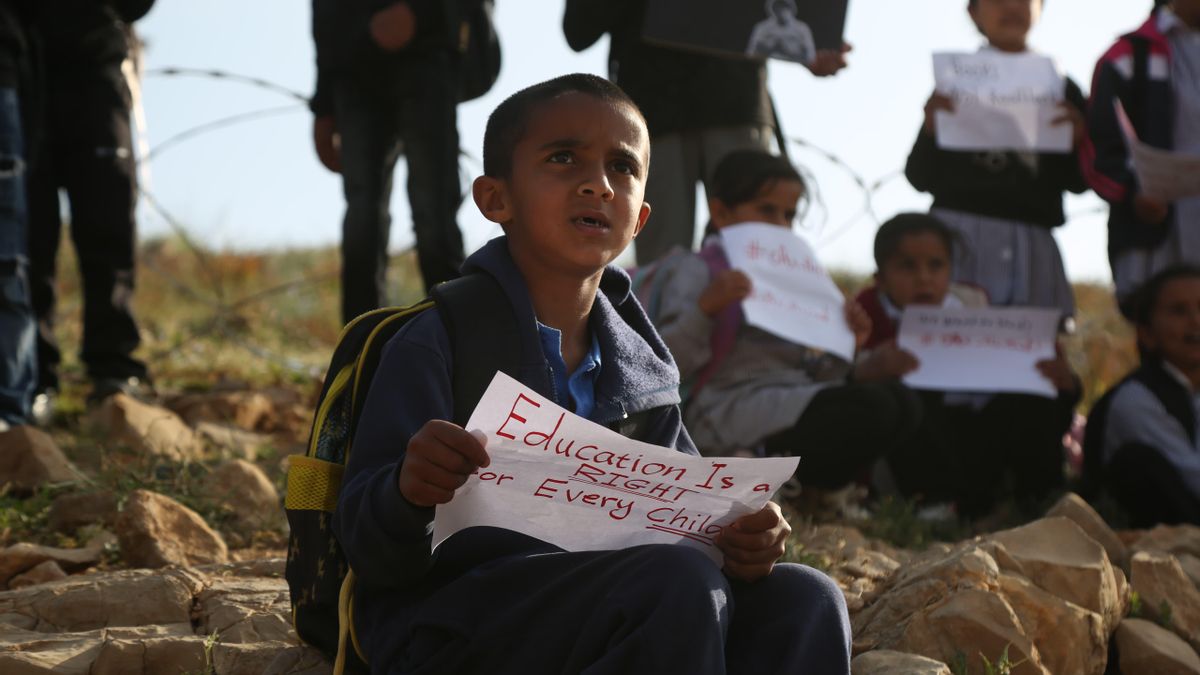
UMM AL-KHAIR, West Bank — One morning, children in the small Palestinian community of Umm al-Khair left for school only to find their road blocked. Israeli settlers had put up a fence across the street.
“They threw stun grenades at us, and we had to go home,” said Ahmad, a young student.
For Ahmad and dozens of other children, getting to school is now a daily struggle. In the occupied West Bank, education is no longer just about classrooms, teachers, and books. It is increasingly controlled by roadblocks, military raids, settler attacks, and forced displacement.
In the village of Rummon, east of Ramallah, settlers attacked a school under construction, damaging the building and stealing equipment, including cameras and generators. Weeks earlier, in the nearby village of Al-Mughayyir, settlers opened fire near a kindergarten, killing 14-year-old Aws al-Naasan and 32-year-old Jihad Abu Naim. Several students were also wounded.
Further north, in the Jordan Valley, settlers demolished Al-Maleh School in April, ending education for the few families left in the area. The school once served about 70 students. Years of settler pressure and repeated displacement gradually emptied the community.
The destruction of a school is not just the loss of a building. In many Palestinian villages, it signals the collapse of daily life. Attacks on schools are not limited to remote areas. In Al-Khader, near Bethlehem, Israeli forces entered several schools and questioned students. In Nablus, settlers damaged school infrastructure.
Students and teachers describe a growing fear. Schools are struggling to remain safe spaces. Problems start long before children reach the classroom. Military checkpoints, road closures, and movement restrictions delay or block access to schools. In the Old City of Hebron, many students pass through Israeli military checks just to attend class.
For communities like Masafer Yatta, the situation is worse. Settlers recently blocked the only road connecting Umm al-Khair to nearby schools, forcing students to miss class or find dangerous alternate routes. High school students had to take exams outside after being denied access to school buildings.
“The problem has become much bigger than the closure of a single road,” said Walid al-Hathaleen, a local teacher. “We face settler violence, military restrictions, economic hardship, and an unstable education system at the same time. Education in the West Bank is approaching a dangerous point.”
He warns the impact is both academic and psychological. “Children are increasingly afraid. Many feel unsafe just trying to get to school.”
**Refugee camps under pressure**
In Al-Fawwar refugee camp, south of Hebron, education faces different challenges. Residents describe frequent Israeli military raids that disrupt school hours and create constant uncertainty.
“If soldiers enter the camp before students arrive, many children cannot reach their schools,” said Abdel Rahim Abu Hamad, a camp resident. “Other times, students get trapped inside school buildings until the military violence ends.”
The camp has two schools run by UNRWA, the UN agency for Palestinian refugees. Despite growing financial and operational pressures, residents say these schools are essential.
“UNRWA continues to support education here,” Abu Hamad said. “Without these schools, the situation would be much worse.”
In the northern West Bank, large-scale Israeli military raids that began in early 2025 caused one of the biggest waves of forced displacement in years. Thousands of families fled the Jenin, Tulkarem, and Nur Shams refugee camps, leaving behind homes, schools, and community networks.
An estimated 12,000 displaced Palestinian refugee children now live in temporary shelters in northern West Bank areas. Many have limited access to steady education. For children already dealing with the trauma of displacement, losing school adds another layer of uncertainty.
With some UNRWA schools in the camps still inaccessible, the agency has moved displaced students to other schools in the area and started online learning. These steps have prevented a total halt to classes, but teachers warn that displacement continues to undermine educational stability—one of the few sources of normalcy for refugee children.
**A generation at risk**
The challenges facing Palestinian education today are not the result of a single event. They come from multiple crises happening at once: attacks on schools, movement restrictions, military raids in refugee camps, displacement, economic collapse, and growing insecurity.
Despite all this, teachers keep teaching. Parents keep sending their children to school when they can. UNRWA keeps trying to keep classrooms open.
But across much of the West Bank, education is becoming an act of resistance. For thousands of Palestinian children, the question is no longer just what they will learn in school.
The question is whether they can get there.