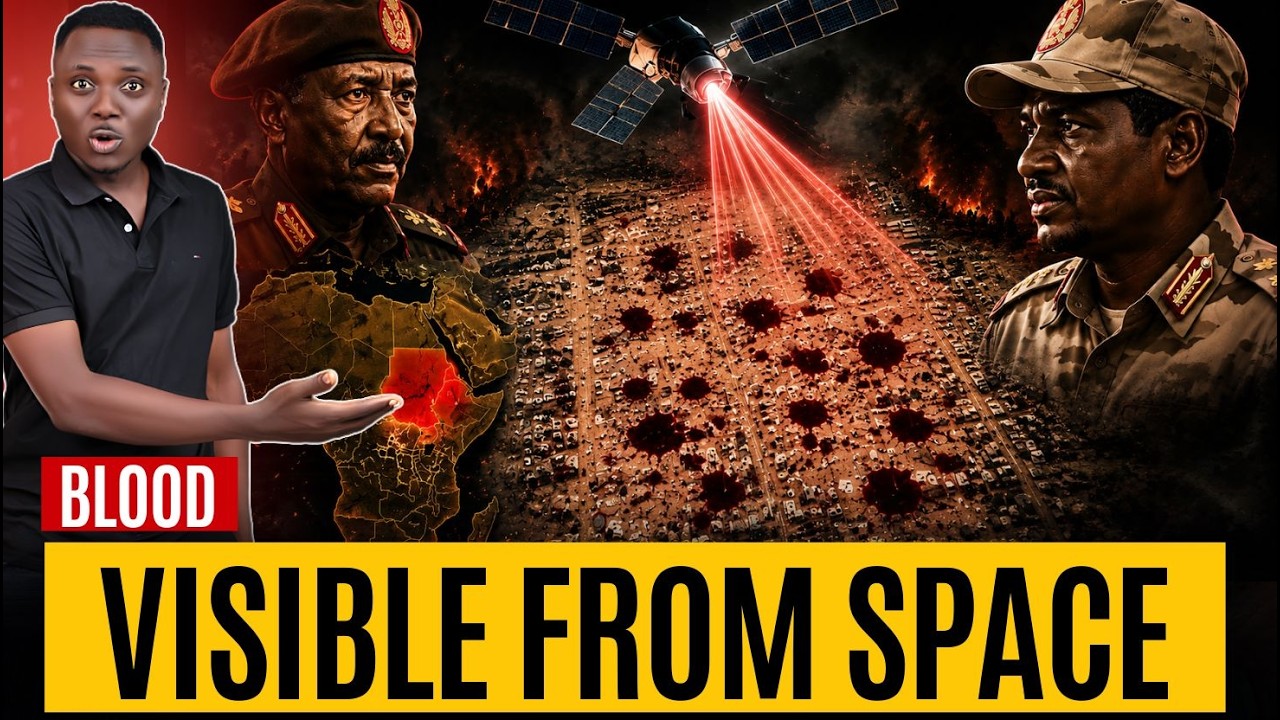
Sudan’s Silent Scourge: The Red Patches on Satellite Images No One Speaks Of
By [Author Name], International Affairs Editor High-resolution satellite imagery of Sudan has revealed a disturbing pattern: red patches spreading across the country’s landscape. These are not geological formations or agricultural phenomena.
By [Author Name], International Affairs Editor
High-resolution satellite imagery of Sudan has revealed a disturbing pattern: red patches spreading across the country’s landscape. These are not geological formations or agricultural phenomena. They are the unmistakable signatures of mass graves—freshly turned earth, laced with iron-rich soil, marking sites where hundreds, possibly thousands, of bodies have been buried.
For months, these images have circulated among intelligence agencies and humanitarian organizations. Yet, public discussion remains muted. The red patches are a silent testimony to a conflict that the world has largely ignored.
The Evidence from Above
Satellite analysts have identified at least 47 distinct sites across Darfur, Kordofan, and the Blue Nile region that exhibit the characteristic spectral signature of mass burials. The “red” in the imagery comes from oxidized iron in the soil, which becomes more visible when earth is disturbed and exposed to air. When combined with contextual data—such as proximity to villages that have been attacked, or the presence of military vehicles—the pattern becomes unmistakable.
“We are looking at a systematic campaign of violence,” explains Dr. Amira Hassan, a remote sensing specialist at the University of Khartoum, who has studied the imagery. “These are not isolated incidents. The spatial clustering tells us this is organized.”
A War Hidden in Plain Sight
The conflict in Sudan, which escalated dramatically in April 2023 between the Sudanese Armed Forces (SAF) and the Rapid Support Forces (RSF), has killed an estimated 150,000 people and displaced over 11 million. Yet, international media coverage has been sporadic, and diplomatic action has been paralyzed by geopolitical divisions.
The red patches are concentrated in areas where the RSF has been most active, particularly in West Darfur. Human rights groups have documented ethnically targeted violence against the Masalit, Fur, and Zaghawa communities—echoes of the genocide that killed 300,000 people in the early 2000s.
Why the Silence?
Several factors explain why these images have not sparked global outrage. First, Sudan’s conflict is complex, involving multiple armed groups with shifting alliances. Second, major powers—including Russia, the United Arab Emirates, and Saudi Arabia—have competing interests in the region, often prioritizing access to gold and strategic ports over civilian protection.
Third, the Sudanese government has restricted access for international investigators and journalists. “We cannot verify every grave on the ground,” says a UN official who requested anonymity. “But the satellite data is consistent with survivor testimony and mass atrocity patterns.”
The Humanitarian Catastrophe
Beyond the graves, the scale of suffering is staggering. Over 25 million people—more than half the population—need humanitarian assistance. Famine has been declared in parts of Darfur. Cholera and measles are spreading through displacement camps.
The red patches are not just evidence of death. They are a warning. If the world does not act, the graves will multiply. And the silence will become complicity.
What Can Be Done?
International criminal investigators have begun collecting the satellite evidence for potential war crimes prosecutions. The International Criminal Court has opened a preliminary examination. But without political will from the UN Security Council, accountability remains distant.
Humanitarian agencies need immediate funding and safe access. Ceasefire negotiations, currently stalled in Jeddah, must be revived with enforceable mechanisms. And the red patches—visible from space—must become impossible to ignore.
The earth in Sudan is bleeding. The question is whether the world will look away.
Related Coverage
Sudan Drone Strikes Kill 41 at Displacement Camp as Violence Spreads Across Country
Drone attacks by Sudan's paramilitary Rapid Support Forces have killed dozens of civilians, mostly women and children, across multiple regions. The strikes hit displacement shelters and residential areas as fighting spreads to new areas.
Sahel Juntas Crack Down on Critics as Militant Attacks Surge – Report Finds Security Worsening
A new report reveals that military juntas in Mali, Burkina Faso, and Niger are silencing journalists and activists instead of adapting their security strategies, even as Islamist militant groups make unprecedented gains across the Sahel region.
Related Editorials
The Silent War: Inside the Resource Conflict Reshaping Central Africa
The Democratic Republic of the Congo (DRC) is home to one of the world’s most protracted and deadly conflicts. While often overshadowed by crises in other regions, the situation in Central Africa is rapidly deteriorating.
The Sahel’s Hidden War: Why Mali’s Conflict Is Far Larger Than Reported
For years, the war in Mali has been framed as a remote insurgency—a localized struggle between government forces and Tuareg rebels in the country’s vast northern desert. But new evidence suggests that this framing is dangerously incomplete.