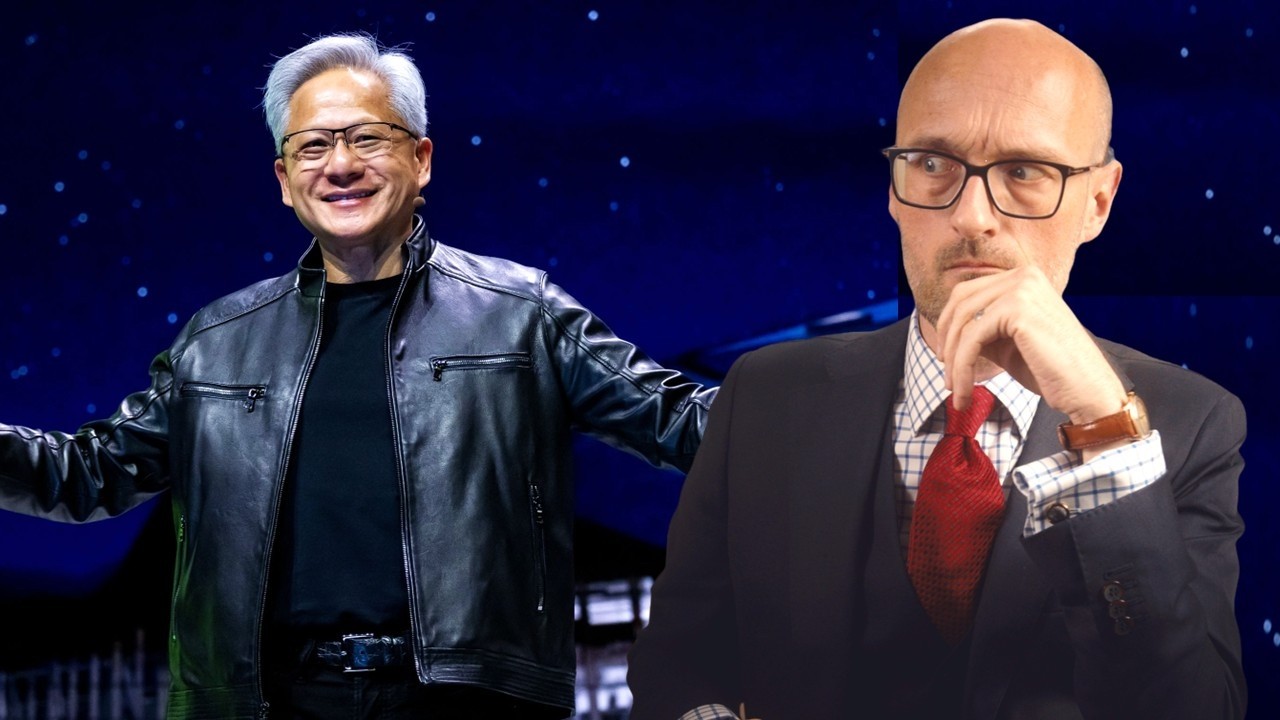
The Nvidia Put: How the White House Reinvented Corporate Governance in a Weekend
When President Trump pardoned a turkey named Freedom on a Tuesday, the bird came with a full dossier on the White House website: his farm of origin, his two rounds of public voting, even his career goal (retirement before Thanksgiving). The day before, the administration had arranged something simi
When President Trump pardoned a turkey named Freedom on a Tuesday, the bird came with a full dossier on the White House website: his farm of origin, his two rounds of public voting, even his career goal (retirement before Thanksgiving). The day before, the administration had arranged something similar for the chief executive of a four-trillion-dollar chip company. The turkey's paperwork was better.
Jensen Huang resigned as Nvidia's CEO on November 12th, following reports of affairs with company employees and with a businesswoman named Alice Wang, whom U.S. intelligence officials suspect of working as a Chinese spy. Beijing denies the allegation. Five days later, Nvidia's newly appointed chair told investors the board had no intention of reinstating him. Five days after that, the president posted that he hoped the board would rehire him. On Monday morning, the directors voted unanimously to do exactly that.
Huang's eleven days off happened to include the release of Grand Theft Auto 6, and he was back at his desk the following Monday, roughly the schedule most gamers would have chosen. The founder of Nvidia was, for those eleven days, free to become a customer of AMD, whose chips power the consoles the game runs on.
According to Nvidia's board, the White House, and the Silicon Valley insiders who spent the weekend lobbying for his return, there was nothing unusual about any of this. It was free-market capitalism working exactly as intended.
In a filing with the Securities and Exchange Commission, the board explained that a series of meetings had left it satisfied with respect to Mr. Huang's candor and ability to lead Nvidia. It also mentioned that it had received input from senior levels of the United States government and that, based on that input, it was confident his return posed no national security risk. The filing did not include a biography of this new advisor or specify which senior levels it had in mind. The president clarified matters on CNBC that morning. I spoke to them, he said. Let me just put it that way. And I convinced them.
Investors liked the new advisor a great deal. Nvidia's stock rose 31 percent on Monday, adding close to a trillion dollars in market value in a single day. That leaves a simple question: what exactly did the market pay a trillion dollars for? Was it Huang's management, or the legal protection his new advisor appears to have provided?
To be fair to Huang, Nvidia's share price had problems of its own before any of this began. The stock peaked on October 6th at a valuation of about 5.8 trillion dollars. By the end of October, when the first reports about Wang appeared, it had already fallen about 11 percent. Big tech was spending hundreds of billions on artificial intelligence, and investors had started asking what exactly they would get back. They were also worried about rising interest rates and the debt piling up for data centers. By the time Huang resigned, the stock was down about 30 percent. The scandal arrived in the middle of a sell-off already underway and gave it much more to work with.
Nvidia's worst day came on Friday, November 20th, when Reuters reported that the SEC was investigating the company's accounting. In a broader tech rout, the Nasdaq 100 fell 5.6 percent; Nvidia fell 14 percent. Its best day came the following Monday. The Nasdaq 100 rose about 7 percent; Nvidia rose 31 percent, even though it had announced no new chip and no new major customer. The only new arrival was the advisor.
How did senior levels of the government clear everything up in a single weekend? According to Semafor, the president dialed into Nvidia's board meeting himself to make the case for Huang, a level of hands-on involvement most advisors never offer. The New York Times noted that it is not clear how much pressure the president actually needed to apply. Six days earlier, the board had said it had no intention of bringing Huang back. So either the president applied enormous pressure or the board needed very little. Neither reads particularly well in an SEC filing.
Taken at face value, the official timeline runs as follows. On Monday, the president told CNBC that his administration had carried out a very thorough investigation and that Huang had been exonerated. Asked whether he had assured the board that Huang would not be prosecuted, he said: I gave them enough assurance. He also posted that Attorney General Todd Blanche had confirmed the government had no evidence of unlawful conduct. On Tuesday, Blanche told reporters that Nvidia was a good corporate citizen but declined to say whether the Justice Department had investigated Huang at all. On Wednesday, Reuters reported that it had not. There had been no formal Justice Department investigation and no counterintelligence probe. Blanche had reviewed evidence from investigations into two Nvidia customers, Super Micro Computer and MegaSpeed, and found nothing pointing at Huang. Later that day, Vice President JD Vance confirmed it, telling reporters that officials had assured him Huang was under no investigation.
Put together, the very thorough investigation that exonerated Jensen Huang was technically no investigation at all, which explains how it finished in time for Monday's market open. Treasury Secretary Scott Bessent had to adjust to the new guidance in real time. A week earlier, he had wondered aloud whether a culture of noncompliance at Nvidia had driven seemingly illicit sales to inflate revenue and earnings, and told Fox News the board needed a dramatic shakeup and should look outside the company for its next chief executive. Asked over the weekend whether the president's support for Huang contradicted that advice, Bessent replied: I said they should go to the outside, but he's on the outside now. By that standard, anyone fired on a Friday is an exciting external hire by Monday morning.
Monday was not a good day for everyone. In London, two firms sell exchange-traded products designed to deliver minus three times Nvidia's daily returns; a one-day rise of a third would wipe them out. Nvidia rose 31 percent. The GraniteShares product lost 92 percent of its value; the Leverage Shares product lost 81 percent after an automatic intraday rebalance the company calls its airbag. A spokesperson told ETF Stream afterward that the airbag did exactly what it is there for. Like any good airbag, it deployed during the crash, and the product walked away with 19 percent of itself intact.
Nvidia shareholders did not enjoy the rally for long. The stock fell about 6 percent on Tuesday and as much as 8.9 percent on Wednesday, leaving it roughly 35 percent, or about two trillion dollars, below its October peak. It now trades at around ten times expected earnings, making the world's most profitable chip maker the cheapest member of the Magnificent Seven. Senior levels of the government can reinstate a chief executive over a weekend, but interest rates, AI spending, and new export rules appear to be outside its remit.
Many have called this Silicon Valley's too-big-to-fail moment, and it is tempting. Nvidia sits at the center of the American stock market, and the White House just stepped in to steady its share price. The problem with the phrase is that Nvidia was not failing. It had just reported earnings of more than 65 billion dollars on revenue that had more than doubled from a year earlier. Most companies on the verge of collapse do not make 65 billion dollars in three months; if they did, their restructuring advisors would tell them to keep at it. Nor was the financial system seizing up. The market had fallen for seven consecutive trading days before Huang returned, which was bad, but it left the market roughly where it started the year. In the middle of the supposed panic, Anthropic completed the largest IPO in stock market history. If that is a systemic crisis, it is a comfortable one.
In finance, a put option gives you the right, but not the obligation, to sell something at a fixed price. It works like insurance: however far the market falls, you know your floor. Since Alan Greenspan's Federal Reserve steadied markets after the 1987 crash, investors have spoken of the Greenspan put, later the Fed put: the belief that if stock prices fall far enough to hurt the economy, the central bank will cut rates or inject liquidity. Economists worry this encourages reckless risk-taking, and they have a point. But the Fed put, if it exists, covers the whole financial system, uses ordinary central bank tools, and usually kicks in after something big has broken.
What appeared on Monday looked more like a government put supporting a single stock. It came without rate cuts or emergency loans. It came from the president and vice president persuading a board to change its mind about who should run a company. When CNBC's Sara Eisen asked the president where he drew the line on involvement in private business, he said: I'm doing it for the country. He described his approach as touch, feel, like a great golfer around the green. On the same call, Jim Cramer asked whether Washington would rescue Nvidia if it ever got into financial trouble. As Tad DeHaven of the Cato Institute noted, the president was fielding a bailout question about one of the most profitable companies in the world.
This is not the first White House intervention in a CEO decision. DeHaven points to March 2009, when the Obama administration's auto task force pushed out General Motors chief executive Rick Wagoner and installed Fritz Henderson. That was unpopular with corporate governance specialists too; Henderson later told federal investigators that GM's directors felt the Treasury had taken over their job of picking the boss. But there was one small difference between General Motors in 2009 and Nvidia today. GM had just lost more than 30 billion dollars in 2008, burned through more than 19 billion in cash, and was about two months from Chapter 11 bankruptcy. It had asked taxpayers for tens of billions in rescue loans. When you are broke and asking someone to lend you billions, the lender gets a say in who runs the place.
Silicon Valley has experience with bailouts as well. In March 2023, when Silicon Valley Bank collapsed, some of the industry's best-known investors, firm believers in free markets particularly on the way up, spent a weekend urging the government to step in. The run had been accelerated by venture firms telling their startups, many of which they had steered to SVB in the first place, to pull their money out. By Sunday night, regulators had gone beyond the 250,000-dollar FDIC limit and guaranteed every deposit. The investors' portfolio companies were saved; the bank's shareholders were wiped out and its management was gone. Three years later, some of the same investors were praising the wisdom of the crowd and explaining that there are double standards for high performers. This time, the shareholders were rescued, the boss kept his job, and his personal fortune rose by about 34 billion dollars in a single day. Nvidia did not even ask the Treasury for a cent. It just had a bad week: no succession plan, a spy scandal, and an SEC accounting investigation. If that is the new threshold for a consultation with senior levels of the government, every board in the S&P 500 can stop wasting time on succession planning. It is cheaper to make sure your CEO's resignation looks like a recession.
How did Silicon Valley reach the point where a weekend phone campaign could get the White House to reinstate a public company's chief executive? It did not start out that way. For a long time, the tech industry treated Washington as a distant annoyance. In the mid-1990s, as Fortune's Jeffrey Birnbaum put it, Microsoft's lobbying presence in the capital amounted to Jack and his Jeep, Jack being the company's only in-house lobbyist. That worked until 1998, when the Justice Department sued Microsoft for antitrust violations with encouragement from rivals like Netscape that had already worked out how Washington operated. Microsoft learned quickly and within a couple of years had one of the largest lobbying operations in town. The rest of the industry decided not to wait for its own antitrust trial before hiring lobbyists.
Even by tech standards, Huang was a late starter. As CNN reported, while Mark Zuckerberg and Jeff Bezos had prime spots at the president's second inauguration, Huang skipped it to spend Lunar New Year with Nvidia staff in Asia. The president later recalled wondering what the hell Nvidia was. That did not last. Eleven days after the inauguration, Huang was in the Oval Office with an introduction from Howard Lutnick. Over the next two years he attended a million-dollar-a-head dinner at Mar-a-Lago, negotiated chip sales to China directly with the president under a deal that gave the government 15 percent of the revenue, and flew to Beijing on Air Force One. Nvidia reportedly gave 25 million dollars to the president's White House ballroom project. This autumn, Huang sat at the head table at the state dinner for Xi Jinping. For a man who skipped the inauguration, it was a rapid climb.
That brings us to the eleven days after he resigned. Weeks earlier, big tech's standing in Washington had looked shaky. Democrats had won both chambers of Congress in the midterms, and voters had rejected data center projects in 40 of 41 ballot measures. Yet within hours of Huang stepping down, a war room of Silicon Valley allies went to work. According to the Financial Times, the group included Uber founder Travis Kalanick, venture capitalists Gavin Baker and Brad Gerstner, Marc Andreessen, and Goldman Sachs executive John Underwood. Within 24 hours, Baker and Gerstner published an open letter urging the board to keep all options on the table, including the potential return of Jensen Huang. A separate public letter backed by Elon Musk gathered almost 200,000 signatures in four days. Behind the scenes, the group went to Vice President Vance, a former venture capitalist with close ties to Silicon Valley, and arranged a 45-minute call between Vance and Huang. Everybody who was important in the tech world was beating his door down, one person told the FT. Their argument was simple: without Huang, the AI boom would stall, the stock market would fall, and the economy could tip into recession. A former Trump official described the weekend as the tech bros striking back. By Sunday night, senior levels of the government had delivered their assurances, and the board had changed its mind.
Judging by Monday's victory lap, everyone involved was delighted with how smoothly American capitalism was working. Musk posted that the mistake had been corrected. A Huang ally told the FT that great men make great mistakes, adding: All the success we're enjoying, all the tech gains, that's all down to one guy. If true, that is a nerve-wracking pitch for an S&P 500 index fund, though it would save analysts a lot of time reading earnings reports. Gavin Baker posted: This is why America is the greatest country on earth. Every part of Jensen's story would have only been possible in America.
A billionaire founder resigns amid a spy scandal. His Silicon Valley friends make some calls. The president dials into the board meeting, and the directors unanimously reverse themselves six days after saying they would not. You could conclude that this could only happen in America, unless you follow business news elsewhere.
Before looking abroad, it is worth checking how consistently this is applied at home. In August, the president publicly called on Intel chief executive Lip-Bu Tan to resign over ties to Chinese companies, declaring there was no other solution to the problem. Tan flew to the White House, where, according to the president, he was told: If you're smart, give the United States of America 10 percent of your company. Tan kept his job, and the federal government became a 9.9 percent shareholder in Intel. On Tuesday, the president told the New York Post he had not raised the idea of taking a stake in Nvidia, adding that it is probably not too late. In the same interview, on the day he pardoned the turkeys, he said a pardon for Jensen Huang was always an option, a comforting thing to hear about a chief executive who, according to the vice president, is not under investigation for anything.
If you wonder whether this is still capitalism as Americans typically understand it, you need not ask the opposition. Some of the sharpest criticism has come from the free-market right. The Cato Institute wrote that the president has no business picking public company CEOs. Republican Senator Dave McCormick warned on Bloomberg that the intervention creates a slippery slope for corporate governance. Republican Senators John Curtis, Pete Ricketts, and John Cornyn all publicly questioned the decision. Even Steve Bannon told the Financial Times: I think we may have just nationalized Nvidia. The Wall Street Journal editorial board, not a group normally accused of being anti-business, wrote: We're beginning to understand why Mr. Trump so admires Xi Jinping. He likes the way China's Communist Party boss can give orders to private companies and ignore the law when it suits his purposes.
Abroad, the parallels are not hard to find. In China, when the stock market falls too far, Beijing sends in the national team, state-backed funds that buy shares to put a floor under prices. When a tech founder falls out of favor with the leadership, as Jack Ma did in 2020, his 37-billion-dollar Ant Group IPO is cancelled two days before listing. In South Korea, the parallel is closer. For decades, Seoul has convicted the billionaire bosses of its family-run conglomerates, the chaebol, for bribery or embezzlement, then pardoned them for the good of the national economy. Samsung's former chairman was pardoned twice, once officially to help South Korea win its Winter Olympics bid. His son, who now runs the company, was pardoned in 2022 with the government citing the need to help the economy. The logic is always the same: the company is too important to the country, so the usual rules do not apply to the man at the top.
Economists have spent decades studying what happens when companies rely on friends in government instead of market discipline, and the results are consistent. In a well-known 2001 study, Raymond Fisman tracked shares on the Jakarta stock exchange when rumors spread about the health of Indonesia's President Suharto. Companies closely connected to Suharto fell much more than others on each rumor, showing that a substantial part of their value came from the relationship, not the business. Closer to home, a 2014 study by Maria Correia found that politically connected U.S. companies face fewer SEC enforcement actions and pay lower penalties when caught. That is the short-term payoff, the part the market priced in on Monday.
The people paying closest attention on Monday were probably not Nvidia shareholders. Nobody has shown that Jensen Huang broke any law; the Justice Department never investigated him. But if you are an executive quietly bending the rules, Monday's events were encouraging. Since Gary Becker's work in the late 1960s, economists have argued that people weigh a crime by its expected cost: the chance of getting caught multiplied by the punishment. Monday suggested that, for a well-connected executive, both numbers are negotiable. The SEC is already doing far less catching. In fiscal 2025 it brought fewer enforcement actions than in any year for at least two decades. That matters more than it sounds. Dyck, Morse, and Zingales estimate that even in normal times only about a third of corporate fraud is detected, and that fraud destroys about 1.6 percent of the stock market's value every year. Investors pay that bill whether anyone is caught or not. It just grows when nobody is looking.
Those bills tend to arrive later. A study by Fan, Wong, and Zhang looked at Chinese companies whose chief executives had government ties and found they underperformed unconnected firms by almost 18 percent over the three years after listing, partly because they filled their boards with former officials instead of people who understood the business. When Suharto fell in 1998, the companies closest to him lost market share to competitors that had spent the previous decades building businesses instead of relationships.
Joseph Schumpeter called this creative destruction: the process by which capitalism clears out companies and the people running them so that better ones can take their place. It is unpleasant while it happens, but it is how economies get richer. That makes it odd to see senior levels of the government step in over a weekend to prevent it. In the short run, political protection can look like a wonderful asset, adding a trillion dollars of market value before lunch. But it is worth remembering how Nvidia got here. In the mid-1990s it was about 30 days from going out of business. Huang has told the story many times. Nobody in Washington noticed. It survived by building better chips than the competition. In 2024 it replaced Intel in the Dow Jones Industrial Average. That is creative destruction at work. Today, Intel and Nvidia have something new in common: both have received input from senior levels of the government.
One way or another, Huang has his old job back. The problem is that the job has changed considerably during his eleven days away. Begin with his calendar. Next week, Nvidia faces three straight days before Congress: Huang on Tuesday, his general counsel on Wednesday, Huang again on Thursday, on one of the few subjects that annoys Republicans and Democrats equally. Washington has spent four years saying these chips are so important to national security that they must be treated almost like weapons. That is the entire point of export controls, and the risk is not hypothetical. Ukrainian intelligence has found Nvidia's Jetson modules, small computers selling for a few hundred dollars, inside Russian drones and a new Russian cruise missile. In one drone, the module was mounted on a Chinese-made circuit board. Nvidia says it does not sell them in Russia and cannot track resale, and nobody has suggested it knowingly supplied anyone. But it shows how easily these chips end up where they are not supposed to go. If the head of a defense contractor were in Huang's position, the board would be unlikely to issue statements about his candor.
Senior levels of the government have already vouched for Huang at the Justice Department, and the Wall Street Journal editorial board has wondered about the SEC's accounting probe too. As it put it, the SEC had opened a probe into Nvidia's accounting practices, or at least it had before the president gave the board his non-enforcement assurances. But many of the people asking questions about Nvidia do not report to the White House. California's attorney general has subpoenaed the company over whether its chips or secrets reach China and whether investors were misled. Missouri's attorney general is examining whether Huang's affairs hurt state pension funds. Shareholders have filed at least two lawsuits. A University of Richmond law professor told the FT that all of this will absorb much of Huang's time, a polite way of saying that even a man with 60 direct reports has only so many hours in the day.
That is just the work calendar. Huang has publicly acknowledged being unfaithful to his wife of more than 40 years, and several family members hold senior roles at Nvidia. The president has said the couple worked it out, and there is no need to speculate about anyone's marriage, but investors are allowed to notice that what happens at home affects what happens at work. A Stanford study of CEO divorces by David Larcker and colleagues found that such turmoil can affect a chief executive's control of the company, concentration, and appetite for risk. Research by Morten Bennedsen and co-authors found that when a CEO's close family member dies, company performance tends to suffer. CEOs, it turns out, are human, an awkward finding for a company organized around one of them.
In January, the people asking Nvidia the toughest questions get a promotion. Democrats take control of both chambers of Congress. Senator Elizabeth Warren, who called Huang's return reckless, is expected to chair the Senate Banking Committee, and Chuck Schumer has promised Democrats will wield their full power to investigate. As Tracy Alloway put it on the Odd Lots podcast, the AI trade has just gained a very obvious political sponsor, which also means it has a giant political target on its back. Senior levels of the government are about to include many people much less keen on Jensen Huang.
Then there is the board's own investigation. On November 10th, the board hired Jun Kim, a former federal prosecutor now at the law firm Wachtell Lipton, to examine whether Huang had been the target of a foreign intelligence operation. Kim reports to a committee of independent directors led by Steven Neal, who formerly ran Cooley, Nvidia's longtime outside law firm. Those same directors are now defendants in a shareholder lawsuit accusing them of failing to oversee Huang. On Monday, before Kim had finished, they announced they were satisfied with Huang's candor. If the report turns up anything serious, the board will have to explain why it reinstated Huang first and read the report second. As Matt Levine noted in Money Stuff, two weeks ago Kim's job was presumably to find as many affairs as possible; now he is presumably going through the draft deleting affairs.
None of this appears to have changed how Huang plans to run the place. He owns only about 3.5 percent of Nvidia, with none of the super-voting shares that protect founders like Mark Zuckerberg, and it turns out he did not need them. At Tuesday's all-hands meeting he apologized, said he was in daily therapy, took no questions, and defended running a four-trillion-dollar company with dozens of direct reports and no succession plan on the grounds that grooming successors creates rivalries. Nvidia is, however, hiring its first chief compliance officer. That job will mostly involve reading through the last few years of decisions and saying: I wouldn't have done that.
Spare a thought for last year's CEO caught on the Coldplay kiss cam. No suspected spies, no classified memos, just a few embarrassing seconds on a stadium screen, and he was gone within a week. Where were his Silicon Valley friends? His mistake was running a company worth less than four trillion dollars.
Then there is the business itself. Even with the president on his side, Huang's favorite argument, that America should keep selling chips to China so China stays hooked on American technology, is much harder to make. Nvidia has already stopped selling its data center chips to China. The Commerce Department now requires licenses for data centers in Malaysia, Singapore, Thailand, Indonesia, and Brazil that rent computing power to Chinese companies. Nvidia has told Dell and Super Micro to stop shipping its servers to four of those countries, and banks have frozen billions of dollars of loans to data centers in the region. Republican China hawks want tighter export controls written into the defense budget, and from January Democrats may be able to get enough Republicans on board to override a veto.
Lenders have noticed. S&P placed Nvidia's double-A credit rating on watch for a downgrade, citing management and governance, a week after Moody's cut its outlook; the cost of insuring Nvidia's debt against default hit a record high. Its biggest customers, the cloud giants that make up around half its revenue, are already designing their own chips, and now have one more reason to use them. As Joe Weisenthal pointed out on Odd Lots, Nvidia does not make its own chips; it designs them and TSMC builds them. If Nvidia's people start to leave, there is no factory left behind. He also pointed to Cisco, which dominated networking equipment during the dot-com boom until Huawei took over the market once the boom ended. Huawei is now making AI chips too.
And then there is the problem that bringing Huang back does not solve at all. Silicon Valley still does not take spying seriously. Until this month, Nvidia's board had no member with a background in government, defense, or intelligence, and its first national security committee was set up only a couple of weeks ago. It is not alone. Last month, a former OpenAI engineer was arrested on wiretapping charges after a security sweep allegedly found a recording device wrapped in toilet paper behind a television in an executive meeting room. Last week, the Justice Department indicted a Russian national accused of stalking Palantir employees and trying to photograph their laptop screens in Palo Alto coffee shops. You can hire a chief compliance officer and take input from senior levels of the government, but neither will check behind the television.
After Huang's two days before Congress, one more date is worth watching. Friday, December 4th, is Nvidia's deadline to file its quarterly report, the Form 10-Q, with the SEC. Nvidia is not late yet. As John Reed Stark, a former SEC enforcement official, has pointed out, a company of Nvidia's size gets 40 days after quarter-end and can request five more. But Nvidia normally files within a day of reporting earnings. This time it said the filing would come in the coming weeks, understandable given that its lawyers have had to keep rewriting the section on who the chief executive is. Now that Huang is back, Section 302 of the Sarbanes-Oxley Act requires him and his finance chief to personally certify the company's financial statements and internal controls.
Which brings us to a neat bit of market history. Twenty-five years ago this weekend, Enron was removed from the S&P 500, and the company chosen to replace it was a graphics chip maker called Nvidia. The following summer, after the collapses of Enron and WorldCom, Congress passed Sarbanes-Oxley. Nobody is suggesting Nvidia is the next Enron. History does not repeat itself, but occasionally it lines up the filing deadlines. Senior levels of the government have been very helpful over the past two weeks. They vouched for Huang on national security, exonerated him from an investigation that technically never happened, and talked the board around in a single weekend. But Sarbanes-Oxley is quite particular about whose name goes on that certification, and it is not senior levels.
By the time Huang signs, Freedom and Feathers will be settling into retirement at Texas A&M, Feathers having achieved his career goal of retiring before Thanksgiving. Jensen Huang will have spent the week explaining himself to Congress. And the turkey's paperwork was better.
Related Coverage
AI Leaders Sign "Constitution" to Police Themselves, Trump Says After Meeting Top Executives
President Trump announced that artificial intelligence leaders have signed a "constitution" to govern themselves, following a meeting with top AI executives who have issued dire warnings about the technology's risks.
Trump Moves to Fire Fed's Lisa Cook After Supreme Court Blocks First Attempt
President Trump has launched a committee to investigate Federal Reserve Governor Lisa Cook over mortgage fraud allegations, renewing his effort to remove her from the central bank's board after the Supreme Court blocked his first attempt.
Supreme Court Hands Trump Power to Fire Regulators, Overturning 90-Year Precedent – But Protects Fed Chief
In a landmark decision, the U.S. Supreme Court has ruled that President Donald Trump can fire the heads of most independent federal agencies at will, overturning a 1935 legal precedent that had shielded them from political dismissal. However, the court carved out a major exception by protecting the independence of the Federal Reserve, blocking Trump from firing Fed Governor Lisa Cook.
DOJ Drops Subpoenas on Alaska Senate Race Just Days Before Midterms as Trump Questions "Honest" Elections
The U.S. Department of Justice has issued subpoenas in Alaska's Senate race over a controversy involving candidates with the same name, while President Donald Trump says he will accept November 3 midterm results only if they are "honest."
Turkey Seizes Control of Billion-Dollar Poultry Sector as Opposition Leader Threatens to Split Party
Turkey has appointed a state trustee to oversee the country’s billion-dollar white meat industry, creating uncertainty that could disrupt production and exports, while the leader of the main opposition party announced plans to form a new political group amid deepening internal turmoil.