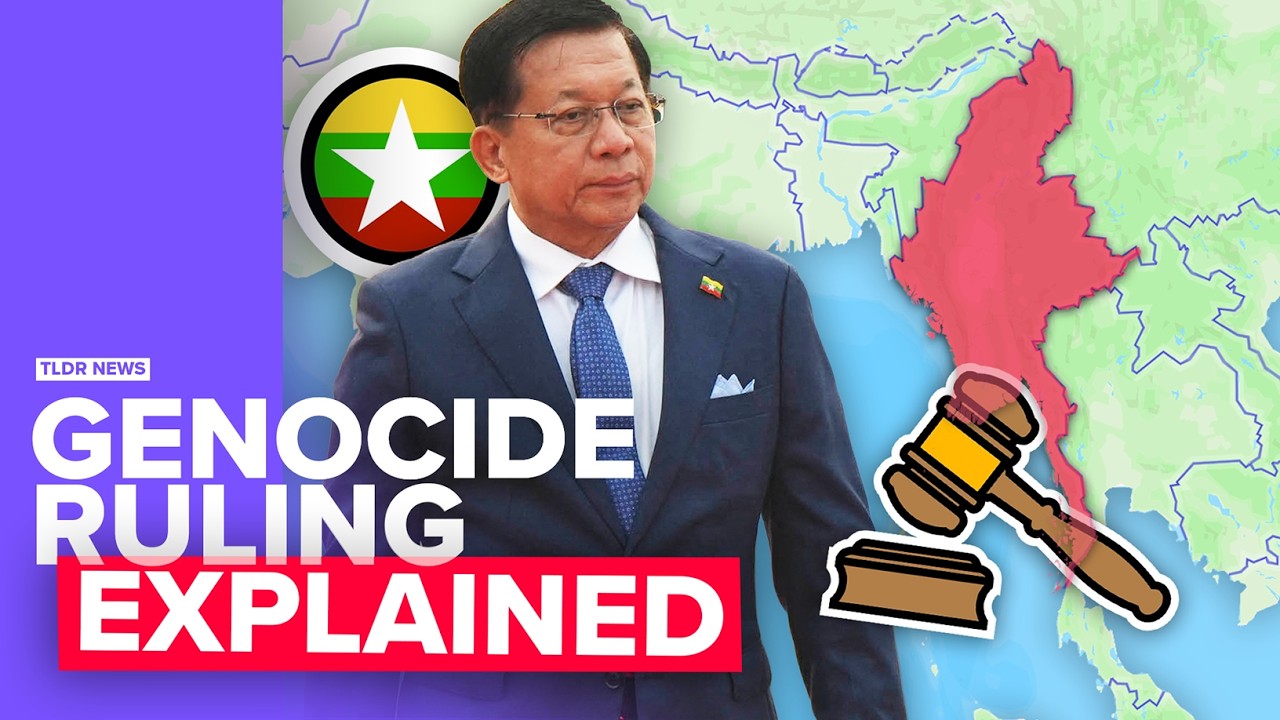
ICJ Rules Myanmar Committed Genocide: Historic Verdict, Limited Enforcement
For the first time, the International Court of Justice has found a state responsible for committing genocide. On Thursday, the United Nations' principal judicial organ ruled that Myanmar committed genocide against its Rohingya Muslim minority.
For the first time, the International Court of Justice has found a state responsible for committing genocide. On Thursday, the United Nations' principal judicial organ ruled that Myanmar committed genocide against its Rohingya Muslim minority. The decision ends a seven-year legal battle and sets a precedent for other genocide claims, including the ongoing case against Israel. The ruling has been hailed worldwide as historic. However, its practical impact remains uncertain, as the court lacks enforcement power. This article examines the origins of the case, the implications of the verdict, and what it signals for South Africa's case against Israel.
The Case Against Myanmar
The case centers on the Rohingya, a Muslim ethnic minority living primarily in Myanmar's western Rakhine state. For decades, the Rohingya have faced successive waves of extreme violence from the security forces of the Buddhist-majority country. The worst violence occurred between 2016 and 2017. After Rohingya militant attacks on border police, Myanmar's military launched what it called a clearance operation. The military targeted villages and towns home to Rohingya Muslims, killing more than 10,000 Rohingya in a few weeks, including children. The ICJ also found evidence of rape and other sexual violence committed by Myanmar's military against Rohingya women and girls. Hundreds of Rohingya villages were burned down. By 2017, more than 700,000 Rohingya had fled to neighboring Bangladesh. With Myanmar now locked in a brutal civil war, that number has only increased, especially since a rebel group known as the Arakan Army seized control of large parts of Rakhine State. Today, more than 1.2 million refugees from Myanmar live in Bangladesh, making it the largest refugee settlement in the world.
In 2019, The Gambia, a small African nation with no direct connection to the Rohingya, brought Myanmar before the court under the Genocide Convention. The Gambia could do so because international law allows countries to act against genocide even if they are not directly affected. This principle also enabled South Africa to bring its case against Israel. Such cases take years to reach a conclusion because genocide is notoriously difficult to prove. The crime was defined after the Holocaust by a 1948 UN convention. Proving it requires evidence of a specific intent to destroy a national, ethnic, racial, or religious group. The ICJ has ruled on the merits of a genocide claim only twice before. In 2007, the court found that Bosnian Serb forces committed genocide at Srebrenica in 1995, but ruled that Serbia itself was not responsible for committing genocide, only for failing to prevent or punish it. In 2015, the ICJ dismissed genocide claims brought by Serbia and Croatia against each other. In Myanmar's case, after seven years of hearing harrowing accounts, the court concluded that the army showed an intention to destroy a substantial part of the Rohingya population. This marks the first time the ICJ has found a state responsible for committing genocide.
Symbolic Victory, Limited Enforcement
However historic, the ruling may prove more symbolic than consequential. ICJ rulings are final and binding, and the court was established by the UN Charter in 1945. Yet it has no power to enforce its decisions. The court ordered Myanmar's government to provide reparations for victims, including safe, voluntary, and dignified return to their homes and restitution of property or compensation when restitution is not possible. If Myanmar ignores these orders, the country faces no real consequences unless The Gambia refers the matter to the UN Security Council. The Security Council could then enforce the ruling through a resolution. A resolution, however, requires a vote, and the deeply divided Security Council usually entails vetoes. In this case, China and Russia, which have relatively cordial relations with Myanmar's military junta, would likely veto any resolution. Without a Security Council resolution, the only other enforcement path is for interested states to exert leverage over the junta. The UK, for example, has announced the expulsion of Myanmar's defense attaché and called for a Security Council discussion. Such diplomatic nudges are unlikely to push Myanmar to comply meaningfully. After all, the country's current leader, Min Aung Hlaing, is the same man against whom the International Criminal Court sought an arrest warrant in 2024 over alleged crimes against humanity committed against the Rohingya when he headed the army. The ICC tries individuals, unlike the ICJ, which tries states. Min Aung Hlaing took power in a 2021 coup. In recent years, he has tried to reverse his status as an international pariah by organizing elections that were neither free nor fair and by stepping up international trips. To the disappointment of anyone who cares about international law, he has been quite successful. Myanmar's rare earth reserves have even drawn the attention of the Trump administration, which has recently reopened talks with his government.
Implications for Israel
The Myanmar verdict carries implications for the other genocide case at the ICJ: South Africa's case against Israel over its conduct in Gaza, brought in late 2023. Had the ICJ absolved Myanmar, ruling against Israel would have been difficult to imagine. The ruling against Myanmar demonstrates not only that a genocide verdict against a state is a real possibility, but also that, in the ICJ's eyes, self-defense or counter-terrorism justifications do not preclude a genocide verdict. The verdict on the South Africa-Israel case will not be known for years. Still, the Myanmar ruling should worry the Israeli government, which has made self-defense its primary argument against accusations of committing genocide in Gaza. Even if ICJ orders can technically be ignored without Security Council intervention, that should not minimize the importance of the Rohingya having their plight recognized by the world's highest court, or the possibility that Palestinians may one day receive similar recognition.
Related Coverage
Myanmar Military Committed Genocide Against Rohingya, UN Court Rules
The International Court of Justice has ruled that Myanmar's security forces carried out genocide against the Rohingya people, marking a historic legal step for the Muslim minority group.
World Court Finds Myanmar Guilty of Genocide Against Rohingya
The International Court of Justice has ruled for the first time that a country committed genocide, finding Myanmar responsible for atrocities against the Rohingya people. The court ordered Myanmar to stop the violence, punish those responsible, and provide reparations to victims.
World Court Rules Myanmar Committed Genocide Against Rohingya
The International Court of Justice has ruled that Myanmar committed genocide against the Rohingya, a Muslim minority group. The decision brings hope to refugees who fled a violent military campaign in 2017.
World Court finds Myanmar guilty of Rohingya genocide
The International Court of Justice has ruled that Myanmar committed genocide against the Rohingya people during military operations in 2016 and 2017. The court's decision is final and cannot be appealed.
Al-Azhar Backs ICJ Genocide Ruling Against Myanmar
Al-Azhar, Sunni Islam's leading religious institution, has endorsed a landmark International Court of Justice (ICJ) ruling on Myanmar's responsibility for genocide against Rohingya Muslims. The institution cited the killings of innocent Muslim civilians by security forces.
ICJ to Rule on Myanmar Genocide Case Against Rohingya
The International Court of Justice will decide this week whether Myanmar committed genocide against its Rohingya minority, a landmark ruling that could shape how the world judges the gravest crimes.