China’s Gold Rush: Why Beijing Is Quietly Stockpiling Bullion
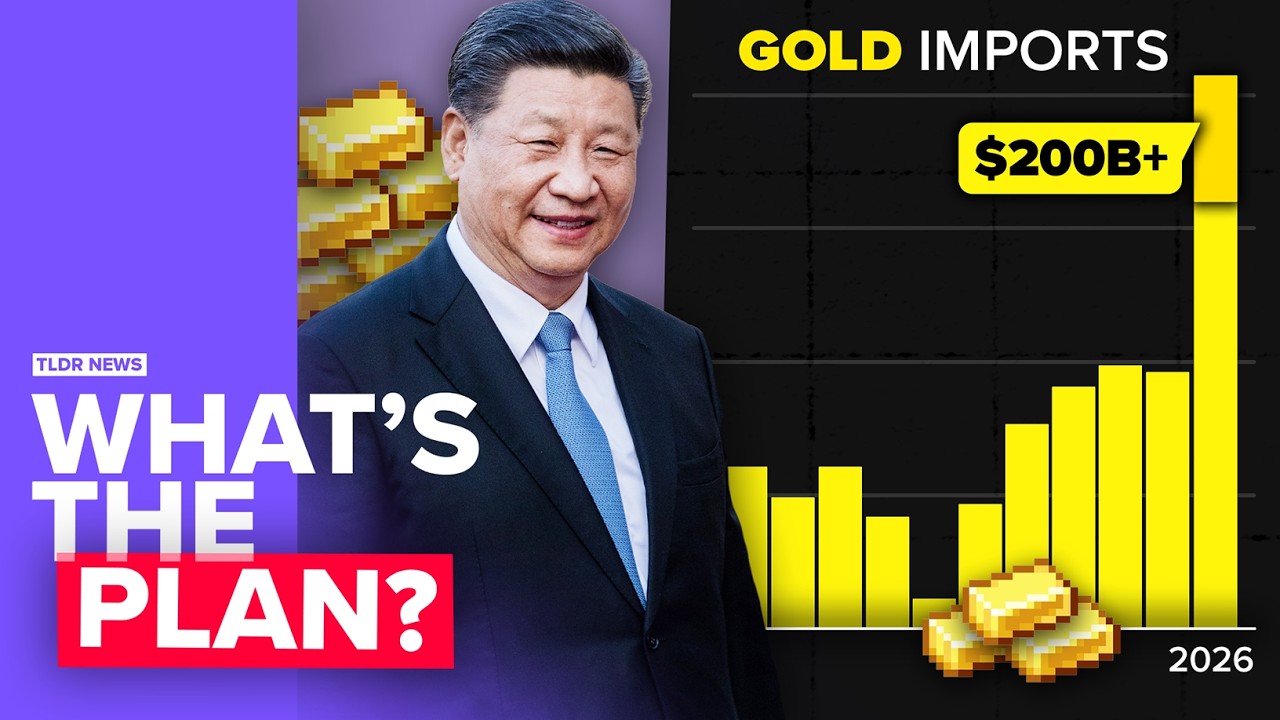
China has imported an extraordinary volume of gold this year. Customs data show that in the first eight months of 2026 alone, China brought in $159 billion worth of gold, up from $96.
China has imported an extraordinary volume of gold this year. Customs data show that in the first eight months of 2026 alone, China brought in $159 billion worth of gold, up from $96.5 billion for all of 2025. At the current pace, the country is on track to spend more than $200 billion on gold imports this year, roughly equal to the entire GDP of Hungary. Understanding why requires separating two distinct questions: why the Chinese government is buying so much gold, and why Chinese households and businesses are doing the same.
Start with the public sector. According to official data, the People’s Bank of China (PBOC), the country’s central bank, has added gold to its foreign exchange reserves continuously for the past two years. It now holds 78 million troy ounces, up about 25 percent since 2022, giving China the fifth-largest gold reserves in the world. If current trends continue, it will likely overtake France and Italy to take third place.
One common explanation is that Beijing is buying gold to replace US government bonds. For decades, the PBOC recycled much of the cash China earned from its trade surplus into US Treasuries, holding them in its foreign exchange reserves. The arrangement worked well: the PBOC earned interest on its reserves by effectively lending to the US, while giving America the purchasing power to keep buying Chinese goods. In recent years, however, China’s Treasury holdings have fallen sharply, from a peak of $1.3 trillion in late 2013 to roughly $600 billion today.
That combination of fewer Treasuries and more gold has led some analysts to conclude that the PBOC is replacing Treasuries with gold because it no longer considers Treasuries a safe reserve asset. The evidence does not support this. Analysis by Brad Setser of the Council on Foreign Relations suggests the PBOC has not dumped its Treasuries but moved them to custodians in Belgium, Luxembourg, France, and the UK, whose total Treasury holdings have risen as China’s have fallen. In practice, China’s overall Treasury holdings have stayed relatively constant; Beijing is simply hiding some of them. The motive is unclear. It may be a response to domestic pressure from nationalists who dislike lending to America, or an effort to make US policymakers less anxious about how indebted they are to Beijing. Either way, the theory that the PBOC is rotating out of Treasuries and into gold does not hold.
This is not to say the new gold gives Beijing no hedge against sanctions that could be imposed on its dollar-based reserves. But it is hard to see this as part of a broader pivot away from the dollar, since the share of dollar-based assets in China’s overall reserves has remained relatively constant over time once custodians are included.
So why else is the PBOC buying so much gold? Given its apparent penchant for financial skulduggery, the most likely reason is to disguise the true size of China’s trade surplus. Gold occupies an unusual position: it is money-like, its value clearly detached from its utility as a commodity, and it often behaves like a safe-haven currency, appreciating in times of turmoil. Yet when a country calculates its trade balance, gold is treated not as money but as an ordinary import. When China uses dollars earned from exports to buy gold, the resulting gold imports count against its trade surplus. Had it used the same dollars to buy Treasuries, those inflows would not have counted against the surplus. Converting foreign currency into gold thus lets China understate its trade surplus while continuing to hoard money, because gold is, again, money-like.
The effect is that China’s trade surplus appears to have flatlined over the past year, when in reality, once gold is stripped out, it has continued to rise at a relatively steady rate. This in turn allows Chinese policymakers to deflect attention from the surplus, which has drawn considerable criticism from Western officials, especially after it hit $1 trillion last year. That figure is often cited as proof that China discriminates unfairly against imports from other countries.
The private sector is also keen on bullion. According to the China Gold Association, purchases of gold bars and coins rose nearly 30 percent in the first half of 2026 compared with the same period last year. The most plausible explanation is that Chinese households and businesses have nowhere else to invest. In most countries, a saver with a large pile of cash has two obvious options: property, as many Britons choose, or the stock market, as many Americans do. In China, neither is viable.
The housing market has been declining since late 2021, when the Chinese Communist Party imposed its so-called three red lines in an attempt to deleverage the sector. Property prices are now 20 percent below their peak with no recovery in sight. The stock market has fared little better. The Shanghai Composite, which tracks every company listed on the Shanghai Stock Exchange on a capitalization-weighted basis, is down 15 percent from its May peak and has barely moved in a decade. An investor who bought at the top in 2015, or even back in 2008, would still be in the red today. Capital controls also prevent ordinary households from investing in more lucrative markets such as the S&P 500 in the US. With few good options at home, more Chinese savers are turning to gold.
The picture that emerges is of a government using gold to obscure the scale of its trade surplus and a public using it as a refuge from moribund property and equity markets. Both strands of demand point to the same underlying reality: in an economy with limited outlets for capital, the shiny metal has become the asset of choice.
Related Coverage
Gold Hits $4,000 as Iran Talks and Fed Decision Loom
Gold prices surged past $4,000 per ounce on Monday, as investors anxiously await the outcome of U.S.-Iran peace talks and signals from the Federal Reserve on potential interest rate cuts [185476]. The jump reflects growing uncertainty in global markets, with traders turning to safe-haven assets amid diplomatic developments in the Middle East and the central bank’s next policy meeting [185476].
Gold Tops $4,400 as Oil Rally Fans Inflation Fears
Gold prices surged past $4,400 per ounce for the first time, extending a record-breaking rally as a four-day climb in oil prices reignited inflation concerns ahead of a key U.S. consumer price index (CPI) report due later this week [216081][216078].
Chinese Cars Are Eating Europe: 20 Brands Storm Paris as Market Share Doubles to 10.7%
A record 20 Chinese automakers are showcasing their vehicles at the Paris Motor Show as Chinese brands rapidly expand across Europe, more than doubling their market share in just one year and forcing European manufacturers to demand political protection.
Chinese AI Chipmaker Biren Sees Revenue Soar Up to 2,107% on Domestic Demand
Chinese artificial intelligence chipmaker Biren Technology has projected a massive surge in first-half revenue, forecasting growth of up to 2,107 percent as domestic demand for home-grown semiconductors explodes [221169].
China’s Summer Travel Boom: Niche Tours and New Perks Draw Record Visitors
China is seeing a surge in summer inbound tourism, fueled by niche travel experiences and fresh government initiatives. The country is actively courting international visitors with new policies and unique attractions, aiming to turn a seasonal spike into a long-term trend.
China Builds Sanctions Shield as 100+ Nations Plug Into Its Dollar-Free Payment System
China is quietly constructing a financial backup system designed to survive U.S. sanctions, with its Cross-Border Interbank Payment System (CIPS) now operating in over 100 countries as Beijing seeks to reduce reliance on the dollar [227337].