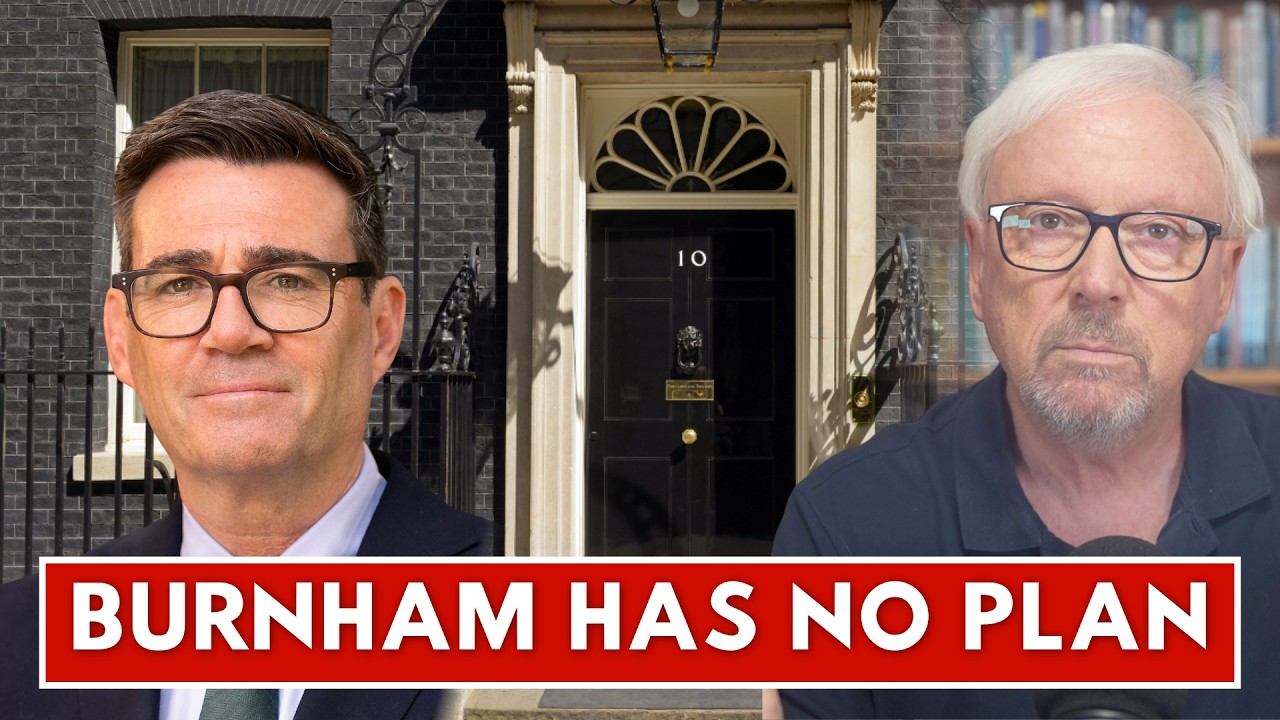
The Man Who Would Be Prime Minister Has No Plan for Britain
Andy Burnham says Britain needs a ten-year plan. He is right.
Andy Burnham says Britain needs a ten-year plan. He is right. The problem is that he does not have one. More than that, he appears not to know what it should contain. Having promised to deliver a plan on arriving in Westminster, he has instead hired someone to write it for him, and now reportedly engaged consultants to help with the process. The plan is delayed, with no new date set.
This should worry voters. Any new prime minister ought to have a plan before seeking office. Otherwise, why seek power at all? Politicians should know why they want power and what they want to achieve before they enter politics, let alone before they become prime minister. They should understand the society they want to create, how government and the economy actually work, and how they would deliver. Their political philosophy should determine their priorities, which is why having one matters. If Burnham cannot produce a plan, does he have a political philosophy at all? A plan should follow naturally from conviction. It should not need to be worked out after taking office.
I have no ambition to become prime minister, but I know what government is for and what I want it to achieve. My understanding of political economy and my technical expertise inform these choices. I have developed many plans for many organisations over the years, so this is almost second nature.
Let me be clear about what such a plan is not. It is not a prediction. Nobody can know what will happen over ten years. War, drought, famine, flooding: events beyond our control will occur. A plan must therefore be flexible. It must accept that elections will come and go, that some policies will fail while others succeed, and that new opportunities will emerge that nobody anticipated. None of this makes planning pointless.
A plan of this kind provides a framework for government. It establishes the objectives government should pursue, identifies the principles guiding its decisions, and helps resolve conflicts between competing priorities by making clear where the government is heading. It provides consistency when circumstances change and gives direction without prescribing every decision, which is the last thing it should do. Nobody knows what will need to be decided in eight, nine or ten years. It is a plan for direction, not a detailed plan for delivery.
It is worth stressing how novel this is, because neoliberalism is the absence of a plan. That is what we have had for 45 years. Neoliberalism represented the abandonment of purposeful government. It assumed markets knew best and that government should stand aside. Markets, in that framework, provide outcomes and replace democratically determined priorities. Fiscal rules deliberately constrain what governments can do. But markets cannot decide what society needs, and that is precisely why we need a plan. Neoliberalism deliberately denied us one.
Markets are important, powerful and necessary, but they cannot determine what makes a good society. They respond to purchasing power, not to human need. They cannot guarantee full employment, ensure everyone has a decent home, or decide how much inequality is acceptable. Those are political choices that government must make.
So what should government seek to achieve? These goals define any plan. Governments should seek to meet human needs. Everyone should enjoy economic and social security. Everyone should have access to essential public services. Everyone should have a secure and affordable home. Economic activity must respect environmental limits. Democracy must be given meaningful purpose and influence over decisions. Business should be respected, but it should not govern the needs of society.
Planning also requires understanding what is actually possible. In government, money is not the fundamental constraint. Labour, skills, energy, materials and environmental limits determine what can be done. Different priorities compete for those available resources. Government's job is to reconcile those demands with its own objectives and those of the marketplace. That requires coordination, not blind faith. Because our resources are limited, particularly by climate change, we must decide our priorities. That is the purpose of planning.
A plan also makes government accountable. If a government has stated what it intends to do, and parliament has approved it, the electorate and the opposition can hold it to account for what it has or has not achieved. Progress can be appraised, so the plan must be detailed enough to allow realistic appraisal. It cannot state definite outcomes, but the direction of travel must be clear and progress against it measurable. When circumstances change, the direction should either stay consistent and be achieved differently, or the change should be acknowledged and the plan altered. Either way, accountability is key. Learning from failure should be treated as an opportunity for correction, not as a disaster. This requires mature government and a mature opposition. The silly game in which opposition parties claim the government is wrong on everything and they are always right is not the politics we need. We need politics that recognises when something is good and offers constructive criticism when it is not, without bragging for its own sake. Accountability must concern itself with results, not arbitrary fiscal targets, and it must put people at its centre.
My ten-year plan begins with the courageous state, a subject I have written about for more than fifteen years: a state that believes it has a duty to act on behalf of people and must deliver for them. A courageous government must know what it is trying to achieve and believe it should deliver it. It must understand the economy it seeks to change, its capacity to deliver, and the instruments of government available to it. I will elaborate these proposals in a series of articles.
Andy Burnham clearly has no idea about these things. If he did, he would have delivered his plan already. He should have written it long before he was elected as MP for Makerfield, because he knew when he won that by-election that he was heading for Downing Street. That was his goal. Since he does not know what he is doing, I will step into the gap and suggest what the country should be doing before he puts pen to paper. The question is what you would want a ten-year plan to achieve. I would be interested to hear your plans as well.
Related Coverage
Related Editorials
Burnham’s Ten-Year Plan Cannot Succeed Without a Real Understanding of Government
Andy Burnham’s failure to produce the ten-year plan he promised raises a question that goes beyond one politician’s missed deadline. A credible plan for Britain requires more than ambition or a list of attractive promises.
Can Andy Burnham Think Big Enough to Succeed as Prime Minister?
Andy Burnham, the Mayor of Greater Manchester, is frequently cited as a potential future leader of the Labour Party and, by extension, a candidate for Prime Minister. His record, however, presents a complex picture.
Andy Burnham’s Ambition for Manchester Will Fail Unless He Breaks the Economic Rules
By [Your Name/Editorial Staff] Greater Manchester’s Mayor, Andy Burnham, has set an ambitious goal: to transform his region into a global economic powerhouse. Yet, according to a growing chorus of analysts and economists, his plan is destined to fail unless he is willing to challenge the very fisca
Does Andy Burnham Understand Economics? A Critical Look at the Mayor’s Fiscal Vision
By an Expert Editor, International Policy Review The question sounds almost impertinent: does a successful mayor, a former cabinet minister, understand the basic principles of economics? Yet, when Andy Burnham, the Mayor of Greater Manchester, recently laid out his vision for the region’s financial
Andy Burnham’s December Election Gamble: A Calculated Bid for Downing Street?
Introduction Is Andy Burnham preparing to trigger a general election in December? Recent political maneuvering suggests the Mayor of Greater Manchester is positioning himself for a dramatic return to Westminster.
Andy Burnham Must Answer These Questions: The Unanswered Questions Haunting Greater Manchester
Andy Burnham, the Mayor of Greater Manchester, has long positioned himself as a champion of the North, a voice for the working class, and a potential future leader of the Labour Party. Yet, as his tenure continues, a series of troubling questions remain unanswered.