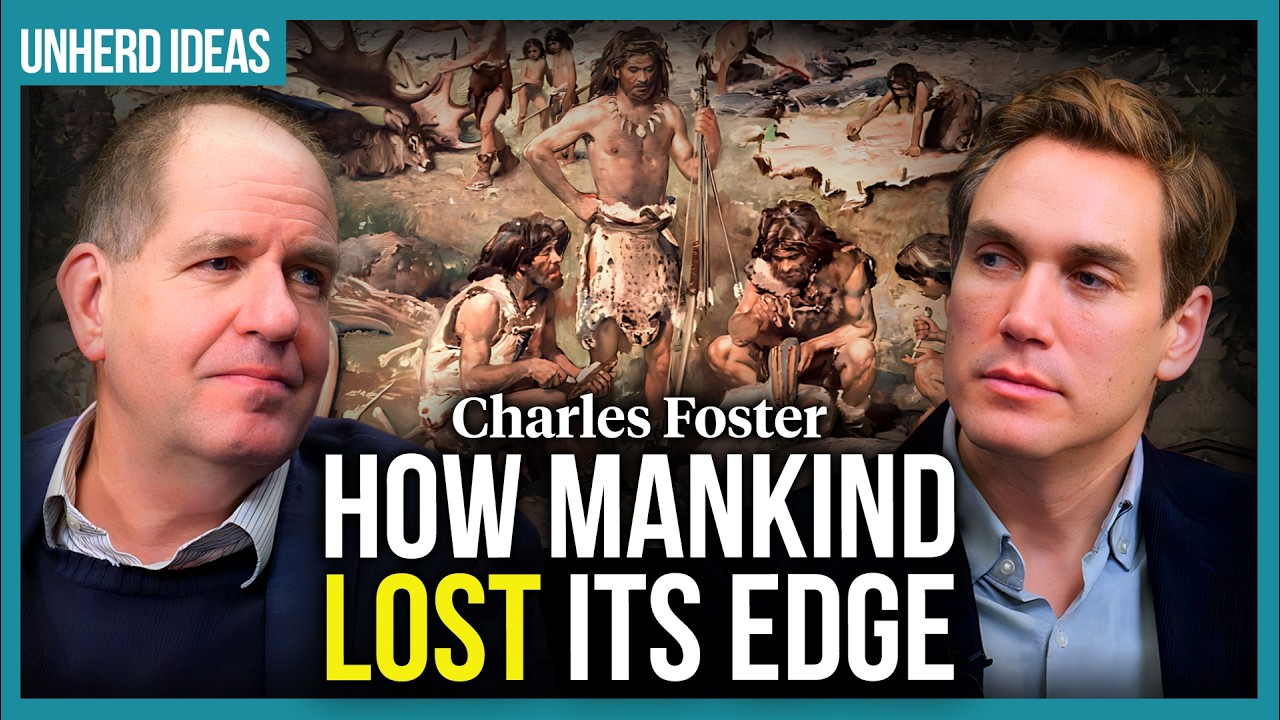
The Comfort Trap: How Modern Life Is Erasing Humanity's Greatest Evolutionary Edge
For most of human history, survival demanded acute sensory awareness. Our ancestors navigated the world through heightened smell, hearing, and vision—abilities that modern humans have largely abandoned in favor of comfort and convenience.
For most of human history, survival demanded acute sensory awareness. Our ancestors navigated the world through heightened smell, hearing, and vision—abilities that modern humans have largely abandoned in favor of comfort and convenience. This loss of sensory engagement with the natural world may be more consequential than we realize, argues Charles Foster, a fellow of Green Templeton College at Oxford University and author of Being a Beast.
Foster's central thesis is provocative: humanity has traded its evolutionary edge for domestic ease, and in doing so, has become increasingly disconnected from the very environment that shaped us. Understanding this loss requires examining how our ancestors perceived the world—and what we have sacrificed to escape it.
The Sensory World of Our Ancestors
Early humans lived in a world saturated with information that most modern people can no longer access. They could track animals by scent, detect subtle changes in weather through smell, and navigate vast landscapes using sensory cues invisible to contemporary humans. This was not a matter of mystical ability but of necessity. Survival depended on reading the environment with precision.
Foster illustrates this through the example of smell—perhaps the most neglected of human senses. Our ancestors possessed a vocabulary for odors that rivaled their language for colors. They could distinguish between dozens of types of animal musk, detect the presence of predators by scent, and even smell emotions such as fear or aggression. Today, most people struggle to describe a single smell beyond "good" or "bad."
This sensory atrophy is not merely a curiosity. It represents a fundamental shift in how humans relate to their environment. When we lose the ability to perceive the world through multiple senses, we lose the capacity to understand it deeply. The consequences extend beyond nostalgia for a more "primitive" existence—they affect how we make decisions, how we assess risk, and how we connect with the natural world.
The Domestication of Perception
Foster argues that this sensory decline is a direct result of domestication—not just of animals and plants, but of humans themselves. Over millennia, humans have selected for traits that favor comfort, predictability, and control over those that enhance environmental awareness. We have built environments that minimize sensory challenge: temperature-controlled homes, artificial lighting, processed foods, and digital interfaces that replace direct experience with mediated information.
This process has accelerated dramatically in the industrial and digital ages. The average person today spends more time in front of screens than in natural environments. Children are increasingly raised in urban settings where the sounds, smells, and sights of the natural world are absent or muted. The result is a population that is functionally illiterate in the language of the senses.
Foster does not advocate for a return to primitive living. Rather, he suggests that this loss of sensory acuity represents a form of collective disability—one that we have normalized but not fully understood. Just as a person who loses their sight must adapt, humanity has adapted to sensory deprivation by developing technologies that compensate. But compensation is not the same as restoration, and the underlying disconnect remains.
The Evolutionary Trade-Off
From an evolutionary perspective, this trade-off might seem puzzling. Why would natural selection favor traits that reduce environmental awareness? Foster argues that the answer lies in the nature of human adaptation. Humans are unique in their ability to modify their environment rather than adapt to it biologically. We build shelters instead of growing fur; we create agriculture instead of foraging; we develop medicine instead of evolving immunity.
This strategy has been extraordinarily successful in terms of population growth and technological advancement. But it has also created a mismatch between our evolved sensory capabilities and the environments we now inhabit. We retain the sensory apparatus of our ancestors—the olfactory receptors, the auditory range, the visual acuity—but we no longer use them in the ways they evolved to function.
The result is a kind of sensory phantom limb: we possess the equipment for rich sensory engagement with the world, but we have lost the cultural and practical knowledge of how to use it. This disconnect may contribute to modern malaise, including the sense of alienation from nature that characterizes much of contemporary life.
Reclaiming the Lost Edge
Foster's work is not merely diagnostic. He suggests that reclaiming sensory awareness is possible, though it requires deliberate effort. Practices such as tracking, foraging, and nature observation can help restore sensory acuity. More fundamentally, he advocates for a cultural shift that values sensory engagement as a form of knowledge and well-being.
This does not mean rejecting technology or modern comforts. Rather, it means recognizing that these advances have come at a cost—and that the cost may be higher than we have acknowledged. The human edge that allowed our ancestors to thrive in challenging environments was not just physical strength or intelligence. It was a deep, embodied connection to the world around them, mediated through senses that we have largely allowed to atrophy.
Whether this edge can be recovered—or whether it even needs to be—remains an open question. But Foster's argument invites us to consider what we have lost in our pursuit of comfort, and whether the trade was worth the price.