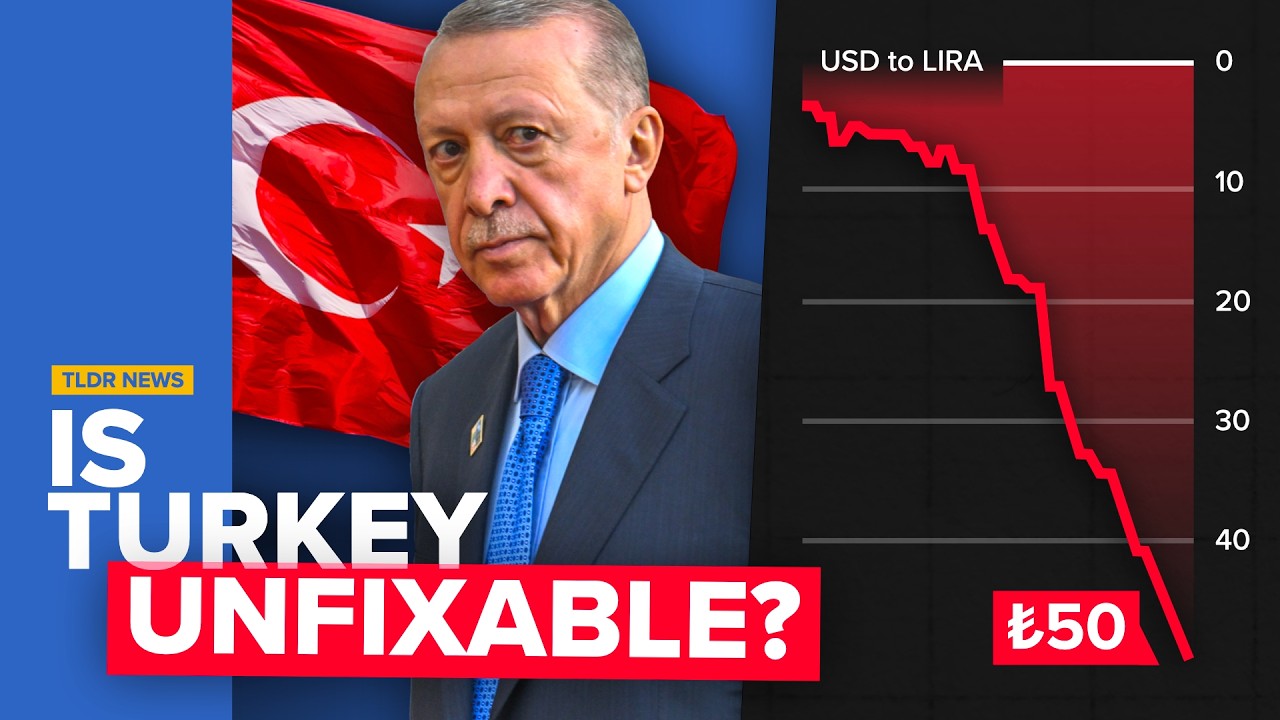
Turkey’s Economic Paradox: Growing GDP, Shrinking Paychecks
Turkey occupies a strategic position between Europe and Asia, bordering the Middle East and the Black Sea. It is a nation of 85 million people and a lynchpin of NATO.
Turkey occupies a strategic position between Europe and Asia, bordering the Middle East and the Black Sea. It is a nation of 85 million people and a lynchpin of NATO. For years, it was touted as an economic miracle—a model for the developing world. Today, that narrative has collapsed. Despite occasional reports of growth, the lived reality for the average Turkish citizen is one of relentless financial strain. How did a country with so much potential find itself trapped in a cycle of currency collapse and soaring inflation?
The Illusion of Growth
On paper, Turkey’s economy sometimes appears to be expanding. However, economists warn that this growth is deceptive. The country is caught in a "middle-income trap," a situation where a nation reaches a certain income level but struggles to advance further due to structural flaws.
The numbers tell a concerning story. While the economy has grown in terms of Gross Domestic Product (GDP), the standard measure of goods and services produced, the wealth is not reaching the people. GDP per capita, which measures individual prosperity, has been falling. In 2013, Turkey’s GDP per capita peaked at roughly $12,500. Today, when adjusted for inflation, it has dropped to levels comparable to 2008. The economy is growing on paper, but the citizens are getting poorer.
The Inflation Crisis
The most visible symptom of Turkey’s malaise is inflation. Official figures place inflation at around 60%, but independent economists argue the real number is much higher—closer to 120%. This discrepancy is not accidental. For years, the government has interfered with the Turkish Statistical Institute (TUIK), the body responsible for reporting economic data. By manipulating the basket of goods used to calculate inflation, the government masks the severity of the crisis.
This manipulation has real-world consequences. Banks and employers often use the official, lower rate to calculate wage increases and loan interest, leaving citizens with less purchasing power. To understand the true cost of living, one only needs to look at the price of basic staples. The cost of food, rent, and transportation has skyrocketed, making it increasingly difficult for families to afford necessities.
The "Erdoganomics" Experiment
The root of this crisis lies in unorthodox economic policies championed by President Recep Tayyip Erdogan. Erdogan, who has ruled Turkey for two decades, holds a firm belief that high interest rates cause inflation—a view contrary to established economic theory. Standard economics dictates that raising interest rates cools down inflation. Erdogan, however, believes that high interest rates make borrowing expensive and slow down the economy, so he has pressured the central bank to keep rates low.
This policy, often dubbed "Erdoganomics," has been disastrous. By keeping interest rates low while inflation soared, the government effectively devalued the Turkish Lira. As the currency crashed, the cost of imported goods—including fuel, medicine, and raw materials—exploded. This created a feedback loop: the weak currency drove up prices, which in turn eroded the value of the currency further.
The Erosion of Trust
The economic crisis has triggered a crisis of trust. The government’s control over the media and the central bank has eroded confidence among foreign investors. Without foreign investment, Turkey struggles to finance its large current account deficit—the gap between what it imports and what it exports.
To stem the bleeding, the government has resorted to desperate measures. In 2021, authorities introduced a scheme to protect lira deposits against currency fluctuations, effectively paying citizens to keep their money in the local currency. While this temporarily slowed the crash, it has drained the government's budget and created a massive liability.
A Society Under Strain
The economic collapse has fractured Turkish society. The gap between the rich and the poor has widened. While the wealthy can protect their assets by converting them to foreign currencies or gold, the working class is trapped.
Furthermore, the crisis has fueled political polarization. Erdogan’s supporters argue that the country is under attack by foreign powers and that the new economic model will eventually lead to independence from foreign energy and technology. Critics, however, see the situation as a self-inflicted wound caused by authoritarian mismanagement.
The Brain Drain
Perhaps the most damaging long-term effect is the exodus of talent. Young, educated Turks are leaving the country in droves, seeking better opportunities in Europe and North America. This "brain drain" threatens Turkey’s future growth, as the country loses the very people it needs to innovate and rebuild.
Conclusion
Turkey stands at a crossroads. The government continues to insist that its new economic model will eventually stabilize the country, but the data suggests otherwise. With reserves depleted, inflation spiraling, and trust in institutions at an all-time low, the path to recovery is narrow. For the average citizen, the immediate future holds little relief. The Turkish economic miracle is over; what remains is a difficult struggle for survival in a nation that has lost its financial footing.
Related Coverage
NATO Summit Kicks Off in Ankara as Turkey’s Own Crisis Boils Over: Bridge Tolls Jump 534%, School Lunch Funds Missing
As NATO leaders gather in Ankara to discuss Europe taking on more military burden, Turkey faces a deepening domestic crisis over democratic backsliding, soaring living costs, and a crackdown on dissent.
Indonesia Leads ASEAN Push as Turkey Joins, Defense Pacts Signed, South Korea Deal Sped Up
Indonesia is spearheading a major diplomatic and security push across Southeast Asia, as Turkey officially joins ASEAN as a dialogue partner, Jakarta ratifies defense pacts with Turkey and Malaysia, and accelerates defense and investment deals with South Korea.
Erdogan and Netanyahu’s War of Wills: 2 Armies, 1 Region, Zero Room for Compromise
Turkey’s opposition has dropped its domestic fight to back President Recep Tayyip Erdogan as the standoff with Israel over Syria and Gaza escalates, turning a personal rivalry into a strategic clash reshaping the Middle East.
Turkey Locks Down Opposition, Opens Peace Talks in Power Grab
Turkey is shifting its political balance by launching new peace talks on the Kurdish issue while simultaneously cracking down on opposition parties, a dual strategy that appears designed to create a more manageable political system.
Turkey’s Economic Squeeze: Inflation Target Soars to 28.4%, Growth Cut as Labor Underuse Hits 30.6%
Turkey is facing a harsh economic reality check, as the government sharply raises its inflation target for 2026 while cutting growth forecasts, even as new data reveals that nearly a third of the workforce is struggling to find full, stable employment.
Turkey Locks Up 19.5 Years for Activist, Jails NATO Protesters, Crushes Dissent—But the Money Trail Points to Erdogan’s Asset Protection
Turkish authorities handed down a 19.5-year sentence to women’s rights activist Ayşe Gökkan and jailed two NATO summit protesters, while a court refused to reduce an LGBT+ activist’s sentence citing “negative personality traits.” These moves are not about ideology—they are about protecting President Erdogan’s political and financial grip by eliminating opposition that threatens his regime’s stability and donor networks.
Related Editorials
The Emerging Axis: Inside the Turkey-Pakistan-Saudi Arabia Defense Compact
In the shifting sands of global geopolitics, a new triangle of military cooperation is taking shape. Stretching from the Bosporus to the Arabian Sea, Turkey, Pakistan, and Saudi Arabia are forging a defense pact that could redraw the strategic map of the Middle East and South Asia.
Turkey’s Silent Surge: How Ankara Is Reshaping the Battlefield in Mali
For years, the conflict in Mali has been defined by a complex web of local militias, foreign mercenaries, and shifting jihadi alliances. Yet, a new player has quietly moved to the center of the board, altering the strategic calculus of the Sahel.