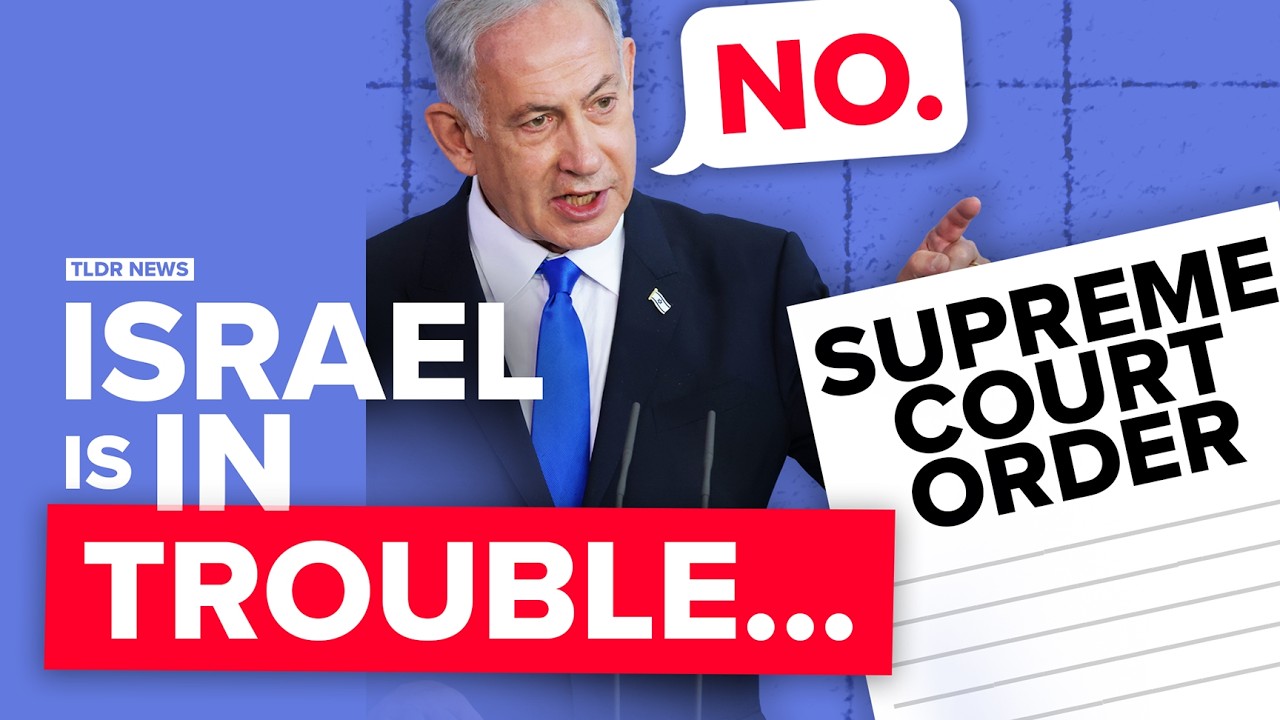
A Historic First: Israel's Government Refuses to Obey Its Supreme Court
On Sunday, Israel's government did something no Israeli government had ever done. With the unanimous backing of the cabinet, it announced that it would disobey a ruling from the country's highest court.
On Sunday, Israel's government did something no Israeli government had ever done. With the unanimous backing of the cabinet, it announced that it would disobey a ruling from the country's highest court.
The ruling concerned a dispute over Israel's media regulator, and at first glance the issue may look technical. The consequences are not. The move has pushed Israel into a constitutional crisis, meaning the country's institutions now openly clash over the basic rules of state power. It has also intensified Prime Minister Benjamin Netanyahu's long-running conflict with the judiciary, just months before a national election that could decide the fate of his government.
The fight over a television channel
The story begins with Channel 13, an influential commercial television station in Israel. The channel loses money, but it matters. It has aired investigative reports critical of Netanyahu.
Two groups competed to buy Channel 13 this year. One bid came from Patrick Drahi, a French-Israeli telecom billionaire who owns i24NEWS, a network aligned with Netanyahu. Critics, including Israel's Union of Journalists, warned that a Drahi takeover would erode press freedom. They described it as part of what they called the government's "master plan to capture the media."
The rival bid won. It came from a consortium of tech entrepreneurs led by Asaf Rappaport, an Israeli billionaire and outspoken critic of Netanyahu, particularly of his judicial reform plans.
Then the regulator entered the story. The Second Authority for Television and Radio, the government body that oversees commercial broadcasting in Israel, had to approve the sale to Rappaport's group. The decision rested with its Regulatory Council, a board made up mostly of appointees from the previous government, which opposed Netanyahu.
The council's term expired at the end of 2025. Netanyahu's government tried to appoint new members, but several nominations faced legal challenges over issues such as conflicts of interest. The Supreme Court therefore ordered the existing council to stay in place until it ruled on the appointments.
Then came a twist. Several council members resigned after pressure from Communications Minister Shlomo Karhi, according to reports. Their departure dropped the council below the two-thirds "quorum" it needs under Israeli law, the minimum number of members required for its decisions to be valid. Reports suggest the government wanted exactly this outcome: to paralyze the old council, block the Channel 13 sale, and clear the way for its own appointees.
The Supreme Court intervened again in mid-June. It ruled that the council could keep operating without a quorum because of the exceptional circumstances.
Defying the court
That ruling proved to be the trigger. On Sunday, the cabinet unanimously issued an extraordinary statement rejecting the court's decision, which it claimed contradicted the law. Karhi and Justice Minister Yariv Levin accused the court of being "drunk with power." They said the government would not recognize any decision, approval, appointment, or action taken by the council in its current state.
In practice, the declaration may have little effect on the regulator's daily work. In principle, it is unprecedented. According to The Times of Israel, this is the first time in Israel's history that a government has openly declared it will not respect a ruling by the nation's highest court.
The reaction was immediate. Opposition leader Yair Lapid said the government had "become criminal." Naftali Bennett, another opposition figure and longtime Netanyahu rival, warned that disobeying a court ruling "leads to anarchy in the streets and to the dismantling of our state." President Isaac Herzog said that ignoring a court ruling is "a red line that must not be crossed under any circumstances."
A long feud with the judiciary
The standoff is the latest chapter in a much longer conflict between Netanyahu and Israel's courts.
Part of the tension is personal. Netanyahu has stood trial on corruption charges for years. He denies the allegations.
The conflict turned political after the 2022 election, when Netanyahu returned to office and formed the most right-wing government in Israel's history. His coalition proposed far-reaching judicial reforms, arguing that the Supreme Court holds a liberal bias, acts undemocratically, and interferes too deeply in politics. The reforms would have weakened the court's power and independence.
The plan sparked mass protests across Israel throughout 2023. It was largely shelved after the October 7, 2023 attack and the outbreak of the war in Gaza. In recent months, however, the government has tried to revive parts of the overhaul.
An election and a divided country
Netanyahu's opponents see a darker purpose behind the defiance. They fear the government is normalizing disobedience to the courts and preparing to ignore more consequential rulings in the future. Yair Golan, leader of the small center-left Democrats party, went furthest. He called the decision to ignore the ruling "the operational order ahead of election day," accusing the coalition of laying the groundwork to reject the election results.
That election is due in October, and it could decide the survival of Netanyahu's coalition.
The crisis also exposes divisions that foreign audiences rarely see. Coverage of Israel usually focuses on security and its military actions in Gaza, the West Bank, Lebanon, and Syria. Yet inside the country, society is splitting over the war on multiple fronts, the effort to bring home the hostages taken on October 7, military service exemptions for ultra-Orthodox Jewish Israelis, and the judicial reforms themselves.
The numbers show how deep the rift runs. A May 2026 poll by the Israeli Democracy Institute found that only 40 percent of Israelis were optimistic about the future of democratic rule, and just 21 percent were optimistic about social cohesion. A separate poll by the Jewish People Policy Institute produced an even more striking result. Asked to name the greatest threat to Israel's continued existence, 55 percent of Israelis chose polarization and internal conflict. That ranked above the perceived threat of an Iranian nuclear bomb and above the conflict with the Palestinians.
The government's declaration may matter less for what it does to a television deal than for what it signals: that Israel's governing institutions no longer feel bound by the same rules. By its own citizens' assessment, the gravest danger Israel faces is no longer Iran or the war with the Palestinians. It is the country's division from within.