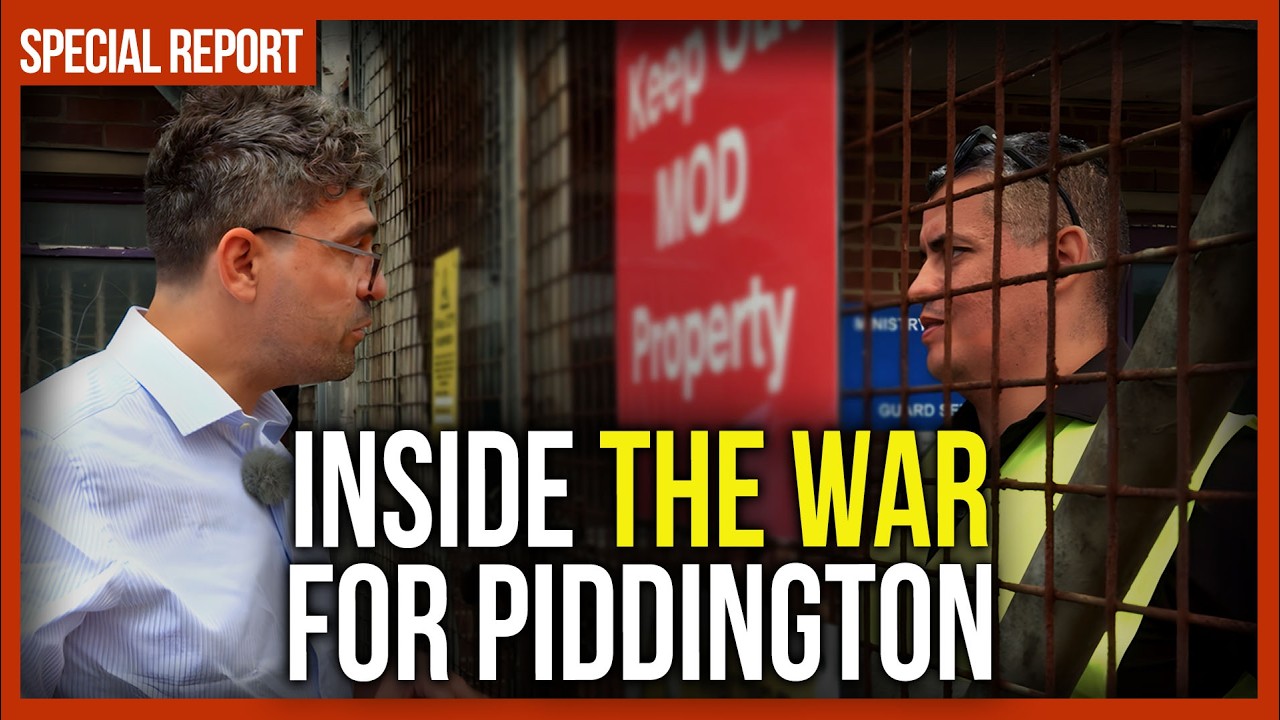
# The Battle for Piddington: How One English Village Became a Test Case for Britain's Asylum Crisis
A quiet parish in Northamptonshire finds itself at the center of a national storm over immigration, community consent, and the limits of government power. --- ## A Village Transformed Piddington is a small village in Northamptonshire, England.
A quiet parish in Northamptonshire finds itself at the center of a national storm over immigration, community consent, and the limits of government power.
A Village Transformed
Piddington is a small village in Northamptonshire, England. It has a church, a pub, and a population of roughly 1,500 people. For most of its history, it has been unremarkable—the kind of place where nothing much happens and residents like it that way.
That changed when the British government selected a site near the village to house asylum seekers. The decision, made without consulting local residents, triggered a fierce conflict that would draw national attention and expose deep fractures in how Britain handles immigration.
The Government's Plan
Under pressure to reduce the cost of housing asylum seekers in hotels, the government announced plans to convert a former military site near Piddington into accommodation for hundreds of migrants. Officials described the move as a practical solution: cheaper than hotels, faster than building new facilities, and part of a broader strategy to process asylum claims more efficiently.
The government framed the decision as necessary and temporary. Local councils were informed, but residents were not consulted. For officials in London, Piddington was a logistical problem to be solved. For the people who lived there, it was an imposition.
The Community Responds
Residents organized. They attended meetings, wrote to their representatives, and formed action groups. Their objections were not uniformly about immigration itself. Many raised concerns about infrastructure: the village's roads, doctors' surgeries, and schools were already stretched. Others questioned the lack of transparency—why had they not been asked?
Some residents expressed fears about safety, citing incidents in other towns. Others worried about the message the decision sent: that rural communities could be used as dumping grounds for policies they had no say in shaping.
The opposition was not monolithic. Some residents supported the plan or remained neutral. But the loudest voices came from those who felt their community had been ignored.
National Attention
The story spread. Journalists arrived. Politicians weighed in. The conflict in Piddington became a proxy for a larger debate: How should Britain house and process asylum seekers? Who should decide where they live? And what obligations does the state have to consult the communities it places them in?
Supporters of the government's plan argued that opposition was driven by racism or xenophobia. Critics countered that dismissing legitimate concerns as bigotry shut down necessary debate. Both sides accused the other of bad faith.
The Broader Context
Piddington is not unique. Across Britain, similar conflicts have erupted in towns and cities selected to host asylum accommodation. The government's reliance on hotels has cost billions of pounds, and its efforts to move migrants into cheaper facilities have met resistance in numerous communities.
The debate reflects a deeper tension. Britain has legal obligations to provide shelter and process asylum claims. But the mechanisms for doing so are unpopular, underfunded, and often imposed on communities with little warning. The result is a cycle of crisis, backlash, and resentment.
What Happened Next
The government pressed ahead. The site near Piddington was prepared. Asylum seekers arrived. The village adjusted—some residents volunteering to help, others maintaining their opposition. The national spotlight moved on, but the underlying issues remained unresolved.
For Piddington, the experience left scars. Trust in government declined. Neighbors disagreed. And the village became a symbol—whether it wanted to or not—of a country struggling to reconcile its humanitarian obligations with the anxieties of its citizens.
The Lesson
Piddington illustrates a fundamental problem: Policies imposed without consent, even when legally sound, breed resistance. The government's failure to consult residents did not make the plan illegal, but it made it illegitimate in the eyes of many.
The conflict also exposed the limits of top-down governance. Britain can house asylum seekers. It can process their claims. But it cannot force communities to accept decisions they had no part in making—at least not without cost.
The war for Piddington is over. The larger war—over how Britain manages immigration, community consent, and national identity—continues.
Related Coverage
Trump’s Shadow Looms Over Europe’s Biggest Air Base as Ramstein Faces an Uncertain Future
The giant U.S. air base in Ramstein, Germany, is facing growing questions about its role in Europe as Donald Trump returns to the White House. The base, a closed American island surrounded by idyllic German villages, now stands at a political crossroads [167813].
Trump’s Return Throws Europe’s Biggest U.S. Air Base Into Question
The future of Ramstein Air Base, the massive U.S. military hub in Germany, is facing new uncertainty as Donald Trump returns to the White House, raising questions about America’s role in European defense. The base, a closed American island surrounded by German countryside, has long been a symbol of U.S. power on the continent, but its strategic position is now under fresh scrutiny [167813].
Related Editorials
# The Village That Voted to Abolish Itself: Inside England's Quiet Planning Rebellion
A small Buckinghamshire village has become an unlikely battleground over who controls the English countryside. Its residents voted to scrap their own neighbourhood plan — and in doing so, they exposed a planning system that many say has stopped listening.
Inflation Is Rising. Will the Bank of England Finally Pull the Trigger?
The debate over the cost of living has shifted from academic circles to the kitchen table. As global supply chains strain and energy prices climb, the United Kingdom is facing a familiar yet uncomfortable specter: rising inflation.