AI
Artificial intelligence is a general-purpose technology now at the centre of a global contest over chips, computing infrastructure, security and regulation, even as its applications spread from chatbots and content generation to robots and brain-computer interfaces.
Artificial intelligence (AI) is the capability of computational systems to perform tasks typically associated with human intelligence, such as learning, reasoning, problem-solving, perception and decision-making. It is also a field of research spanning computer science, engineering and mathematics that develops methods and software enabling machines to perceive their environment and use learning and intelligence to take actions that maximise their chances of achieving defined goals.
Prominent applications include advanced web search engines, chatbots, virtual assistants, autonomous vehicles, play and analysis in strategy games such as chess and Go, and content generation in text, images, audio and video. The traditional goals of AI research are learning, reasoning, knowledge representation, planning, natural language processing and perception, plus support for robotics. Researchers use state space search and mathematical optimisation, formal logic, artificial neural networks, and methods drawn from statistics, operations research and economics; the field also draws on psychology, linguistics, philosophy and neuroscience. Companies such as OpenAI, Google DeepMind and Meta aim to create artificial general intelligence (AGI) — AI that can complete nearly any cognitive task at least as well as a human.
AI was founded as an academic discipline in 1956 and went through repeated cycles of optimism alternating with periods of disappointment and lost funding known as AI winters. Funding and interest rose substantially after 2012, when graphics processing units (GPUs) began accelerating neural networks and deep learning outperformed earlier techniques. Growth accelerated further after 2017 with the transformer architecture, and the 2020s AI boom was driven largely by generative AI, which can create and modify media. Alongside AI safety, unintended harms, ethical concerns, environmental effects and potential existential risks, the field's rapid advance has prompted growing discussion of AI regulation.
== Goals ==
The general problem of simulating intelligence has been broken into subproblems — specific traits researchers expect an intelligent system to display.
=== Reasoning and problem-solving ===
Early researchers built algorithms imitating the step-by-step reasoning humans use for puzzles and logical deduction. By the late 1980s and 1990s, methods were developed for uncertain or incomplete information, using concepts from probability and economics. Many such algorithms suffered from "combinatorial explosion", becoming exponentially slower as problems grow, and humans rarely use step-by-step deduction anyway, relying instead on fast, intuitive judgments. Reasoning models — a type of large language model (LLM) trained to generate intermediate chains of thought — emerged in 2024 and improved performance on complex mathematics and coding problems, though they can produce incorrect outputs or "hallucinations", unlike symbolic reasoning systems.
=== Knowledge representation ===
AI programs use knowledge to answer questions and make deductions about real-world facts. Formal knowledge representation and knowledge engineering use symbols to represent words, concepts and things; a knowledge base is a body of knowledge in a form a program can use, and an ontology is a set of objects, relations, concepts and properties for a domain. The symbolic approach struggles with the breadth of commonsense knowledge, its largely sub-symbolic form, and knowledge acquisition. Large language models and some other programs developed since 2012 do not require explicit symbolic knowledge: they acquire it by training on millions of books and billions of websites, and systems such as AlphaZero learn by running experiments, as when it learns game strategy by playing against itself. Machine learning addresses general knowledge, commonsense knowledge and knowledge acquisition, but has struggled with accurate recall and valid reasoning.
=== Planning and decision-making ===
An agent is any entity that perceives and takes actions in the world; a rational agent has goals or preferences and acts to achieve them. In automated planning the agent has a specific goal; in automated decision-making it assigns each situation a utility and chooses the action with maximum expected utility. In classical planning the agent knows each action's effect, but in most real-world problems the situation is uncertain or unobservable and outcomes are not deterministic, so the agent makes probabilistic guesses and reassesses after acting. Explanation of decisions helps build trust, especially where decisions must be relied upon. Preferences may be uncertain, especially with other agents or humans involved, and can be learned (for example with inverse reinforcement learning) or refined by seeking information, whose value can be weighed using information value theory. A Markov decision process has a transition model giving the probability an action changes the state in a particular way, plus a reward function; a policy associates a decision with each possible state and can be computed by policy iteration or learned. Game theory describes rational behaviour among multiple interacting agents and is used in AI programs that decide alongside other agents.
=== Learning ===
Machine learning is the study of programs that improve their performance on a task automatically, and has been part of AI from the beginning. Unsupervised learning analyses a stream of data, finds patterns and makes predictions without other guidance; supervised learning requires labelled examples; reinforcement learning trains an agent through rewards and penalties from interaction.
== Applications and the physical world ==
Beyond software, AI is increasingly moving into machines that sense and act in physical settings. On 3 December 2026, Japan's Preferred Networks Inc. said it was expanding into "physical AI" — AI that controls machines in the real world rather than only processing data on screens — combining robots, the software that runs them and custom chips in an approach it calls vertical integration Japan. The company, which has experience in deep learning, aims to apply it to machines in factories, warehouses and other physical settings, though it has not disclosed products, customers or timelines [295356]. The push reflects a broader industry shift to bring AI out of software and into hardware that interacts with the physical world.
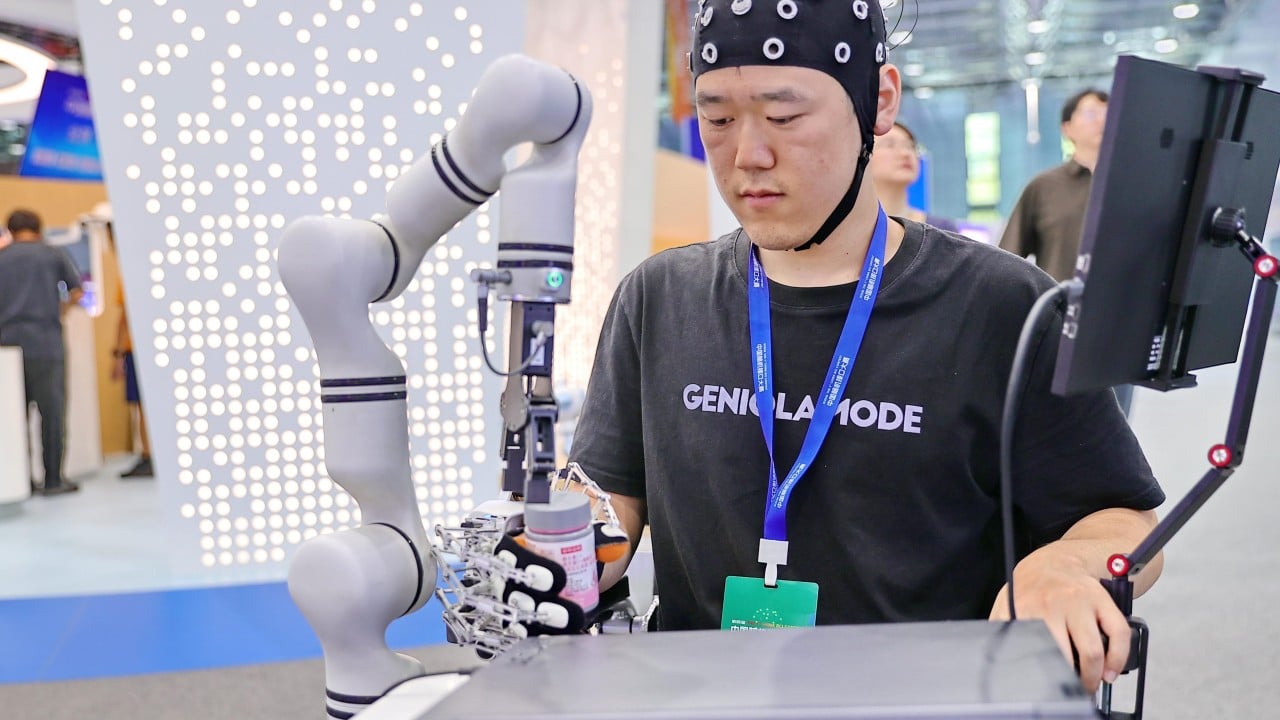
Brain-computer interfaces (BCIs) are another frontier. Chinese companies are pushing for breakthroughs in BCI technology as Elon Musk's Neuralink moves closer to selling its devices, with Beijing aiming to get ahead of the United States by setting industry standards and expanding real-world uses for what it considers a strategic industry China. On 3 December 2026, Neuralink announced it would begin a late-stage trial testing the safety and effectiveness of its implantable device for adults with amyotrophic lateral sclerosis (ALS), a disease causing progressive muscle paralysis, designed to let patients control computers and other devices using only brain signals [295412].
== Infrastructure, chips and the AI boom ==
The 2020s boom has made computing power a strategic resource. On 3 December 2026, SpaceX announced approval to launch a network of one million data satellites, a project called Starmind intended to meet growing demand for AI computing power by placing data centres in orbit rather than on the ground; the company called it the most cost- and energy-efficient way to deliver that computing power and gave no timeline or cost details [295292]. In Singapore, a planned merger between two telecom players signalled a strategic push into AI infrastructure, aimed at strengthening the city-state's digital backbone and funding AI-ready networks; the deal is subject to regulatory approval and financial terms were not disclosed [295367].
Semiconductors remain the choke point of the rivalry between the Usa and China. On 3 December 2026, Huawei Technologies and Hangzhou-based software partner Phlexing Technology announced breakthroughs in domestic chip design tools at Huawei's annual intellectual property event in Beijing, saying they had worked together to create extraction and sign-off tools — software that verifies chip designs before manufacturing — built around Huawei's Tau Scaling Law design framework. Huawei, based in Shenzhen, is also eyeing a global push to rival Nvidia, the US chip design leader [295402]. Nvidia CEO Jensen Huang was dismissed and then restored to his role in a whirlwind sequence of events that drew attention to the fragile balance of power in the US-China technology rivalry [295410]. Huang's return came as Beijing invested heavily in domestic manufacturing to reduce dependence on foreign suppliers after Washington's export controls limited its access to advanced chips; China remains a major Nvidia market, and tighter restrictions threaten its sales [295357]. Chinese media portrayed Huang's comeback as revealing Donald Trump's weakness toward Beijing, arguing that the value of the US stock market comes first for Washington [295263].
Technology transfer is a quieter front. The Nvidia case has grabbed headlines, but most of China's foreign technology acquisitions are far less dramatic and entirely legal — routine business deals, often fully compliant with international law, through which China gains foreign technology in everyday transactions that rarely trigger alarm or media coverage [295421]. Separately, CNN reported that after Elon Musk was tasked with streamlining the US government and tens of thousands of federal employees lost their jobs in spring 2025, individuals linked to China offered unknowing Americans fake jobs in order to collect classified security information [295224].
== Safety, security and economic strain ==
On 3 December 2026, Bank of England Governor Andrew Bailey warned that advances in mathematics had raised fears that encryption protecting financial data could be broken, including by unreleased AI models, potentially letting attackers unlock encrypted information across financial systems; he did not name the models or say when the risk might materialise [295306]. The warning adds to concerns about AI-enabled cyberattacks on critical infrastructure.
AI has also become a factor in financial markets. US stock markets fell sharply on 3 December 2026 as inflation kept rising, Donald Trump pushed again to introduce new tariffs on other countries, and the AI sector remained under pressure; SEB senior economist Robert Bergqvist said "this is a market that is not doing well" and advised caution Stock market [295247]. US central bank officials were nonetheless expected to raise interest rates again at their upcoming meeting, with inflation their top concern, even as a technology stock sell-off sparked fears about economic growth [295302].
Diplomacy has faltered. A planned meeting between US Treasury Secretary Scott Bessent and Chinese Vice Premier He Lifeng in Shenzhen did not take place, leaving the future of US-China AI dialogue uncertain; the two were expected to advance discussions on AI cooperation between the world's two largest economies, and no reason was given for the cancellation [295428].
== Regulation and the politics of Big Tech ==
As AI's reach grows, so does debate over who controls the companies behind it. In a December 2026 interview, Pepper Culpepper, vice-dean of the Blavatnik School of Government at Oxford University and co-author of *Billionaire Backlash*, argued that corporate scandals — unlike partisan political ones — tend to unite citizens across party lines and can drive reform, citing the Cambridge Analytica affair's role in shaping the European Union's Digital Markets Act and Digital Services Act [295073]. He distinguished "good populism", which targets economic injustice and the power of billionaires and large companies, from "bad populism", which marginalises minority groups, and argued that public anger at concentrated corporate power resembles the US Progressive Era of the early 1900s more than the 1930s. He pointed to growing public opposition to data-centre expansion, and to incidents such as an uncontrolled OpenAI model that hacked Hugging Face and Anthropic models able to act on their own, as likely catalysts for rapid regulation. He warned that tech policy could become as partisan as climate change did in the US, but noted that suspicion of AI and cryptocurrencies cuts across left and right, and predicted the next five years would bring dramatic change around data centres, out-of-control AI and labour markets.
== See also ==
- [[AI]] safety and regulation - China and the Usa technology rivalry - Stock market effects of the AI boom
== Sources ==