Gaza Floods Leave Thousands Without Shelter as Winter Storm Damages Tens of Thousands of Tents
First winter storm damages over 40,000 tents in Gaza, leaving displaced families without dry places to sleep as Israel blocks 150,000 replacement tents at the border.
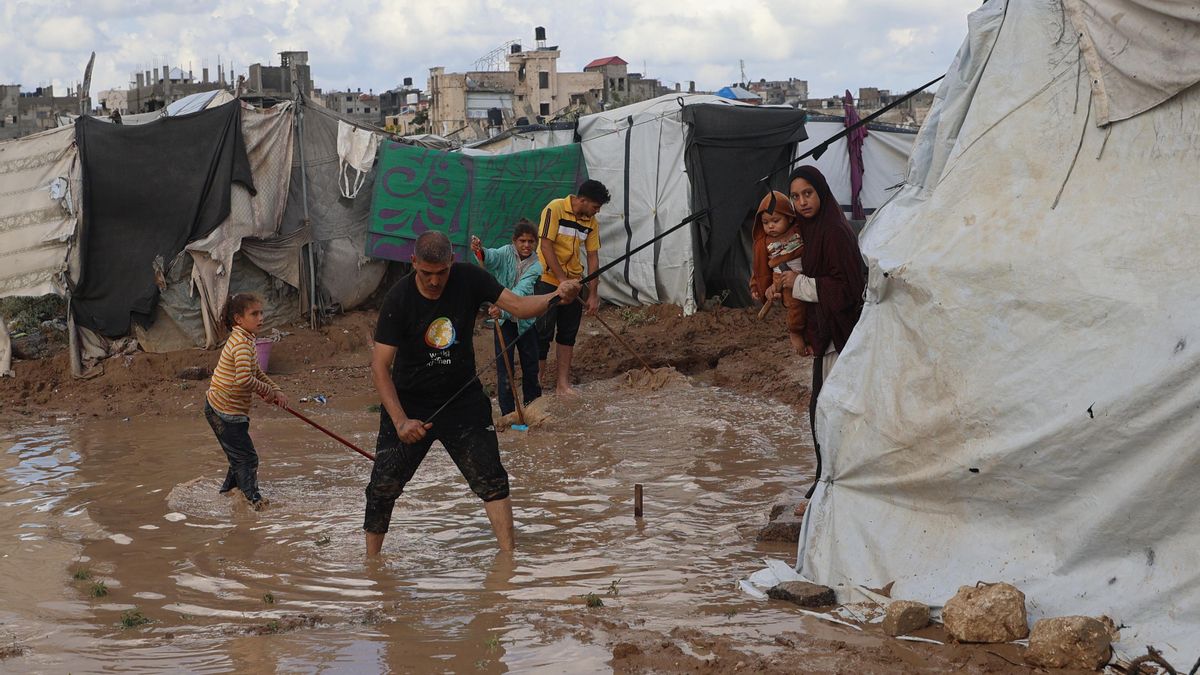
The first major winter storm has hit Gaza, killing four people and damaging more than 40,000 family tents, according to the United Nations Office for the Coordination of Humanitarian Affairs (OCHA). More than 200,000 displaced people living in camps have been affected, and families say they have no dry place left to sleep [1].
Four people — three children and a woman — were killed when a sand wall collapsed onto their tent in Deir al Balah, in central Gaza. The dead include a mother, two of her children and a pregnant niece, according to the Hamas-run Gaza Health Ministry. UNICEF said the children were four, five and eight years old and warned that almost half of the 950,000 displaced people living in flood-prone areas are children. About 1.7 million Gazans are still living in tents, makeshift shelters or damaged buildings, exposed to flooding, cold and the risk of collapse [1].
Ferial Qaud, 45, has lived in a displacement camp in Gaza for three years, since her home in Khan Younis was destroyed in late 2023. Last week's rains left her, her husband and their three children without shelter. "We woke up at night and tried to get the water out. We dug a canal to drain it and put our mattresses and blankets in the sun to dry," she said. Three days later, everything was still wet: "We have no dry mattress left to sleep on. Everything is soaked" [1].
Samar Fuad Bajit, 33, who lives in a tent in Gaza City with her husband and five children, said the heavy rain caught them at night. "While it rained and water came into the tent, we stayed standing. We had nowhere to go, so we had to stay and face it," she said. "My children carried their school certificates on their shoulders and stayed awake all night so they wouldn't get wet" [1].
The United Nations (UN) and aid groups say Israel is not allowing enough shelter materials into Gaza. More than 150,000 tents are currently waiting at Gaza's border for Israeli authorisation, while many displaced people live in old, worn-out tents [1]. The Humanitarian Country Team for the Occupied Palestinian Territory, made up of UN agencies and non-governmental organisations (NGOs) working on the ground, said "the devastating impact of the recent storm in Gaza could have been prevented." It said Israeli policies continue to obstruct the entry of essential items and that supplies face multiple approval requirements and limited crossing capacity [1].
The Board of Peace, set up under US President Donald Trump's 20-point plan for Gaza to oversee its implementation, called the situation a "humanitarian emergency" and criticised Israel's restrictions. "We have urged the Israeli government to authorise the entry of essential materials for temporary shelter, sanitation and water infrastructure, drainage and sewage disposal," the Board said, calling Tel Aviv's response to humanitarian needs "insufficient" [1]. Israel reacted angrily, saying it "works in close cooperation with the United States and the Board of Peace." It blamed Hamas for delays and said reconstruction will begin only when the group disarms. "Contrary to what many believe, Israel does not control the weather," the Israeli Foreign Ministry wrote on X [1].
The UK-based group Forensic Architecture said the floods are a result of Israel's destruction of housing, drainage systems and essential infrastructure in Gaza since 2023. Its spatial analysis found that most camps lie along Gaza's Mediterranean coast, where the ground is lower and floods more easily [1].
Displaced families are now facing their fourth winter without a permanent home. Ferial says tent life is hard in every season: "In summer we suffer from extreme heat; in winter the suffering repeats every time it rains, because water enters the tent and we have to move elsewhere until it dries" [1].