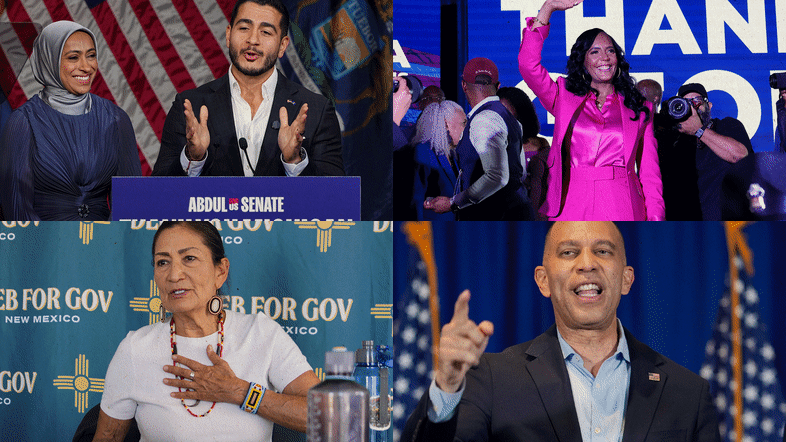
Democrats Flip 7 Senate Seats, Elect First Muslim Senator and First Texas Democrat in Decades
Democrats won control of both chambers of Congress in a historic midterm wave, flipping seven Republican-held Senate seats and electing a record number of historic firsts.
Democrats have seized control of both the House of Representatives and the Senate in the 2026 midterm elections, flipping seven Republican-held Senate seats in a sweeping victory that deals a major blow to President Donald Trump [279043][279514]. With two races in Mississippi and Alaska still undecided, Democrats hold at least 54 Senate seats, giving the party control of both chambers of Congress for the first time in the Trump era [279043].
The results, widely described as a "blue wave" or "blue tsunami," reshaped the balance of power in Washington and produced a series of historic firsts across the country [278754][279811]. The party entered Election Day uncertain about its chances of retaking the Senate, but ultimately won more seats than needed for a majority, including in traditionally Republican states such as Texas and Kansas [279043].
In Texas, James Talarico defeated Republican Ken Paxton with 55.1% of the vote, flipping the seat held by Republican Senator John Cornyn [279043]. Talarico will be the first Democratic senator from Texas since 1988, ending more than 30 years of Republican rule in the home of the U.S. oil and gas industry [279043][279815][279181]. Democrat Gina Hinojosa also defeated Republican Governor Greg Abbott in the governor's race, becoming Texas' first Latina governor and the state's first Democratic governor since Ann Richards in 1990 [279043][279050].
In Kansas, Democrat Adam Hamilton defeated incumbent Republican Senator Roger Marshall with 50.9% of the vote, ending nearly a century of Republican control of the state's Senate seat [278546][279043]. Kansas last elected a Democratic senator in 1932 [279043].
In Michigan, Democrat Abdul El-Sayed defeated Republican Mike Rogers, becoming the first Muslim senator in U.S. history [279555][279050]. El-Sayed, a member of the Democratic Party's left wing, won in what was the only state where Republicans had a realistic chance of flipping a Senate seat from the Democrats [279555].
The seven flipped Senate seats include Maine, where Troy Jackson defeated incumbent Republican Senator Susan Collins with 53.8% of the vote after Collins had served 30 years in the Senate; Ohio, where Sherrod Brown defeated incumbent Republican Senator Jon Husted with 50.0%; North Carolina, where Roy Cooper defeated Republican Michael Whatley with 58.7%; Iowa, where Josh Turek defeated Republican Representative Ashley Hinson with 50.5%; and South Carolina, where Annie Andrews defeated incumbent Republican Senator Darline Graham with 51.1%, marking the first time South Carolina has elected a Democratic senator since 1998 [279043].
The midterms also produced an unprecedented wave of historic firsts in governorships and Congress [279050]. Four states elected their first Black governors, and four elected a woman governor for the first time [279050]. In Georgia, Keisha Lance Bottoms became the first Black woman elected governor in any U.S. state [279050]. For the first time in U.S. history, five Black governors will serve at the same time, and at least 17 women will serve as state governors simultaneously [279050].
In the Senate, Peggy Flanagan of Minnesota became the first Native American woman U.S. senator, Chris Pappas of New Hampshire became the first openly gay man elected to the Senate, and Juliana Stratton of Illinois joined Tammy Duckworth to make Illinois the first state represented by two women of color in the Senate [279050]. Three Black women will now serve in the Senate at the same time — another historic first [279050].
In the House, Melat Kiros of Colorado became the first Gen Z woman elected to Congress at age 29, Adam Hamawy of New Jersey became the state's first Muslim member of Congress, and Claire Valdez of New York became the first Native American woman elected to Congress from that state [279050].
President Trump acknowledged that the war with Iran and high gasoline prices weighed heavily on the results, but refused to accept the outcome as a personal defeat [279514]. The Democratic victory is more than a routine backlash against an incumbent president, said Adam Jentleson, President of the Searchlight Institute, who called it "a once-in-a-generation event" [279308]. But the win brings a governing challenge, as the Democratic coalition stretches from progressive reformers to culturally conservative voters [279308].
Young voters gave Democrats their strongest support, with 75% of Gen Z voters backing the party [279319]. Elon Musk, who spent $474 million on political groups mostly supporting Republicans, saw his bet fail as Democrats won control of Congress [279744].
Democrats are now promising dramatic change after their historic midterm victory, saying the "blue wave" gives them a mandate to reshape America [279667].