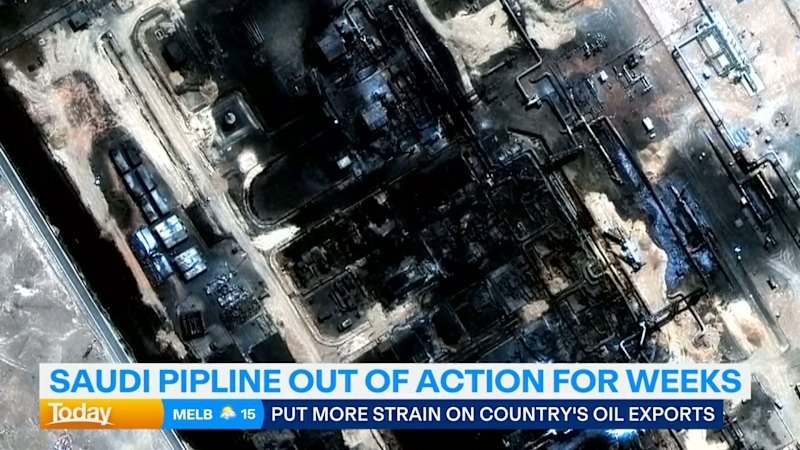
Saudi Pipeline Knocked Out, Houthis Seize Red Sea Islands — Oil Hits $110 and Diesel Sets Record High
Attacks on Middle East shipping routes have shut down a key Saudi oil pipeline and put two strategic Red Sea islands under Houthi control, pushing crude prices as high as $110 a barrel and driving U.S. diesel to record levels.
Saudi Arabia has shut down its East-West pipeline after a series of attacks, including a drone strike launched from Iraq [238854][239087]. The pipeline matters because it allowed Saudi crude to reach the sea without passing through the Strait of Hormuz, the narrow waterway that remains the primary flashpoint in the region's conflict [238854][239415]. The shutdown briefly pushed oil prices to $110 a barrel as markets feared the fighting was widening [239087].
The pipeline could stay offline for weeks, and the attack is expected to slow Saudi oil exports [241322]. A planned meeting between Iran and several Gulf nations to discuss a temporary shipping lane through the Strait of Hormuz was postponed [240708].
In a separate but related advance, Iran-backed Houthi rebels in Yemen captured two strategic islands in the Red Sea — Greater and Lesser Hanish — near the Bab al-Mandab strait, the narrow waterway connecting the Red Sea to the Gulf of Aden [241596]. The Houthis recently took the port of Mokha and Perim island, both in the strait, tightening their grip on a route through which millions of barrels of oil pass every day [241596]. Saudi Arabia said it shut down the major pipeline as a precaution after it came under attack [239059].
The disruption is now reaching consumers. In the United States, diesel prices have hit record highs, squeezing drivers and businesses [241674]. Diesel powers trucks, trains, and farming equipment, so when its price climbs, the cost of moving goods climbs too — and those costs often land on consumers [241674]. It is not yet clear how long the attacks will continue or how much they will affect supply, and officials and shipping companies say they are watching closely [241674].
The economic strain is spreading. Oil futures climbed to their highest level in almost four months as increased fighting across the Persian Gulf raised concerns about supply disruptions [239552]. Inflation rose more than expected, the Houthi takeover of a critical oil chokepoint raised fears of energy shortages, and consumer confidence dropped — three developments that together threaten global economic stability [239524]. In Egypt, a TV host warned that with a barrel exceeding $104, the government's budget — built on an assumption of $75 a barrel — is under threat [239974].
Saudi Arabia is now seeking support from the United States to respond to the crisis, as its oil tankers face the prospect of losing maritime access [239153].